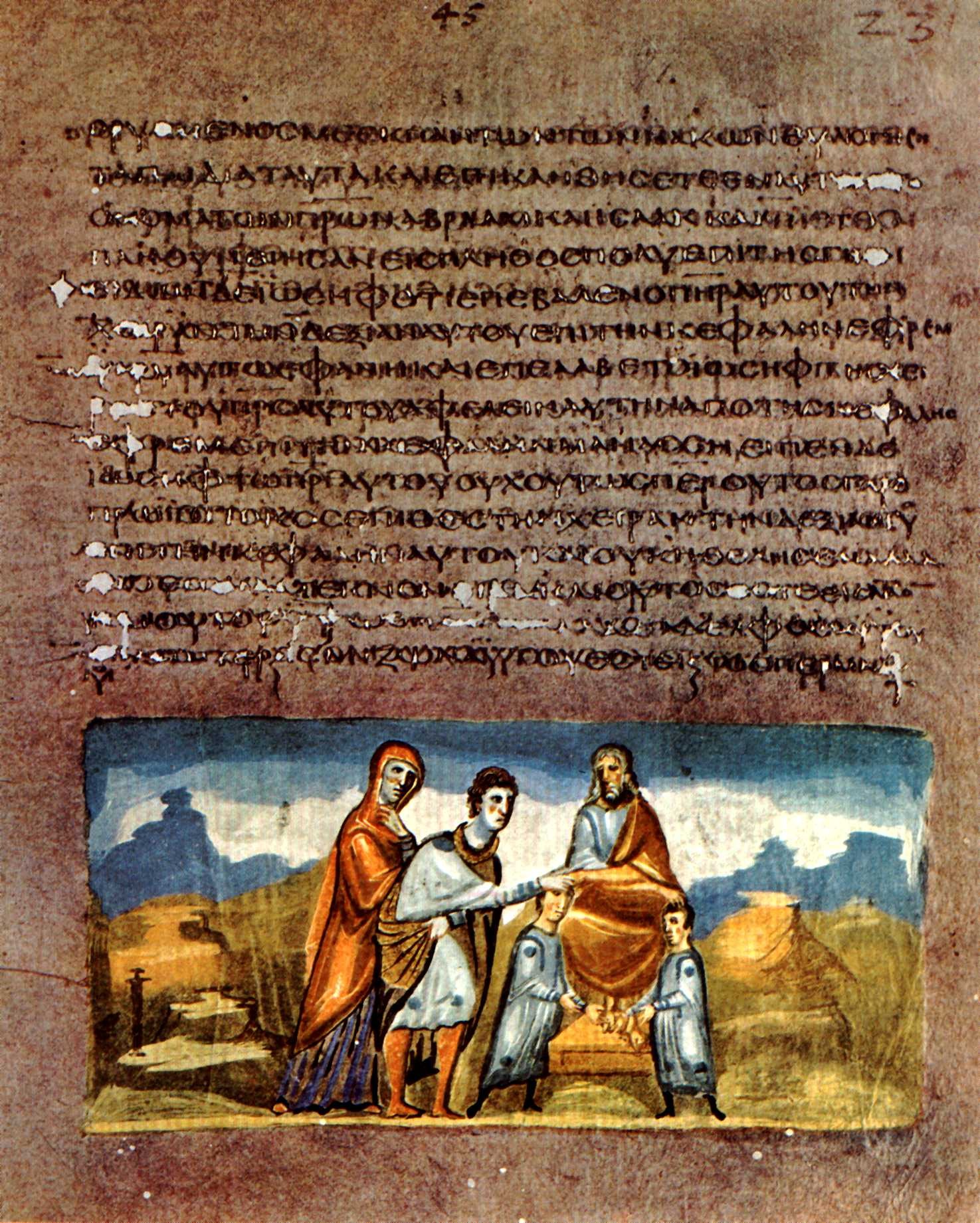
Jacob Blessing Ephraim and Manasseh
Vienna Genesis, fol. 45 — c. 6th century, Antioch / Syria (Codex Vindobonensis Theol. gr. 31)
Doctrinal reflection
Jacob lies on his deathbed at the iconographic center, propped up on cushions. Joseph stands beside the bed; the two grandsons Manasseh (the elder) and Ephraim (the younger) kneel before the dying patriarch. Jacob's hands are extended in blessing — but his arms are crossed: his right hand is on Ephraim's head (the younger), his left hand on Manasseh's (the elder). The composition renders Genesis 48:13–14 with iconographic precision: "Israel stretched out his right hand, and laid it upon Ephraim's head, who was the younger, and his left hand upon Manasseh's head, guiding his hands wittingly; for Manasseh was the firstborn." The folio is from the Vienna Genesis, c. 500–550 — the corpus's third Vienna Genesis entry. Vienna Genesis manuscript closes at 3/3 ceiling.
The crossed-hands blessing — patristic typological reading. Patristic exegesis (Augustine, Bede, Cyril of Alexandria) read Genesis 48 as iconographic prefiguration of the cross-shaped blessing of the gospel. Jacob's crossed hands form the visual sign of the cross, and the reversal of expected order (younger preferred over elder) prefigures the gospel's reversal of first shall be last, and the last shall be first (Matt 19:30; 20:16). The corpus reads this through Romans 9:11–13 — the apostolic gloss on Jacob/Esau where Paul names the elder shall serve the younger as the doctrine of election according to grace, not works. The Genesis 48 blessing extends the Romans 9 logic: blessing flows according to God's choice, not according to human expectation. Mode 1 typology by direct apostolic anchoring (Romans 9 names the pattern; patristic exegesis applies it to Genesis 48).
**Joseph's protest, Jacob's wittingly.** Genesis 48:17–19: "And when Joseph saw that his father laid his right hand upon the head of Ephraim, it displeased him: and he held up his father's hand, to remove it from Ephraim's head unto Manasseh's head. And Joseph said unto his father, Not so, my father: for this is the firstborn; put thy right hand upon his head. And his father refused, and said, I know it, my son, I know it... but truly his younger brother shall be greater than he." The Vienna Genesis iconographer renders the moment of Joseph's protest visible: Joseph's hand reaches toward Jacob's, attempting the correction, but Jacob's wittingly (Hebrew: sikkēl — with insight) holds the crossed hands in place. The compositional theology: the blessing comes through the crossed hands; the protest fails; God's election holds.
The Pauline gloss — Romans 9 and 11 architecture. Paul's larger argument in Romans 9–11 reads the Genesis-Exodus electing-pattern across the canon: Jacob have I loved, but Esau have I hated... not as though the word of God hath taken none effect; for they are not all Israel, which are of Israel (Rom 9:13, 6). The Ephraim-and-Manasseh blessing is the third in the chain of God's surprising-elections in Genesis (Cain/Abel rejected pattern, Isaac over Ishmael, Jacob over Esau, Ephraim over Manasseh). The corpus reads the pattern as apostolically-named typology of the gospel's election — not by works, but of him that calleth (Rom 9:11). The Vienna Genesis painter's Collection 6 rendering points forward to the apostolic doctrine that emerges in Romans 9–11.
The Vienna Genesis manuscript closure at 3/3. The corpus's three-entry Vienna Genesis program now reads as a coherent early-Byzantine OT-typology trio: Joseph and Potiphar's wife (#97 — the temptation-resistance and faithful-witness-under-trial register) + Rebecca at the Well (#121 — the bride-of-Christ unsolicited-service register) + Jacob blessing Ephraim and Manasseh (this entry — the crossed-hands election register). Three folios, three OT typologies, all c. 500–550 Antiochene-Syrian production, all with apostolic-naming anchors (Heb 11 + 1 Cor 10 + Eph 5 + Rom 9 + Matt 19). Per the manuscript-ceiling rule and the iconographic-program-coherence rule (locked after #71), Vienna Genesis closes at 3/3 with full doctrinal program. No further Vienna Genesis entries.
Jacob's hands crossed. The younger received the right-hand blessing. Joseph protested; Jacob refused. The cross-shape of the blessing is the cross-shape of the gospel. Election according to grace, not works — Romans 9 names what Genesis 48 prefigures.