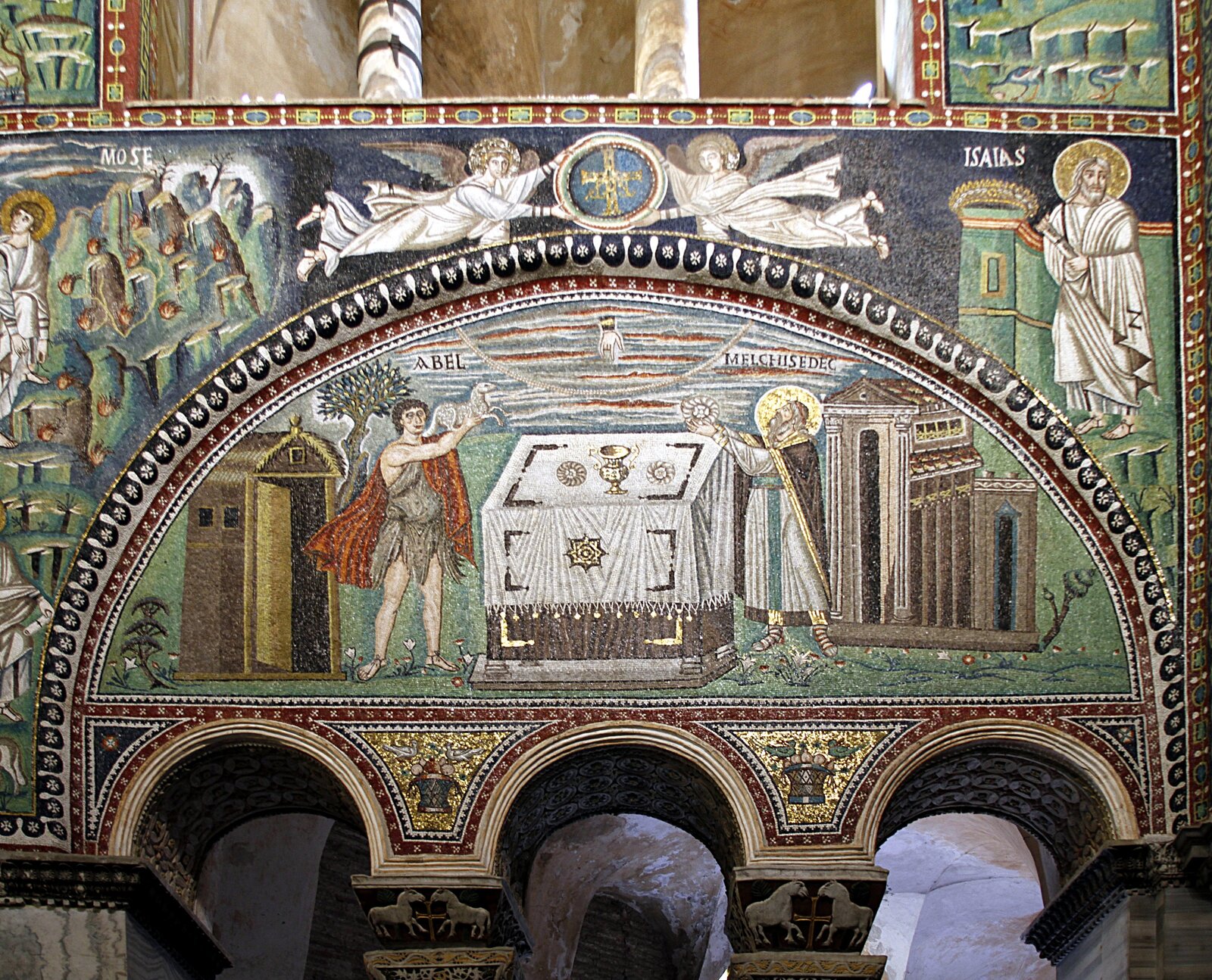
Abel and Melchizedek at the Altar
Presbytery Lunette, San Vitale, Ravenna — c. 547
Doctrinal reflection
Two figures stand at one altar. Abel on the left, in a shepherd's tunic, lifting a small lamb upward in both hands. Melchizedek on the right, robed as a priest, lifting two round loaves on a draped paten. Between them, an altar covered with a white cloth, set with a chalice and two more loaves. A single hand of God descends from clouds at the top of the lunette, accepting both offerings together. The mosaic is on the north wall of the presbytery at San Vitale, c. 547 — paired across the bema with the Sacrifice of Isaac panel on the south wall (corpus #sacrifice-isaac-san-vitale). Two priestly typologies, one altar, one set of mosaicists, one Hebrews-supplied reading.
The composition fuses two Genesis offerings into a single iconographic argument. Abel's lamb (Genesis 4:4 — the LORD had respect unto Abel and to his offering) sits beside Melchizedek's bread and wine (Genesis 14:18 — Melchizedek king of Salem brought forth bread and wine: and he was the priest of the most high God). Two priestly offerings from two different chapters of Genesis, painted at the same altar, accepted by the same Father whose hand descends to receive them. The iconographer is not narrating history. He is reading typology.
Hebrews 7 supplies the apostolic warrant for the Melchizedek panel. "For this Melchizedek, king of Salem, priest of the most high God... abideth a priest continually" (Heb 7:1, 7:3). "Thou art a priest for ever after the order of Melchizedek" (Heb 7:21, citing Psalm 110:4). The Melchizedek priesthood is named explicitly as Christ's priesthood — Mode 1 of the corpus's five-mode typology framework (#38 Rublev): NT-named typology, apostolically authorized. The mosaicist is doing what the writer of Hebrews already did: reading Melchizedek as the figure whose priesthood Christ fulfills.
The Abel side is implicit in Hebrews 11:4 — "By faith Abel offered unto God a more excellent sacrifice than Cain... God testifying of his gifts." Abel is the first faith-offerer in the canon, the prototype of the church's worshipping line. The mosaicist places him beside Melchizedek because both are priestly offerings God had respect unto, and Christ is both — the lamb whose blood was more excellent than every Cain-style imitation, and the priest for ever after Melchizedek's order.
The bema placement is the entry's other argument. This panel is not at the back of the church or the side aisle. It is on the north wall of the presbytery, three meters from the altar where the eucharist is celebrated. The mosaicists placed Abel and Melchizedek where the church's own priestly offering happens — saying compositionally that what Abel offered, what Melchizedek offered, what Christ offered, and what the church now offers in remembrance are not four offerings but one priestly tradition converging in Christ and continuing in his memorial. The altar in the panel and the altar in the apse are the same altar, iconographically.
A small layering note. Hebrews 7 itself does not make the bread-and-wine eucharistic connection. Hebrews 7 reads Melchizedek as priestly type without invoking his Genesis 14:18 offering specifically. The eucharistic-prefigurement reading is patristic and medieval iconographic interpretation building on other apostolic ground (1 Cor 11:23–26). The San Vitale mosaicist makes the connection explicit by placing the loaves and chalice on the altar. The layering is legitimate apostolic-tradition extension while going beyond what Hebrews 7 alone supplies.
Paired-bema-program with the south wall. The Sacrifice of Isaac (#sacrifice-isaac-san-vitale) sits opposite this panel — same bema, same Hebrews 11 framework. The two panels argue priestly continuity converging in Christ from two angles: south wall, Christ as the bound son whose blood God provides instead (Gen 22 / Heb 11:17–19); north wall, Christ as the priest who offers what God accepts (Gen 4 + Gen 14 / Heb 7 + 11:4). One bema, two typologies, one Christ.
Abel offered. Melchizedek offered. Christ offered. The Father's hand received them all.