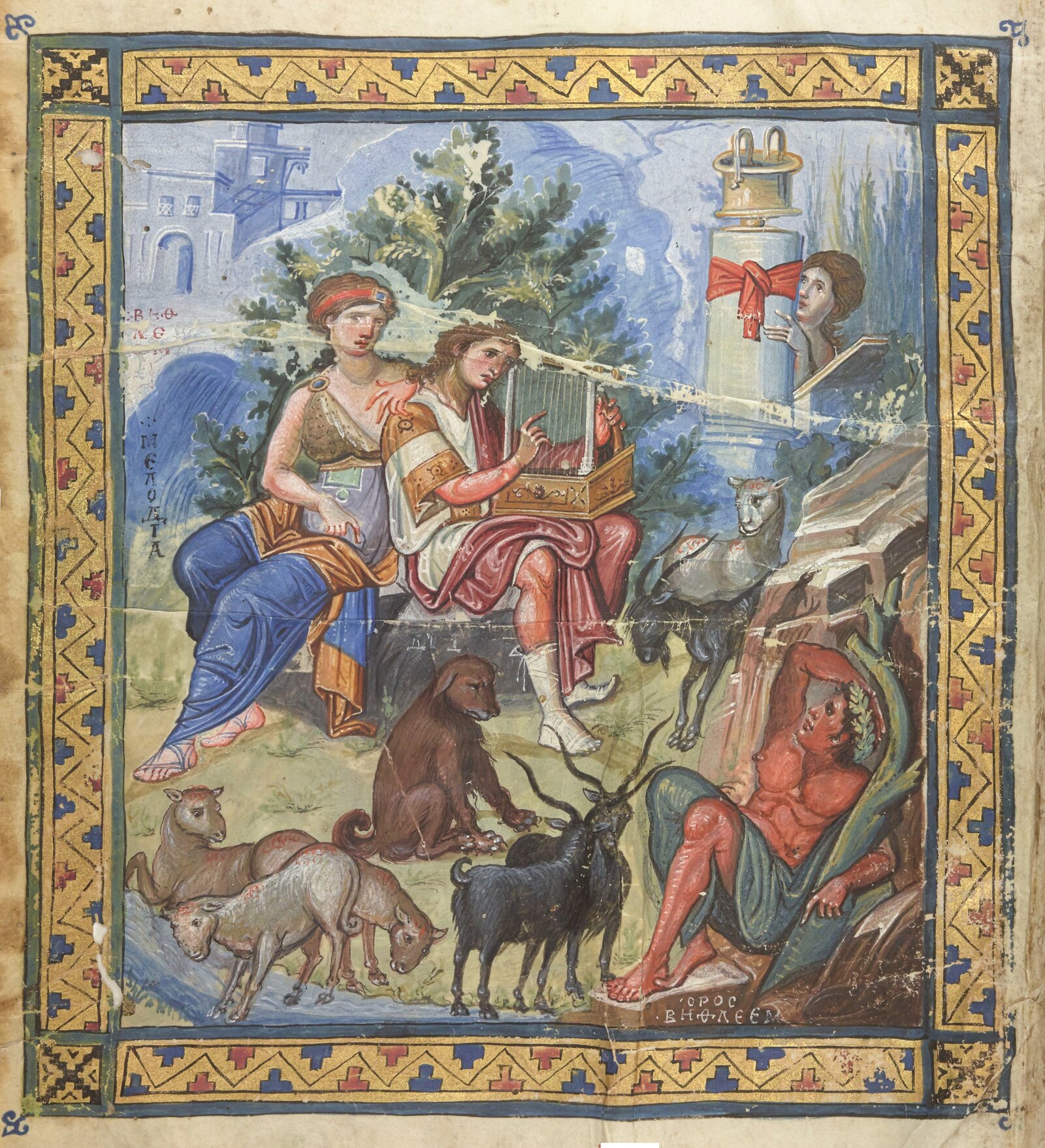
David Composing the Psalms
Paris Psalter, fol. 1v — c. 960 Constantinople (Bibliothèque nationale de France, MS gr. 139)
Doctrinal reflection
David sits in a pastoral landscape, harp on his lap, head tilted in concentration. Behind him stands a personified female figure, Melodia — the Greek allegorical embodiment of melody — with one hand on his shoulder. Sheep graze in the foreground; the dog Eumer watches alertly. To the right, the personified figure of Echo (or possibly Mt Bethlehem) emerges from a column. The composition is the most famous opening folio of any Byzantine illuminated psalter — fol. 1v of the Paris Psalter (BnF gr. 139), c. 960, Macedonian Renaissance Constantinople. It is also the manuscript that most clearly registers the Byzantine return to classical-antique iconographic vocabulary after iconoclasm (730–843).
The classicizing register. The Paris Psalter renders David in the visual idiom of Roman pastoral painting — Orpheus among the animals iconography turned to David. The personification figures (Melodia, Echo, Eumer) are pure classical-allegorical imports. The corpus's locked iconographic-survival principle (#70) operates here in an unusual form: not iconography that survived through doctrinal transitions, but iconography that imported pre-Christian classical visual vocabulary into Christian biblical illustration. The post-iconoclasm Byzantine renaissance reached back to the antique-pagan visual heritage and reframed it Christologically.
David as Mode 1 typology. David is the Old Testament figure most directly named as a Christ-type by the apostolic writers. Acts 2:25–36 (Peter's Pentecost sermon) reads Psalm 16 as Christ's resurrection-prophecy spoken through David's mouth: "David being a prophet... spake of the resurrection of Christ." Hebrews 1:5, 5:5 cites Psalm 2 — "Thou art my Son, this day have I begotten thee" — applying David's psalm to Christ. Romans 1:3 names Christ as of the seed of David according to the flesh. The Paris Psalter's opening folio renders the typological figure-of-figures: David composing the Psalms is the iconographic prototype of Christ speaking through the prophetic-psalmic voice.
The Psalms as Christ's voice. Patristic exegesis (Augustine, Chrysostom) read the Psalms not merely as David's prayers but as Christ's prayers prayed in the voice of the church. The corpus's locked Mode 1 framework (#38 Rublev) handles this kind of NT-named typology directly. David at Paris Psalter fol. 1v is the prototype of every later Christological reading of every Psalm. The harp David plays is the prayer Christ prays. Mode 1, fully apostolically authorized via Acts 2 and Hebrews 1.
The Macedonian Renaissance. The Paris Psalter sits at the crest of the post-iconoclasm Byzantine recovery. After 843 (the Triumph of Orthodoxy, corpus #65), the empire poured patronage into restoring iconographic vocabulary; the Macedonian dynasty (867–1056) supervised the period of greatest classical-revival production. The Paris Psalter and the Vienna Genesis (corpus #97) and the Menologion of Basil II (corpus #67) are three of the Macedonian Renaissance's most-studied surviving manuscripts. The Paris Psalter is the most explicitly classicizing of the three.
Manuscript expansion (Collection 6 + Manuscripts category). The corpus's Manuscripts category now grows to 6 (Rabbula, Khludov, Rossano, Menologion, Xoranasat, Vienna Genesis, Walters W.547, Paris Psalter — the count varies depending on whether Walters and Vienna Genesis are counted under Museum-housed or Manuscripts; per the audit they're Manuscripts-tracked).
David composed the psalms. The Paris Psalter's iconographer rendered him as the type of every Psalm-speaker in the church across the centuries. Christ prays through the Psalms; the church prays the Psalms in Christ's voice; David's harp anchors them all.