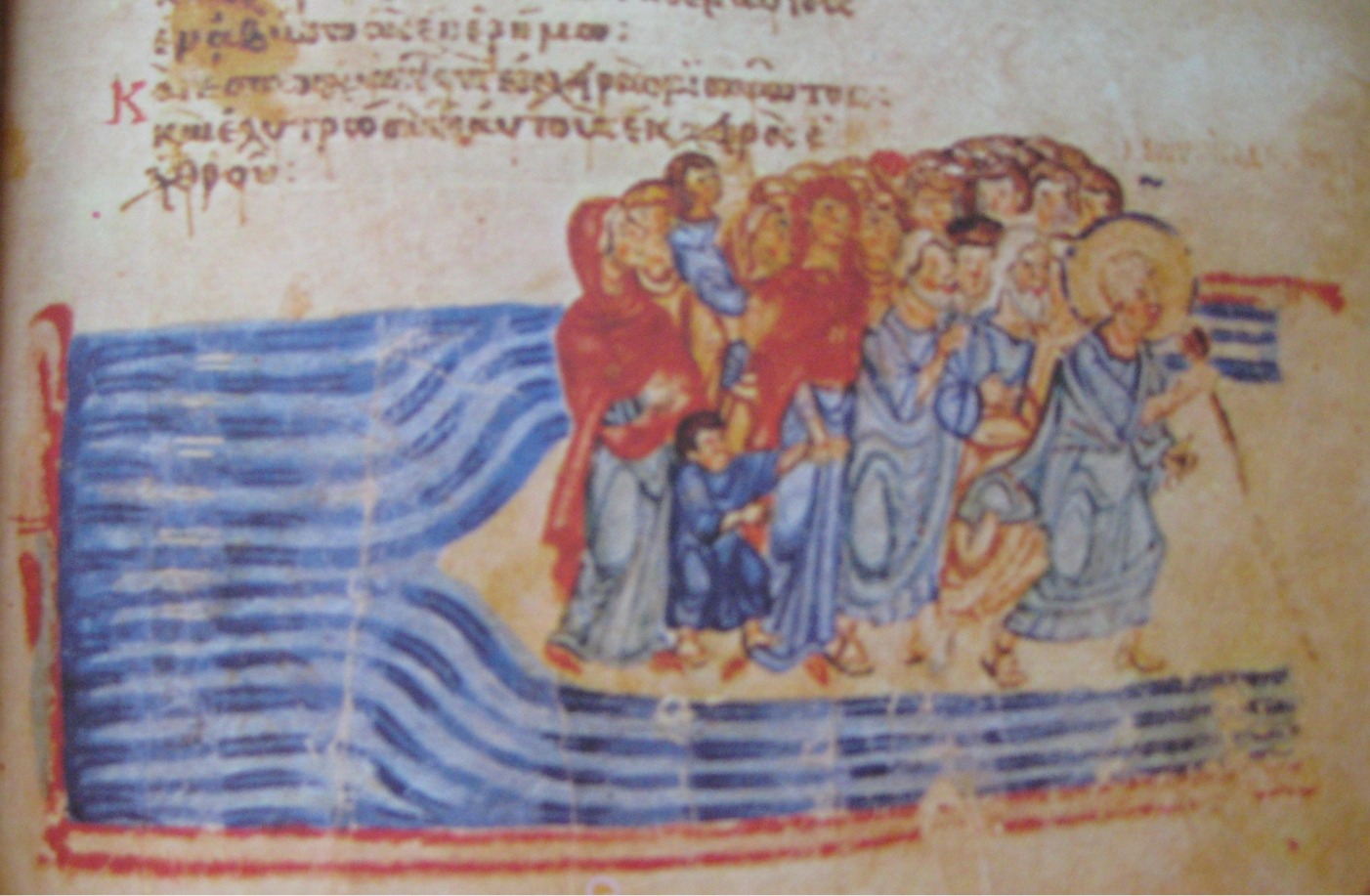
The Crossing of the Red Sea
Khludov Psalter, marginal illumination — c. 850s, Constantinople (State Historical Museum, Moscow, MS D.129)
Doctrinal reflection
Moses on the left, rod outstretched, leads the Israelites across a parted sea-passage. Pharaoh's army on the right, charioteers and horses tumbling into the closing waters. Between the two registers, the path through the sea — opened for Israel, closed against Egypt. The Khludov Psalter renders the iconographic compression typical of the manuscript: the entire Exodus 14 narrative compressed into a single marginal-strip composition. The illumination is c. 850s — the corpus's third Khludov entry alongside khludov-psalter-folio-67r (Crucifixion-with-iconoclasts polemic) and nikephoros-khludov-psalter (#115, Patriarch over iconoclast). Khludov Psalter closes at 3/3 manuscript ceiling.
1 Corinthians 10:1–2 — the apostolic typology anchor. "Moreover, brethren, I would not that ye should be ignorant, how that all our fathers were under the cloud, and all passed through the sea; and were all baptized unto Moses in the cloud and in the sea." Paul names the Red Sea crossing as a typological prefigurement of baptism — the church passing through the sea unto Moses, the church passing through the waters unto Christ. The corpus's Collection 6 framework reads OT typology where the apostles name it; 1 Cor 10:2 is direct apostolic naming. Mode 1 typology, NT-named (locked at #38 Rublev framework). The Khludov iconographer renders the typological parent of every Christian baptism: Israel emerged from the sea as Yahweh's covenant people; the believer emerges from baptismal water as Christ's covenant person.
The Collection 9 cousin frame (Pillar 2 memorial-view applied silently). Christian baptism is sacramentally engaged across traditions; the GLM corpus's Pillar 2 memorial-view (locked at #30 Hosios Loukas Theotokos) applies the same restraint to baptism that it applies to communion. 1 Peter 3:21 as the primary baptism-anchor (sub-anchor locked at #70+ batch 014 review): "The like figure whereunto even baptism doth also now save us, (not the putting away of the filth of the flesh, but the answer of a good conscience toward God,) by the resurrection of Jesus Christ." The Red Sea crossing prefigures this exact dynamic — the salvation is not in the water itself but in what God did at the water (the Red Sea opened by God's act, not by Moses's rod alone; baptism saves by the resurrection received in good conscience). Paul's typology and Peter's anti-magical gloss work together; the Khludov iconographer renders the Pauline side; the corpus reads it through the Petrine corrective.
The Pharaoh-army register and the death of the old life. Romans 6:3–4 — "Know ye not, that so many of us as were baptized into Jesus Christ were baptized into his death? Therefore we are buried with him by baptism into death." The Pharaoh-army drowning under the closing waters is the iconographic prefigurement of the old self drowning in baptism. The Khludov composition's two-register split (Israel walking dry; Egyptians submerged) renders the Pauline two-register: the new life walks free; the old self is buried. The compositional theology operates at the strip-format scale: parallel registers, opposite outcomes, single typological arc.
Khludov manuscript closure at 3/3 ceiling. The corpus's three-entry Khludov program now reads as a coherent doctrinal triad: #67r Crucifixion-with-iconoclasts (Collection 10, iconodule polemic) + #51v Patriarch Nikephoros over iconoclast (Collection 10, post-843 vindication) + Red Sea crossing (Collection 6, OT typology / baptism prefigurement). Three doctrinal collections (10, 10, 6) across three folios from one manuscript, each carrying distinct apostolic doctrinal load. The manuscript's iconodule-polemical character (per the standard scholarly reading of the Khludov as an iconophile-resistance manuscript) doesn't reduce all its content to Collection 10; the iconographer also handled OT typology with apostolic-line precision.
The compositional precision. The marginal-strip composition keeps both registers visually balanced — Moses and Pharaoh as compositional foils, the parted-then-closed sea between them. The visual rhetoric: the same water saved Israel and destroyed Egypt; the same baptism saves the believer and buries the old self. The iconographer's compositional choice carries the apostolic doctrinal claim across both Pauline texts (1 Cor 10 and Romans 6) without verbal articulation.
Israel walked through the sea. The Egyptians drowned in the same sea. The waters opened by God's act, closed by God's act. Paul named the type; Peter glossed the discipline; the iconographer painted both at the margin of Psalm 105's recitation. We were all baptized; we are all buried with him; we walk in newness of life.