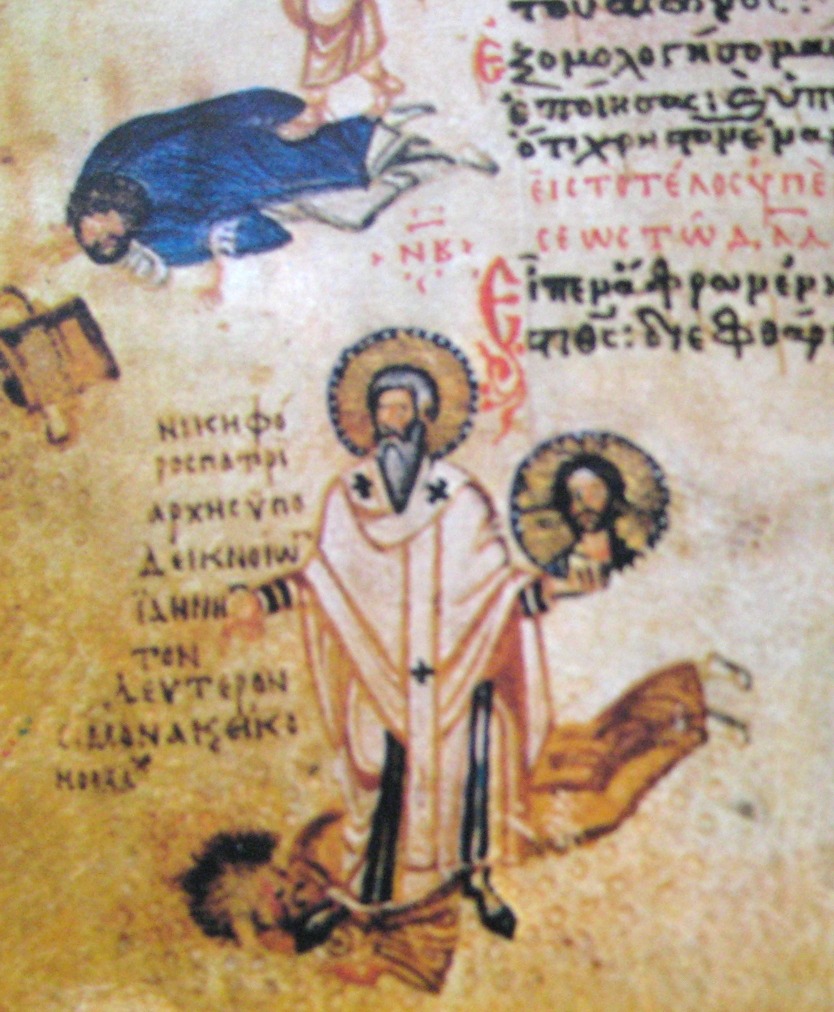
Patriarch Nikephoros and the Iconoclast
Khludov Psalter, fol. 51v — c. 850s, Constantinople
Doctrinal reflection
Patriarch Nikephoros stands frontal, robed in episcopal vestments, holding a small icon of Christ in his right hand. At his feet, prostrate and trampled, lies a smaller figure identified by inscription as John VII Grammatikos — the iconoclast patriarch who replaced Nikephoros's iconodule successors during the second iconoclast wave (837–843). Coins are scattered around the trampled figure, registering the iconographer's polemical accusation that the iconoclast hierarchy had sold the icons of Christ for political-imperial favor. The folio is the Khludov Psalter, fol. 51v — the corpus's second Khludov entry alongside fol. 67r (#khludov-psalter-folio-67r), which depicts iconoclasts as crucifiers. Khludov manuscript at 2/3.
Collection 10 standing rule applied — read the defender at the moment he actually defended (locked at #110+2). Patriarch Nikephoros (758–828) defended icons against Emperor Leo V's iconoclast restoration in 814–815. His three Antirrhetics (composed in exile) ran the systematic argument that if Christ became truly incarnate, his image is not idolatrous because the image refers (not identifies) to the prototype. The corpus reads Nikephoros at the moment he actually defended — incarnation-grounded image-honor logic, structurally identical to Theodore the Studite's argument (locked at #110) — and declines the later medieval mediation drift built on Nikephoros's name. Three-fence pattern: affirm Nikephoros's incarnation-grounded defense; decline the medieval-mediation expansion that went further than his argument; refuse the iconoclast counter-overreach that erased iconography altogether.
The Khludov polemical register — Collection 10 Mode 4. The post-843 Khludov Psalter illumination program is iconodule polemic in visual form. Fol. 51v's iconographer renders Nikephoros in triumphal posture trampling the iconoclast — a compositional inversion of the iconoclast destruction of icons, with the iconodule patriarch now standing in the position of vindication. The corpus has handled this polemical register at #khludov-psalter-folio-67r (iconoclasts-as-crucifiers): affirm the iconodule incarnational concern; decline the polemical-conflation move that reads every iconoclast as functionally a Christ-rejecter; decline the overreach toward mandatory veneration that the post-843 settlement institutionalized.
John VII Grammatikos and the Collection 10 third position. John VII Grammatikos (patriarch 837–843) was the principal iconoclast theologian of the second wave; deposed and anathematized at the 843 Synod of Constantinople (the Triumph of Orthodoxy). The Khludov iconographer renders him trampled and surrounded by coins — the polemical reading is the iconoclast hierarchy as Judas-figure, selling Christ's icons for political coin. The corpus reads what the polemic gets right (icon-removal under imperial pressure was theologically wrong because it denied incarnation's depictability) and what the polemic overreaches on (not every iconoclast was personally a Judas; some were sincerely concerned about idolatry, even if they overreached the apostolic line). The corpus's Collection 10 third position holds: iconoclasts overreached by banning all images; iconodules overreached by establishing mandatory veneration; the apostolic line is memorial-witness without mediation.
The icon Nikephoros holds — composition as doctrine. The iconographer puts a small icon of Christ in Nikephoros's right hand. The compositional eye-line runs: viewer → patriarch → small Christ-icon → trampled iconoclast. The doctrine the composition tracks: the patriarch defends the iconography of Christ because Christ is what the iconography teaches; the iconoclast who removed the icon also removed the catechesis. The eye-line-as-doctrine principle (locked at #72 Climacus) operates here in iconodule polemical register. The composition affirms what the corpus affirms — Christ at the center, the patriarch pointing to him, the iconoclast missing him.
The 1 Cor 8 quiet move. The Khludov polemics could have been written in the register of the iconoclasts are demonic; they weren't. The illuminations consistently render the iconoclasts as missing Christ rather than opposing Christ as demonic enemy. That register restraint pairs with 1 Corinthians 8's framework on Christian disagreement over images: we know that an idol is nothing in the world... but every man hath not that knowledge (1 Cor 8:4–7). The iconodule patriarchs argued that iconoclasts had not understood the incarnation; they did not argue iconoclasts were beyond redemption. Khludov's polemic stays inside that line.
Nikephoros holds the icon. The icon teaches Christ. The patriarch defended what the icon taught. The corpus stands with the defense without the medieval mediation drift built on top of it.