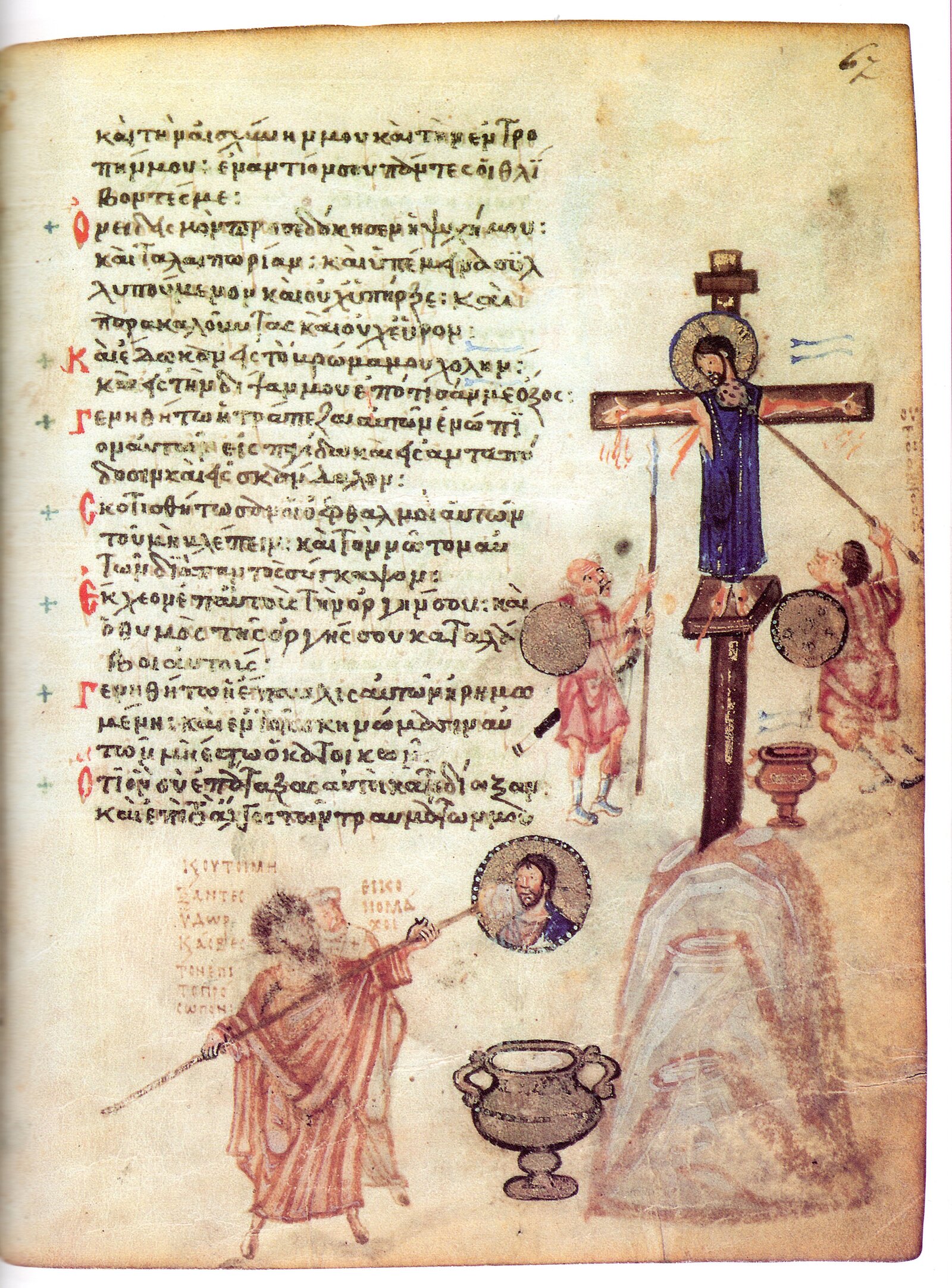
Crucifixion with Iconoclasts
Khludov Psalter, Folio 67r — Iconodule Polemic on Psalm 68 (LXX) / 69 (Heb.)
Doctrinal reflection
Two scenes share the page. On the upper register, Christ on the cross — Mary and John at the foot, a soldier raising a sponge on a reed to Christ's lips. On the lower register, two iconoclasts hold a long-handled sponge to a circular icon of Christ, blotting out the face. The visual rhyme is the entire argument: the soldier sponging vinegar at Calvary and the iconoclast sponging an icon are doing the same thing. The iconoclast crucifies Christ a second time.
This is folio 67r of the Khludov Psalter, made in Constantinople c. 850–875 — within a generation of the iconodule victory at the Council of Constantinople in 843 (the "Triumph of Orthodoxy," still observed in Eastern Orthodox liturgy on the first Sunday of Lent). The psalter illustrates Psalm 68 LXX / 69 Hebrew — "They gave me also gall for my meat; and in my thirst they gave me vinegar to drink" (Ps 69:21) — and the iconodule artist has weaponized the verse against the iconoclast emperors and patriarchs of the previous century. The figure painting the icon is sometimes identified with John VII Grammatikos, the last iconoclast Patriarch of Constantinople (deposed 843).
The iconodules had a real argument. If the incarnation is real — if the Word was made flesh, and dwelt among us (John 1:14) — then Christ took on a real human face. To say that no image of that face can ever be made approaches the heresy of Docetism (the early-Christian error that Christ only seemed to have a body). The Council of Nicaea II in 787 made this Christological case for icons formally: because Christ became circumscribable in his humanity, his visible form can be depicted. On this point the iconodules were correct. The corpus you are reading is built on the same premise — that visual representation of biblical content is theologically legitimate, that the incarnation makes Christian art possible.
But the iconodules overreached. They did not stop at images may be made. They went further:
1. **They mandated veneration of icons** as orthodox practice. Nicaea II distinguished between latria (worship, due to God alone) and proskynesis / dulia (veneration, owed to icons, saints, the cross). The distinction sounds clean in Greek and collapses in pews. By the 9th century, kissing icons, lighting candles to specific painted panels, addressing prayer to icons, and processing icons in liturgy were not optional — they were the test of orthodoxy. The Hezekiah question (2 Kings 18:4) — is veneration accumulating around the bronze object? — got the wrong answer.
2. They defined image-rejection itself as a heresy on par with Christological heresy. This is what folio 67r is doing visually. Refusing to venerate an icon is not analogous to crucifying Christ. The visual polemic is unfair, and it became the template for centuries of polemic to follow.
3. They built a theology of icon-as-window that shaded into icon-as-mediator. Theodore the Studite and (especially in later centuries) Orthodox tradition would describe icons as making present what they depict. This pushes toward the very confusion the iconoclasts feared: the painted panel and what it represents merging in the worshipper's mind.
The corpus holds the third position. With Nicaea II: yes, the incarnation makes images possible; iconoclasm overreaches by banning the legitimate didactic and devotional use of religious art. Against Nicaea II: no, veneration is not the right response to a religious image; the latria / dulia distinction is fragile in practice; the polemical equation of iconoclasts with crucifiers is unjust.
Folio 67r is, ironically, a perfect Collection 10 artwork. It is a sophisticated piece of Byzantine art, made by a real artist, illustrating a real psalm. It is also a dishonest argument. Both things are true. The corpus engages it as a primary historical witness to the iconodule mind, while declining the equation it preaches. The iconoclast at his sponge is not Christ's crucifier. He may be wrong. But he is wrong the way Hezekiah was right — too vigorously, but for a real reason.
When we look at Calvary, we see the Lamb who was slain for our sins. When we look at the iconoclast scrubbing the icon, we should not see the same thing. We should see a man who feared idolatry and overcorrected. We should give him the dignity of his concern, even where we cannot give him his conclusion.