The Holy Mandylion (Image of Edessa)
Cloth-on-Panel Image with Late-14th-Century Palaiologan Silver-Gilt Frame, Church of San Bartolomeo degli Armeni, Genoa
Doctrinal reflection
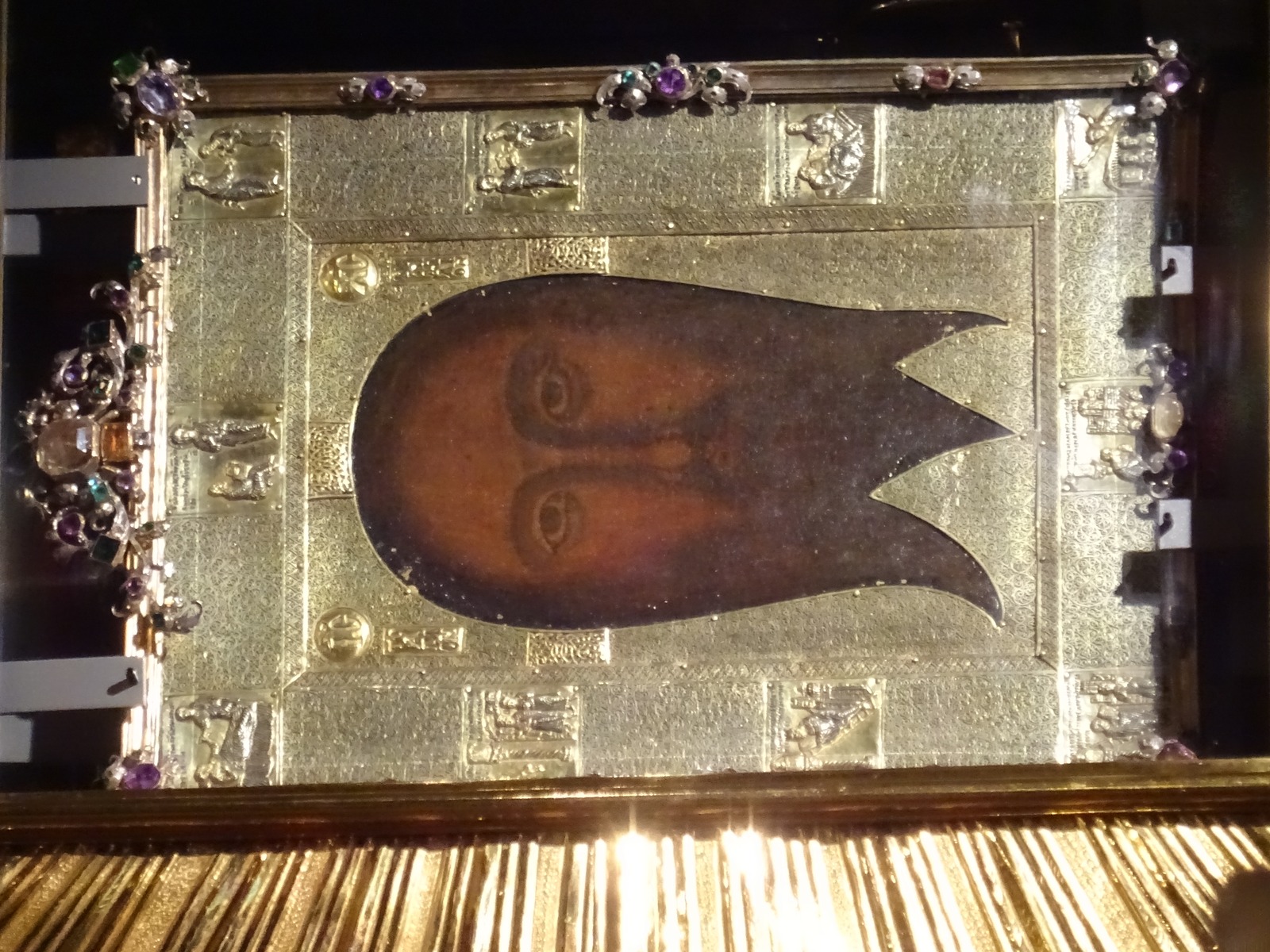
Christ's face stares out from a cloth pasted onto a wooden panel. Long dark hair parted in the center, beard, eyes that meet the viewer's. The face is rendered without a body, without halo (the halo and rays come from the silver-gilt frame). The frame surrounds the icon with ten embossed scenes recounting the Edessa legend — King Abgar's letter to Christ, Christ's reply, the cloth-imprint of the Holy Face, the cloth's transmission to Edessa, its rediscovery, its translation to Constantinople in 944. The icon is held at the Church of San Bartolomeo degli Armeni in Genoa; the Byzantine emperor John V Palaiologos donated it in 1362 to the Doge of Genoa, Leonardo Montaldo, who bequeathed it to the church in 1388. Genoa opens as a fresh Italian site.
Collection 10 territory directly — the Mandylion is the iconographic argument for image-depictability. The 8th–9th-century iconoclast controversy turned on the question can Christ be depicted? Iconoclasts said no: depicting Christ either denied his divinity (you cannot circumscribe the uncircumscribable) or denied his humanity (you depicted his flesh as if his flesh alone). The iconodule defenders (John of Damascus, Theodore the Studite, Patriarch Nikephoros — corpus #104, #110, #115) ran the structural argument: Christ became flesh; the flesh is depictable; depicting Christ-the-incarnate is depicting what God himself joined to himself. The Mandylion legend was the iconodules' visual evidence: Christ himself authorized depiction by leaving his face on cloth — the acheiropoieton (αχειροποίητον, not-made-by-hands).
Collection 10 third position locked — Mandylion as legitimate witness, not as relic-mediator. The corpus's locked Collection 10 framework (anchor at #triumph-of-orthodoxy-icon, expansions at #110 Theodore-Stephen, #115 Nikephoros Khludov) reads three positions: (1) iconoclast (no images), (2) iconodule with mediation drift (images as channels of grace), (3) memorial-witness (images as visual catechesis without mediation). The Mandylion at Genoa requires careful application. Affirmed: the iconographic argument from incarnation — Christ became flesh; the flesh is depictable. Declined: the relic-veneration expansion that grew around the Mandylion in late-medieval Genoa and Counter-Reformation Italy, where the cloth itself became an object of pilgrimage-and-petition. The Edessa legend's iconographic content (Christ's face, depicted) is doctrinally legitimate; the relic-cult that accumulated around the cloth slid past the apostolic line into the Nehushtan trajectory (2 Kings 18:4, locked at Collection 10's framing rule). What Hezekiah did to the bronze serpent is the corpus's standing question: what would Hezekiah do with this cloth? If the icon teaches Christ, it stays; if the icon has accumulated veneration to the point of burning incense to it, it goes.
The compositional theology — face only, no body. The Mandylion's iconographic structure is doctrinally precise. Christ's face is rendered alone, without body. The face register is the Johannine register: the Word was made flesh, and dwelt among us, and we beheld his glory (John 1:14). The face is what the apostles saw. The face is what testifies to the incarnation. The body alone could be a body's body; the face is personal. The iconographer's compositional choice points to John 1:14's we beheld — what was beheld was a face, looked at and remembered. The Mandylion makes the we beheld of John's prologue iconographically central.
The Palaiologan frame as iconographic editorial commentary. The 14th-century silver-gilt frame surrounds the cloth icon with ten embossed scenes of the Edessa legend — King Abgar's correspondence with Christ, the cloth-imprint, the cloth's journey. The frame editorializes the central image: it situates the icon within its legendary-historical context, making the cloth not just an iconographic image but a narrated artifact. The corpus reads the frame's editorial work as itself a Collection 10 move: the frame argues this image is authorized; here is how it came to be authorized. The argument is exactly the apologetic the iconodule defenders ran. The frame's ten panels are John of Damascus's Three Treatises on the Divine Images in goldsmith form.
Why this opens at Genoa. The Mandylion's transmission from Constantinople to Genoa in 1362 marks the late-Byzantine moment when the iconography itself becomes a diplomatic gift across the Greek-Latin tradition boundary. John V Palaiologos was negotiating Byzantine survival under Ottoman pressure; Genoa was the Italian republic with the strongest Eastern-Mediterranean trading network. The icon's Byzantine identity was preserved in its Latin custody for the next 600+ years. The corpus reads the cross-boundary preservation as another iteration of the iconographic-survival principle (#70).
The face is on the cloth. The cloth is on the panel. The panel is in the frame. The frame is in the church. The icon survived the iconoclasts, the Ottoman conquest, the Reformation, the Counter-Reformation — and is still in Genoa. The image testifies to the incarnation. The corpus affirms the testimony; declines the relic-cult that grew around the cloth.