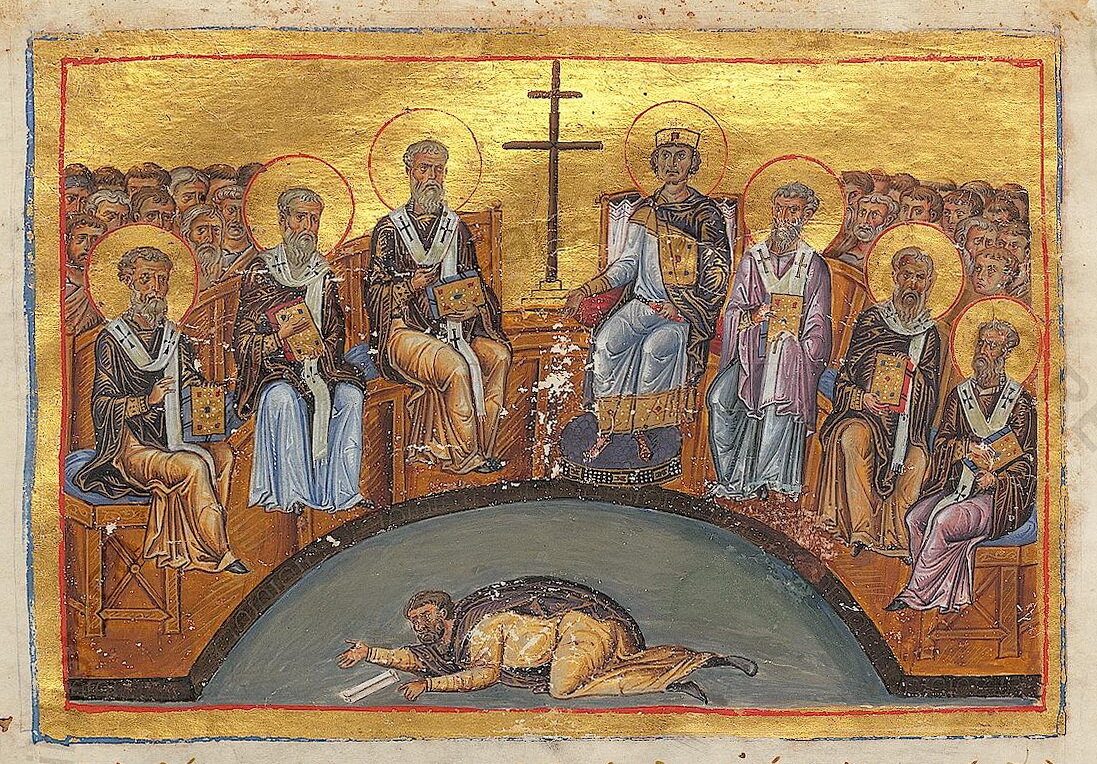
The Second Council of Nicaea
Menologion of Basil II, Folio 108 (Vatican Library, Vat. gr. 1613) — c. 985
Doctrinal reflection
A council in session. The cross is at the center on a draped altar. Patriarch Tarasios stands to the left of the cross, the young Constantine VI (with his mother Empress Irene presumably present though not always shown) stands to the right. Bishops are seated in tiers along the lower register. Beneath their feet, off-center and small, lies a single condemned figure — a deposed iconoclast bishop, the visual signature of the council's anathemas.
The Menologion of Basil II is a late-10th-century Byzantine liturgical calendar made for Emperor Basil II in Constantinople, with 430 illuminations covering saints' feasts and major church events. The illustration of the Second Council of Nicaea (held 24 September – 23 October 787 at Hagia Sophia in Nicaea, modern İznik) was produced about two centuries after the council itself, but it shows how the iconodule settlement was iconographically codified in the post-iconoclasm Middle Byzantine church. The composition is a type-image — every ecumenical council is drawn the same way: cross at center, patriarch and emperor flanking, bishops seated, heretics underfoot. The visual grammar is the council = orthodoxy; what the council condemns = heresy. Underfoot.
The Second Council of Nicaea was the formal iconodule settlement. Its conclusions, in summary:
1. Icons of Christ, the Theotokos, and the saints are to be made and venerated. The text of the council distinguishes latria (true worship, owed to God alone) from proskynesis / timētikē proskynēsis (honorific veneration, owed to icons, the cross, the gospel book, the saints).
2. The honor given to the image passes to the prototype. This is Saint Basil's formulation (drawn from his treatise On the Holy Spirit): when one venerates the image of the emperor, the honor passes to the emperor himself; therefore venerating the icon of Christ honors Christ, not the painted panel. The council took this argument over from John of Damascus's Three Treatises on the Divine Images.
3. Iconoclasm is anathematized. Specific iconoclast theologians and the Council of Hieria (754) are formally condemned. The synodical anathemas are read every year on the Sunday of Orthodoxy in the Eastern Orthodox liturgical calendar.
4. The Christological argument grounds the whole structure. Because Christ became truly human, he became visually circumscribable; therefore icons of Christ are theologically possible; therefore iconoclasm verges on Docetism (the early-Christian heresy that Christ only seemed human). On this Christological point, the iconodules were correct. The corpus has been built on the same premise.
The corpus engages Nicaea II in three layers.
The first layer: agreement. The Christological argument is right. The incarnation grounds the legitimacy of religious visual representation. Iconoclasm overreached when it claimed all images of Christ were illegitimate. The council was correct on this point and the corpus depends on this point being correct.
The second layer: distinction-making that does not work. The latria / proskynesis distinction sounds clean in Greek and collapses in pews. When pilgrims kiss icons, light candles before specific painted panels, address prayers to icons, attribute miracles to particular images, and process icons in liturgy as the locus of divine presence — the technical theological distinction between worship and honorific veneration does not survive contact with practice. The iconoclasts predicted this collapse. The history of Byzantine and post-Byzantine devotion vindicated their prediction. Distinctions that require a doctorate in Greek theology to maintain do not protect the second commandment in pews.
**The third layer: the honor passes to the prototype argument.** The Basil-of-Caesarea move (the imperial-image analogy) was rhetorically powerful but theologically thin. The reason Basil could speak of honoring the emperor through his image is that the emperor was a particular living person whose honor was owed by political theology to his subjects. Christ is not analogous: Christ is Lord, and the honor owed Christ is latria — which is precisely the thing the image-to-prototype doctrine ends up funneling toward the painted panel through the back door. Honor-passing-to-prototype works as polite courtroom etiquette and breaks as theological doctrine.
For these reasons the corpus declines the conciliar veneration mandate while keeping the conciliar Christological argument. We are not on the floor of the council saying anathema with the iconoclasts. We are also not on the floor saying eternal memory with the iconodules. We are reading the acts critically afterward, two thousand years downstream of an apostolic generation that did not have icons in its worship and did not need them, and we are saying: the second commandment is still the second commandment. The pre-iconoclasm Sinai survivors (corpus #2, #20, #24, #66) show that visual Christian art is ancient and good. The Khludov Psalter polemic (#64) and the Triumph of Orthodoxy icon (#65) show how the iconodule victory codified an overreach. The Hagia Eirene cross (#63) shows that the iconoclast concern was not foolish.
The council got the Christology right. It got the practical second-commandment application wrong. We keep what it taught about Christ. We do not keep the discipline it imposed about practice.
When you preach the seventh ecumenical council, preach the incarnation argument as a gift to the Christian visual tradition. Preach the latria / proskynesis distinction as a warning. Preach the honor passes to the prototype doctrine as a beautiful sentence that does not survive the parish. And preach the man underfoot — the deposed iconoclast bishop in the lower margin — back into theological dignity. He was wrong about images being categorically illegitimate. But he was watching for Nehushtan, and that watch is right.
Do not put him underfoot. Stand him up.