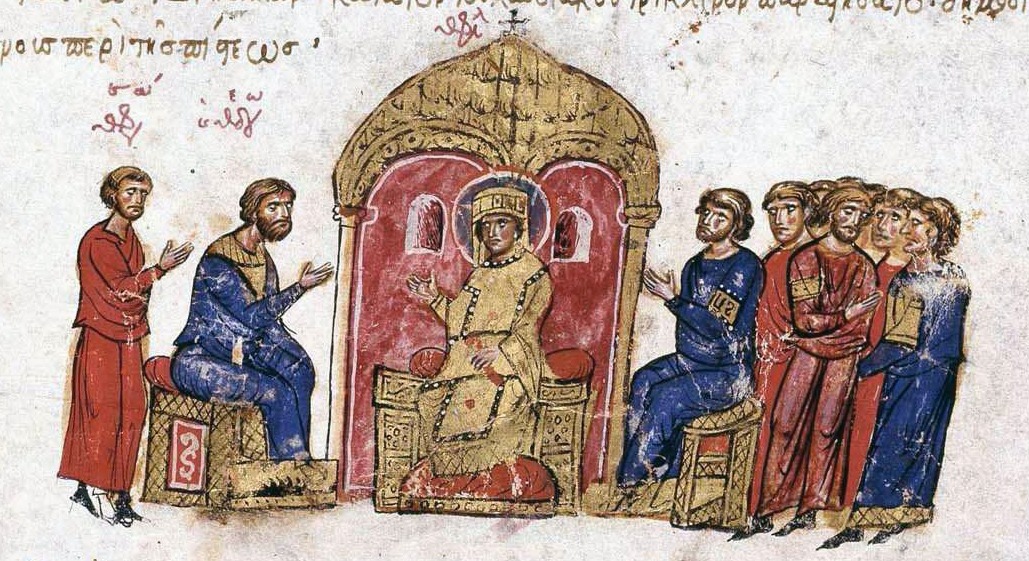
The Argument about Icons (Empress Theodora and the Iconoclasts)
Madrid Skylitzes — c. 1150–1175, Norman Sicily (Biblioteca Nacional de España, Madrid, MS Vitr. 26-2)
Doctrinal reflection
A two-register marginal illumination. Left register: a group of robed monks gesturing toward an icon of Christ, arguing for its veneration. Right register: a corresponding group gesturing dismissively, arguing against. Between them, a small icon-panel of Christ — the object of the argument. The illumination depicts the iconoclasm controversy in compressed didactic form: theology in marginalia, conflict made visible. The Madrid Skylitzes is a c. 1150-1175 Norman-Sicilian production of John Skylitzes's Synopsis of Histories; the manuscript carries 574 marginal illuminations and is housed at the Biblioteca Nacional de España in Madrid (MS Vitr. 26-2). Madrid BNE opens as fresh institution.
Collection 10 register — the controversy depicted, not adjudicated. The Madrid Skylitzes was produced ~300 years after the iconoclasm controversy ended (843 Triumph of Orthodoxy); the manuscript's polemical sympathy is iconodule (the chronicle is sympathetic to the icon-defenders), but the marginalia render the argument-as-event rather than only the iconodule victory. The corpus's locked Collection 10 third position (memorial-witness, not iconoclast extreme, not mediation drift) reads the illumination cleanly: the argument was real; both sides overreached; the apostolic line is memorial-witness. The polemical-restraint candidate pattern (flagged at #115+1) operates here — the iconographer renders the iconoclasts as arguing, not as demonic, which is itself a register-restraint choice.
The Norman-Sicilian production context. The manuscript was produced in 12th-century Sicily under Norman rule — a multilingual, multi-religious court where Latin Christian, Greek Christian, and Islamic intellectual traditions met. The Skylitzes chronicle was a Greek-Byzantine text; the Norman court commissioned an illustrated copy possibly for cultural-political reasons (Norman kings claimed continuity with Byzantine imperial tradition). The corpus reads this transmission as the iconographic-survival principle (#70) operating at the manuscript-tradition level: a Greek chronicle's iconographic vocabulary survived its own controversies into a Latin-rule context where copyists with Greek-Byzantine training reproduced the polemical illuminations without the Constantinopolitan polemical-imperial context.
Theodora and the Triumph of Orthodoxy connection. The Madrid Skylitzes covers the period 811–1057, including the second iconoclast wave (815–842) and Empress Theodora's restoration of icons in 843. The corpus already has the Triumph of Orthodoxy at #triumph-of-orthodoxy-icon — that 14th-c. icon depicts the 843 settlement. The Madrid Skylitzes adds the historical-narrative layer: not the moment of restoration, but the moment of the controversy itself, with monks arguing on both sides. The corpus reads the chronicle's documentation as historically valuable: the iconoclast position was articulated by serious Byzantine theologians, not only by political opportunists. Mode 4 application: the iconoclast theological concern (idolatry-prevention) was real; the iconoclast overreach (banning all images) was theological error. Both can be true.
Madrid BNE as new institutional category. The Spanish national library opens as a fresh corpus institution. The corpus's iconographic-survival principle (#70) operates institutionally: the Madrid Skylitzes survived from 12th-c. Norman Sicily through 16th-c. Spanish royal acquisition (the manuscript entered the Spanish royal library in the 16th century after passing through Italian collections). The Madrid BNE may grow to additional entries over time as the manuscript's 574 illuminations supply further iconographic occasion; for now, single-entry institutional opening.
The compositional theology — argument as iconographic content. The Skylitzes iconographer chose to render the argument itself as iconographically substantive — not just the iconoclast destruction or the iconodule victory, but the moment of theological dispute. The compositional choice: two registers in mirror-image, gesturing toward each other across the icon-object between them. The implied iconographic-doctrinal claim: the church works out its theology through argument; the apostolic line is articulated, defended, refined through controversy. The corpus reads this as Acts 15-pattern: the early church worked through circumcision-controversy by gathering, hearing, deciding (it seemed good to the Holy Ghost, and to us — Acts 15:28, locked across the corpus). The Madrid Skylitzes renders the iconoclasm-controversy as an Acts-15-style working-through.
The argument was real. The iconoclasts argued one position; the iconodules argued another. The icon between them was the object of the dispute. The 12th-century Norman-Sicilian iconographer rendered both sides arguing; the corpus reads what the chronicle reports — controversy as the form in which the church works out its faith.