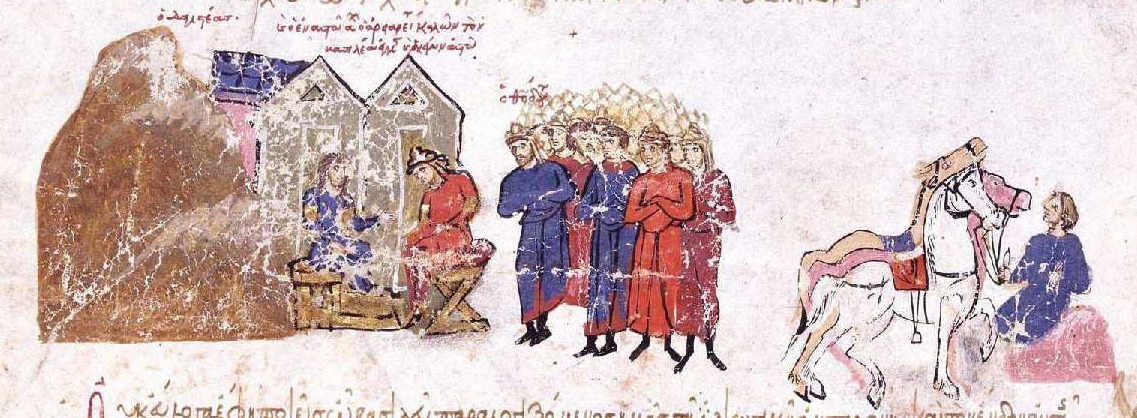
Emperor Leo V and the Monk of Dagisteas
Madrid Skylitzes — c. 1150–1175, Norman Sicily (Biblioteca Nacional de España, Madrid, MS Vitr. 26-2)
Doctrinal reflection
A single-register marginal illumination depicts the iconoclast emperor Leo V the Armenian (r. 813–820) seated in royal posture on the left, gesturing in argumentation toward a monastic figure on the right — the monk of Dagisteas, an iconodule confessor who according to Skylitzes refused Leo's pressure to renounce icon-veneration. Between the figures: an icon-panel, the object of the dispute. The folio is the corpus's second Madrid Skylitzes entry alongside the Argument-about-icons folio (#argument-icons-madrid-skylitzes). Madrid Skylitzes manuscript at 2/3.
The Collection 10 standing rule applied (locked at #110+2). The corpus's locked Collection 10 reading: read the iconodule defender at the moment they actually defended; decline the medieval-mediation drift built later on the defender's name. The monk of Dagisteas is one of dozens of named iconodule confessors of the second iconoclast wave (815–842); the Skylitzes chronicle preserves his testimony. The corpus reads the monk as exemplifying the canonical iconodule argument (incarnation grounds depictability — locked at #115 Nikephoros Khludov, #110 Theodore-Stephen): he refused not because icon-veneration is meritorious but because the icon teaches the incarnation, and the iconoclast's removal of icons removes the teaching.
Leo V's iconoclasm — the political-religious context. Leo V the Armenian succeeded to the throne in 813 amid Byzantine military setbacks against the Bulgars. He associated the empire's military reverses with the post-787 Triumph of Orthodoxy under Empress Irene (the First Restoration of icons), and reversed the icon-restoration in 815, beginning the second iconoclasm. His patriarch was John VII Grammatikos (the figure trampled in the Khludov fol. 51v at #115). Leo's reign ended with his murder in 820 — at the altar of Hagia Sophia by conspirators allied with his successor Michael II. The corpus reads the political-religious entanglement carefully: the iconoclasm controversy was both a theological dispute and a political-imperial maneuver. Mode 4 application — the iconoclasts' theological concern (idolatry-prevention) was real; their political execution of the position was tied to imperial-power calculations.
The iconoclast-defender argumentation register. The compositional structure (emperor on one side, monk on the other, icon between them) renders the theological-political dialogue as the iconographic content. The corpus's polemical-restraint candidate pattern (flagged at #115+1) operates here: the Skylitzes iconographer renders Leo as arguing, not as demonized. The candidate-pattern is now demonstrated at three Collection 10 entries (Khludov #115 against John VII Grammatikos; Madrid Skylitzes #133 generic argument; Madrid Skylitzes #142 Leo-monk dialogue) — the register-restraint is consistent. Pattern is now formalized as standing rule (see polemical-restraint section in voice-templates).
The Acts 5:38–39 register. Gamaliel's counsel before the Sanhedrin ("if this counsel or this work be of men, it will come to nought: but if it be of God, ye cannot overthrow it") is the apostolic register for political-religious disputes. The Madrid Skylitzes iconographer renders the iconoclast-iconodule dispute in similar register: the emperor argues; the monk witnesses; the dispute proceeds; the apostolic line emerges through controversy. The corpus reads this as Acts 15-pattern (the church works out its theology through gathered controversy) plus Acts 5-pattern (witnesses stand firm under political-religious pressure; the truth survives because the truth is from God).
The Madrid manuscript program — two folios on iconoclasm. Both Madrid entries are Collection 10. The two folios together render the full iconoclast-iconodule dialogue: the Argument about icons (#133) shows the dispute generically with monks on both sides; the Leo-monk dialogue (this entry) shows the dispute at the imperial-political level. Lock A's three-entry-gap activates after this 2-from-non-consecutive cluster. Madrid Skylitzes manuscript at 2/3; potential 3rd entry depends on iconographically-supplied occasion.
The emperor argued. The monk refused. The icon was between them. The Skylitzes chronicle preserved the dialogue; the Norman-Sicilian iconographer rendered it; the corpus reads the dialogue as Acts 5 + Acts 15 in iconographic form. The truth survives political-religious controversy because the truth is of God.