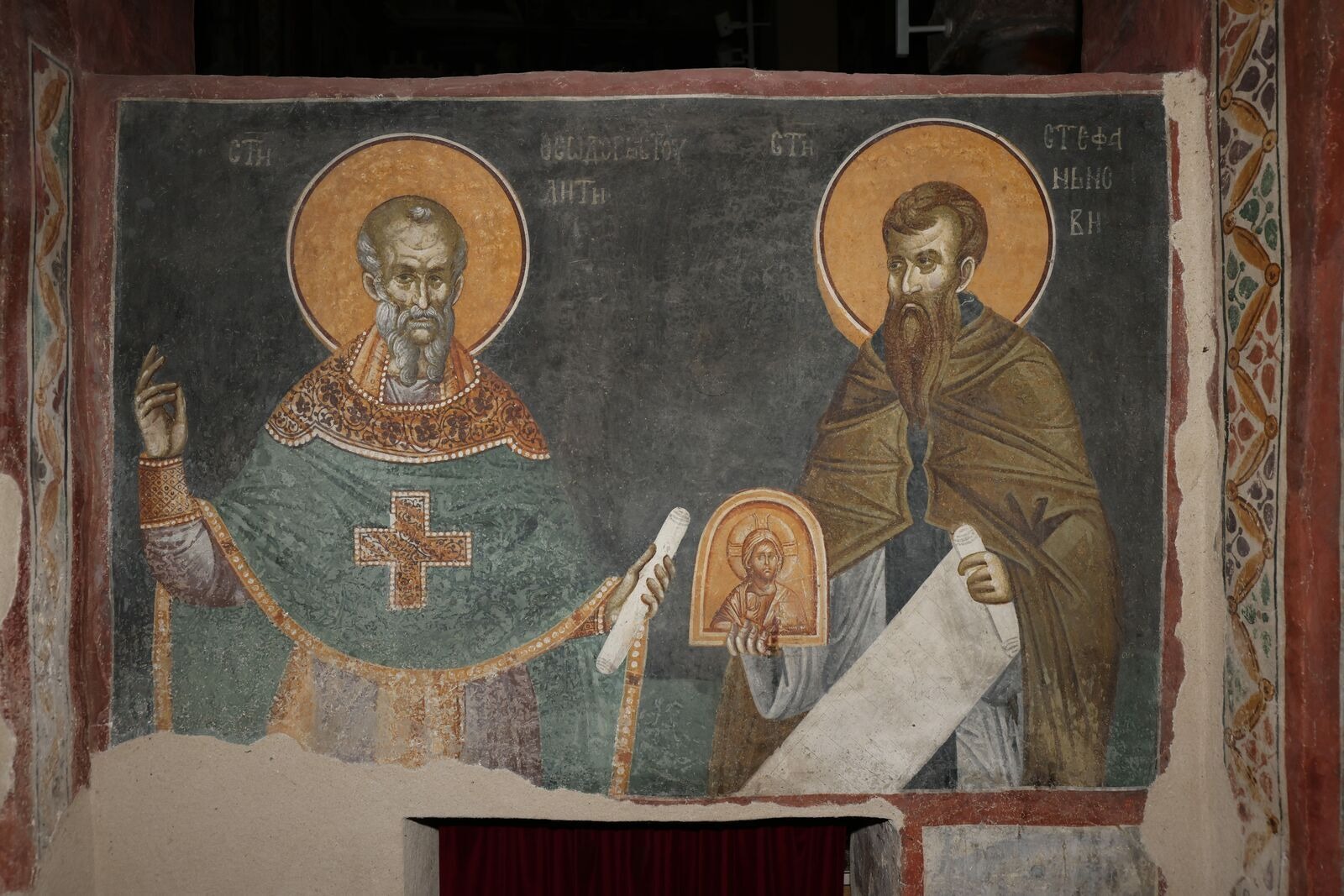
Theodore the Studite and Stephen the Younger
North Chapel Fresco, Gračanica Monastery, Kosovo — c. 1321
Doctrinal reflection
Two monastic figures stand side by side in the north chapel of Gračanica, robed in dark Byzantine monastic habit, scrolls in hand, names in Cyrillic above their haloes: St Theodore the Studite (left) and St Stephen the Younger (right). The fresco belongs to the c. 1321 Gračanica program commissioned by Serbian King Stefan Milutin, painted by Constantinopolitan-trained masters carrying the Palaiologan style north into Serbian church-building. The corpus's second Gračanica entry, paired with the Heavenly Liturgy in the dome (#102).
Two generations of iconodule witness. Stephen the Younger (c. 715–765) was beaten to death under the iconoclast emperor Constantine V — the first generation's principal martyr. Theodore the Studite (759–826) was exiled three times under Leo V the Armenian, Michael II, and Theophilos — the second generation's principal confessor. The Gracanica painter pairs them as the two-generation iconodule witness across the full arc of iconoclast persecution (730–843, with the central iconoclast period resuming under Leo V in 815). Collection 10 territory directly.
Stephen's polemical example. When Constantine V tried to break Stephen's resistance, Stephen reportedly stomped on a coin bearing the emperor's image and asked whether this insult to the imperial image insulted the emperor himself. The argument is image-honor logic: honor passing to the antitype through the type. Apostolically defensible when scoped to memorial witness — what is rendered to the image refers to the prototype — and apostolically dangerous if expanded to image-as-mediator. The corpus's locked Collection 10 third position holds the line: icons function as memorial witnesses (Heb 12:1 cloud-of-witnesses, locked at #83), not as channels of grace independent of Christ. Stephen's polemical move pressed the type/antitype logic, which is sound; the later medieval drift toward image-as-mediator went further than Stephen's argument warranted.
Theodore's theological articulation. Theodore the Studite's On the Holy Icons (c. 815–826) ran the systematic argument: if Christ became truly incarnate, then he is depictable; if he is depictable, then his image bears reference (not identity) to him; refusing the image refuses the incarnation. The argument is apostolically grounded — John 1:14 (the Word was made flesh), Colossians 1:15 (the image of the invisible God), Hebrews 1:3 (the express image of his person). Theodore's iconodule defense is structurally on the apostolic line. The Reformation later named the late-medieval mediation drift (rightly), but several Reformation traditions went further than the apostolic line, eliminating iconography altogether. The corpus's third position — memorial-witness icons; no mediation; no veneration sliding to worship — keeps Theodore's defense intact while declining the mediation drift Theodore himself did not authorize.
The third position locked. Collection 10's framework names three positions: (1) iconoclast (no images allowed), (2) iconodule with mediation drift (images as channels of grace), (3) memorial witness (images as visual catechesis without mediation). Theodore and Stephen defended position 2 in their day — but the content of their defense was closer to position 3 than to the late-medieval drift their argument was later used to support. The corpus reads them at Gracanica as witnesses of the apostolic line, not as patrons of the medieval-mediation expansion.
Gracanica's saints-procession program. The two iconodule monastics are rendered in Gracanica's larger saints-procession iconography — figures-of-witness in the Heb 12:1 cloud-of-witnesses register (15th flagship lock at #83). They watch the church from the chapel walls; the church remembers them; the remembrance is itself the iconographic-survival principle (locked at #70) operating across the iconoclast persecutions.
Theodore and Stephen defended the icons. The icons memorialize Christ. The memorial is not the mediation. The witnesses watch from the wall.