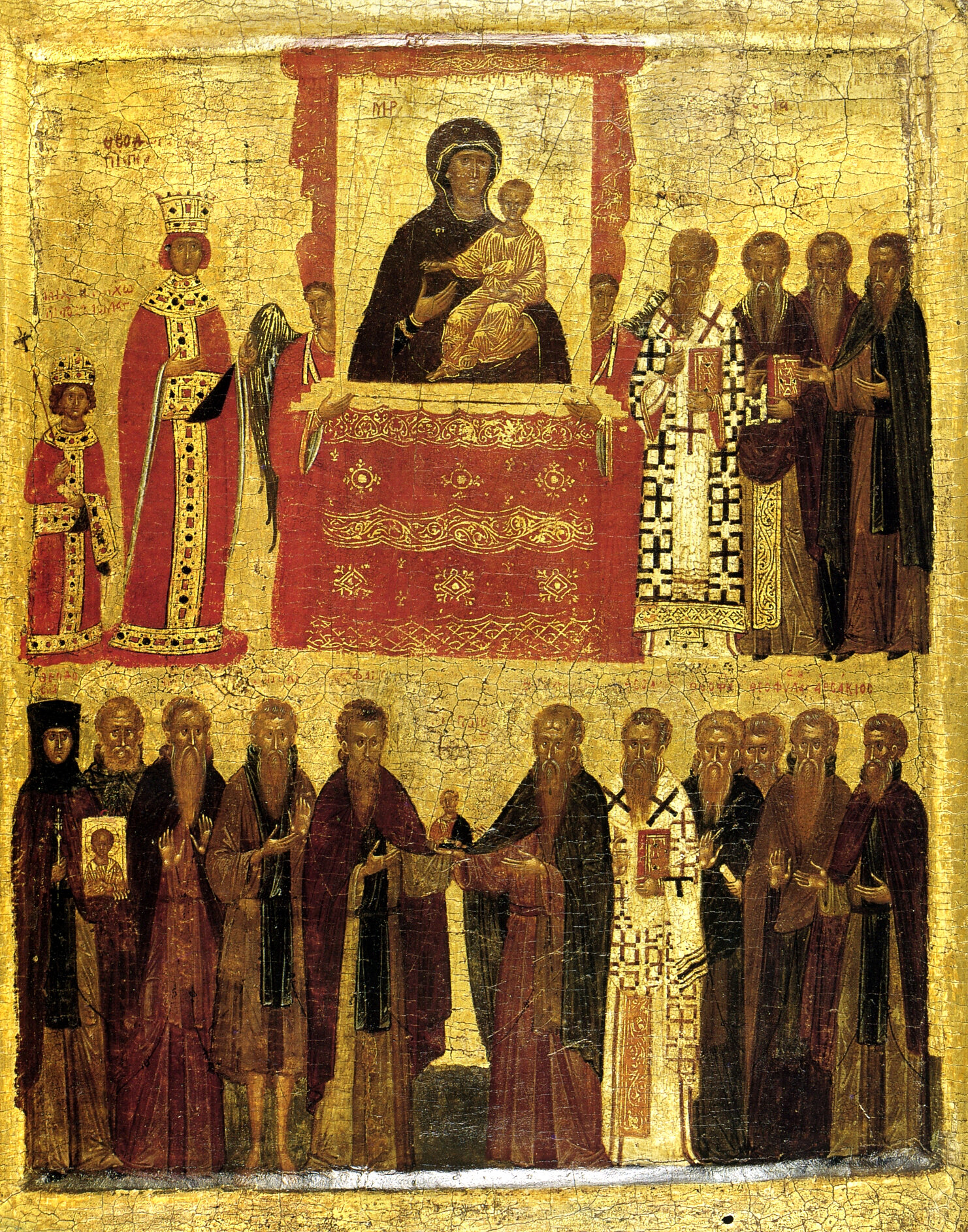
The Triumph of Orthodoxy
Late Byzantine Icon, c. 1400 — British Museum (National Icon Collection 18)
Doctrinal reflection
An icon of an icon. That is the entire iconographic argument.
In the upper register, two angels hold up the Hodegetria — the standing icon of the Theotokos with the Christ-child, the most venerated icon-type of Byzantine Constantinople, traditionally claimed to have been painted from life by Saint Luke. Empress Theodora and her three-year-old son Michael III stand to the left; Patriarch Methodios and his clergy stand to the right. In the lower register, eleven martyrs and confessors who suffered under the iconoclast emperors — Theodore the Studite, Theophanes the Confessor, the brothers Theodore and Theophanes Graptoi (whose foreheads were tattooed with anti-iconodule verses by order of Theophilos), and others.
The icon was made around 1400 to commemorate an event already five and a half centuries old: the Council of Constantinople of 11 March 843, in which Empress Theodora — regent for the infant Michael III after the death of her iconoclast husband Theophilos — formally restored the veneration of icons, ending the second iconoclast period (815–843). The Eastern Orthodox Church still observes the Triumph of Orthodoxy on the first Sunday of Great Lent, and the icon was made for that liturgical feast.
The theological argument is in the structure. The Hodegetria sits on a draped stand at the apex of the composition. The historical actors — empress, child-emperor, patriarch, confessors, martyrs — are all positioned with reference to the icon. The icon is the focal point. The icon is what the figures are venerating, processing toward, and giving testimony for. The composition is not just we won the iconoclasm controversy; the composition is the doctrine. Icons are venerable. Veneration of icons is orthodox. Refusing to venerate icons is heresy. The icon teaches its own veneration.
This is the icon Collection 10 has to engage most carefully, because this is the iconodule overreach made visible.
The empress was right that iconoclasm had overreached. The destruction of centuries of Christian art, the persecution of monks and laity who refused to surrender their household icons, the imperial use of state violence against theological dissent — all of that was wrong, and Theodora's restoration of religious imagery was a real correction.
But the icon teaches more than restoration. It teaches that veneration is the right response — not merely icons may exist as didactic and devotional aids but icons must be kissed, processed, addressed in prayer, treated as the locus of holy presence. The Synodikon of Orthodoxy, read every year on this feast, anathematizes those who refuse such veneration. "Eternal memory" to the iconodules; "anathema" to the iconoclasts.
We cannot give the anathema. The iconoclasts of the 8th and 9th centuries included men like Constantine V, who was theologically deeply confused and politically violent — the anathema may land on him. But the iconoclasts also included rural peasants and provincial monks who saw their neighbors kissing painted panels and praying to wood and gold, and who heard in their own consciences Hezekiah's hammer (2 Kings 18:4). To anathematize that conscience is to anathematize the second commandment functioning as it should.
The corpus engages this icon as a primary historical witness — the iconodule mind in mature, official, liturgically codified form. The composition is sophisticated; the figures are accurately identified; the historical occasion is real. But the doctrinal load it carries — veneration as the test of orthodoxy — we decline.
What we keep from the Triumph of Orthodoxy:
- The historical correction. Iconoclast persecution was wrong. The confessors of the lower register suffered for a real cause.
- The Christological premise. Christ became visible in the incarnation; visual representation of biblical content is theologically legitimate.
- The acknowledgment that icons can teach. The Hodegetria type is a real doctrinal teaching tool — it directs the viewer to Christ.
What we decline:
- The veneration mandate. Religious art is a teacher, not a recipient of devotion.
- The synodical anathema against iconoclasts. The iconoclast conscience, even where excessive, was watching for Nehushtan and that watch is right.
- The icon-of-an-icon move. When an icon teaches its own veneration, the painted panel has crossed from window to object.
The icon shows the empress restoring Christian art. We keep that. The icon shows the empress mandating veneration of art. We do not.
And one more thing the icon does not show. The icon does not show the empress opening a Bible and reading it to her three-year-old son. The Word read aloud is the primary ordinary means by which God's people grow into holiness (Romans 10:17; 2 Tim 3:16). The icon culture of late Byzantium did not have a robust public-Scripture-reading practice for laity. That is a much greater cost of the iconodule victory than the doctrinal overreach itself.