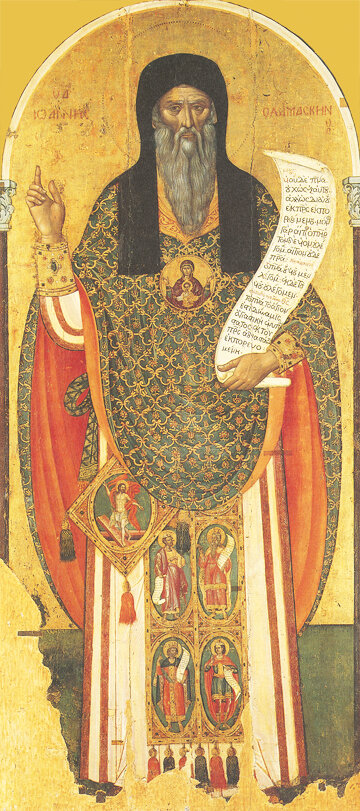
Saint John of Damascus
Icon by Emmanouel Tzanes — 17th-century Cretan school
Doctrinal reflection
John stands frontal, robed as a monk in dark cassock with white shoulder-cloth, holding an open scroll inscribed in Greek with a quotation from his Three Treatises on the Divine Images. The icon is by Emmanouel Tzanes (1610–1690), one of the great late-Cretan-school iconographers whose work continued the Byzantine iconographic tradition after the fall of Constantinople and the Ottoman absorption of the Greek mainland. Tzanes worked primarily in Venice and Corfu among the Greek-Orthodox diaspora, where his icons sustained the eastern theological-iconographic vocabulary in a Latin-Catholic political context.
John of Damascus (c. 675–c. 749) is one of the most consequential figures of the iconoclasm controversy and the corpus's first dedicated entry on his portrait — though his theological position has been referenced repeatedly across Collection 10 entries (#63 Hagia Eirene cross, #64 Khludov Psalter, #65 Triumph of Orthodoxy, #67 Menologion Second Nicaea, #sinai-virgin-theodore-george). John served as a financial-administrative official in the Umayyad Caliphate under the Christian-tolerant early Umayyads, then withdrew to the monastery of Mar Saba near Jerusalem to write theology. His Three Treatises Against Those Who Decry the Holy Images (c. 726–730), composed during the first iconoclast crisis, supplied the theological framework that the Council of Nicaea II (787) would later codify.
The corpus's relationship to John of Damascus is complicated. The 14th flagship's three-fence rule (locked at #82 Hosios David and demonstrated at #85 Vresok) declines speculative Christological readings the apostles do not authorize, and refuses the modernist literary reduction. John's defense of icons is closer to the corpus's affirm-fence than to either decline, but it overshoots in places.
What the corpus keeps from John of Damascus. The Christological argument that grounds visual representation: because Christ became truly human, he became visually circumscribable; therefore icons of Christ are theologically possible; therefore iconoclasm verges on Docetism. On the Divine Images I.16 makes the case clearly: "I do not worship matter; I worship the God of matter, who became matter for my sake... I will not cease from honoring that matter which works my salvation." The argument is right against radical iconoclasm. The corpus depends on the Christological argument for its own existence as a visual-art archive.
What the corpus declines. John's defense extends beyond image-as-teaching-tool to image-as-veneration-vehicle. He distinguishes latria (worship, owed to God alone) from proskynesis / dulia (honorific veneration owed to icons, saints, the cross). The distinction is locked at the corpus's Collection 10 third-position framework — affirmed where it grounds visual representation, declined where it grounds icon-veneration in pews. The latria/proskynesis distinction sounds clean in Greek and collapses in practice; the corpus has named this at #67 Menologion Second Nicaea (the conciliar-codification critique). John supplied the theological framework that became the Eastern church's veneration apparatus; the corpus reads his Christology forward but reads his veneration apparatus through the Collection 10 third-position fence.
The historical context tightens the reading. John wrote from outside Byzantine imperial control — under Umayyad Muslim rule. His treatises could not be suppressed by iconoclast emperors because his patrons were caliphs, not emperors. The political irony: the strongest theological defense of Eastern Christian iconography came from a writer protected by Islamic political power. John's voice survived the iconoclast persecutions because he was geographically beyond their reach — same pattern as the Sinai pre-iconoclasm icons (#sinai-virgin-theodore-george) that survived because the iconoclasts could not reach them. What was rendered or written outside imperial reach survived; what was rendered or written inside imperial reach was subject to imperial revision.
Collection 10 register. This is the corpus's first iconoclasm-debate entry on a defender-figure rather than on the iconography of the controversy itself. John's portrait sits in the corpus's third-position framework — affirm the Christological argument, decline the veneration-apparatus extension, refuse the iconoclast over-correction.
John defended the images. He went too far in some of the defense. The corpus reads his Christology forward and his apparatus through the locked fence.