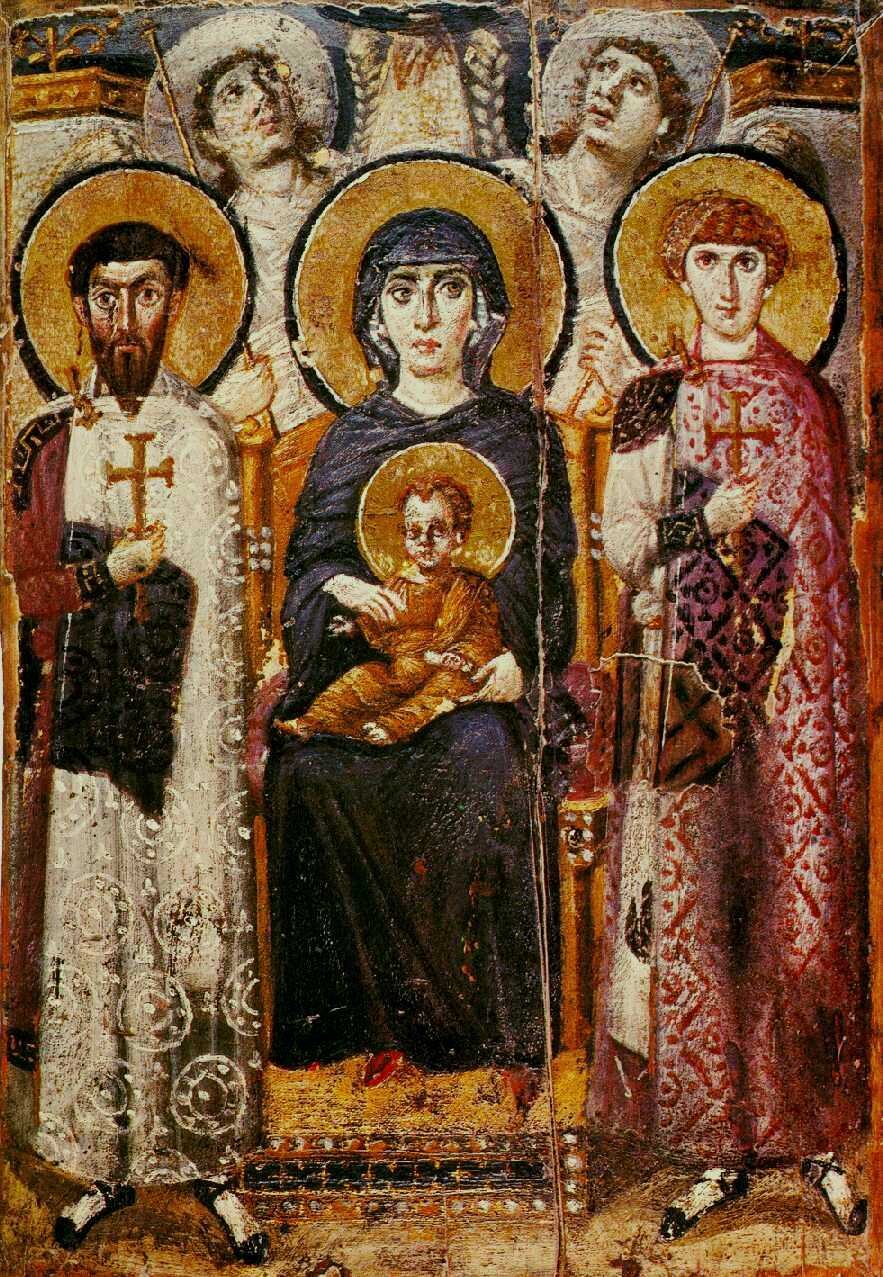
Virgin Enthroned with Saints Theodore and George
6th-c. Encaustic Icon — Saint Catherine's Sinai (a Pre-Iconoclasm Survivor)
Doctrinal reflection
It survived because the iconoclasts couldn't reach it.
This encaustic panel from the late 6th century — the Virgin enthroned with the Christ-child, flanked by two military saints (Theodore at her right, George at her left), with two angels behind craning upward toward a downward-shafting hand-of-God — sits in the icon collection of Saint Catherine's Monastery on the Sinai Peninsula. It is one of perhaps a dozen pre-iconoclasm icons from anywhere in the Byzantine world that survived intact. The reason is simple geography. Sinai fell under Muslim Arab rule in 641. By the time Emperor Leo III issued the first iconoclast edict around 730, Sinai had been outside Byzantine imperial jurisdiction for nearly a century. The iconoclasts had no power there. The icons stayed.
Everywhere else, they were destroyed. Constantinople, Thessaloniki, Ephesus, Antioch, the great urban centers of the Byzantine world — almost the entire pre-iconoclasm icon corpus was burned, scraped, or whitewashed under Leo III, Constantine V, Leo IV, Leo V, Michael II, and Theophilos. What we know about pre-iconoclasm Christian art outside Sinai we know mostly from descriptions, fragments, and a handful of mosaics that survived because they were architecturally embedded (Hagia Eirene's apse cross was iconoclast and so was kept; the Sant'Apollinare Nuovo Ravenna program survived because Ravenna was Lombard / Frankish by 730).
The Sinai survivors give us our only sustained look at what Christian art was doing in the centuries between the catacombs (3rd–4th c.) and the post-iconoclasm Macedonian Renaissance (843+). And what they show is a tradition already mature by 600. The compositional vocabulary is in place. The Theotokos enthroned with the Christ-child is rendered with the same hieratic frontality, the same gold-ground, the same hand-of-God-descending iconography, that will continue into the 14th century. The Pantocrator type (corpus #2) is already complete. The apostle-portrait type (corpus #20 Peter) is already complete.
Two doctrinal points emerge from the Sinai survivors that bear on the iconoclasm question.
First: Christian visual representation of biblical content has continuous roots back through the 6th century, into the 4th century catacombs, and arguably into the 3rd century Dura Europos house-church frescoes. The iconoclast claim that figural Christian art was a recent corruption was historically false. Constantine V and the Council of Hieria argued from theological premises (the supposed Christological problem with depicting Christ) but did not have the historical evidence to support the claim that the church had originally been image-free. The Sinai icons help anchor that historical correction. Christian image-making began with the church.
Second: the icons that survived at Sinai also show what the iconoclasts feared. The Theotokos here is enthroned. The military saints stand beside her with their feet on the ground; they are clearly subordinate. But Mary holds the central position, and the eye is drawn to her at least as much as to the Christ-child on her lap. The composition is theologically right if Mary is honored as the Theotokos (mother of the incarnate Lord, Luke 1:43) and theologically wrong if she becomes a separate object of veneration in her own right (the named-decline rule, applied here). By 600, the iconographic vocabulary that would in later centuries become Mariolatry in popular practice is already visible in seed form. The iconoclasts of the 8th century were not wrong to look at this trajectory and worry.
The Sinai icons are precious because they survived. They are theologically instructive because they show the trajectory in both directions — the legitimate Christian visual tradition that iconoclasm overreached against, and the early seeds of veneration-drift that the iconoclasts were watching for.
The corpus reads them both ways. We are grateful these icons exist; we would have far less to teach from without them. We hold the figures in their proper biblical proportions: the Christ-child on the throne is the Lord; the Theotokos who bore him is honored because she bore him; the military saints flank as witnesses, not as intercessors; the angels above attend the throne, ministering not mediating; the hand-of-God descending is the figure for the entire transaction — the Father gives the Son, and the Spirit comes down upon Mary at Nazareth (Luke 1:35).
The Theotokos-enthroned reading (Collection 2 cross-tag). The icon is also the corpus's earliest surviving image of the Theotokos enthroned, and the iconographic argument is an incarnation-Christology argument. Hebrews 1:8 says of the Son, "Thy throne, O God, is for ever and ever." Luke 1:32 records what Gabriel told Mary: "The Lord God shall give unto him the throne of his father David." The Sinai painter shows where that throne actually was when the prophecy was being fulfilled. It was a Galilean girl's lap. That is the theological scandal at the heart of the incarnation. The God of unapproachable holiness did not commission a golden seat; he took the body of a peasant woman as the throne from which his earthly reign began. Mary is painted frontally and seriously — not as Mediatrix, not as goddess — but as the throne the King required, dignified by the King who sat there. The dignity is the King's; the throne shares in it. Honored, the way you honor any vehicle of the incarnation: by recognizing what it carried. When you preach the incarnation, do not strip Mary out of it. The Word became flesh in a particular woman's body. Without her body, the doctrine collapses — not because she has divine status, but because the throne is part of what makes the King visible.
The icon is good. The veneration is the problem.