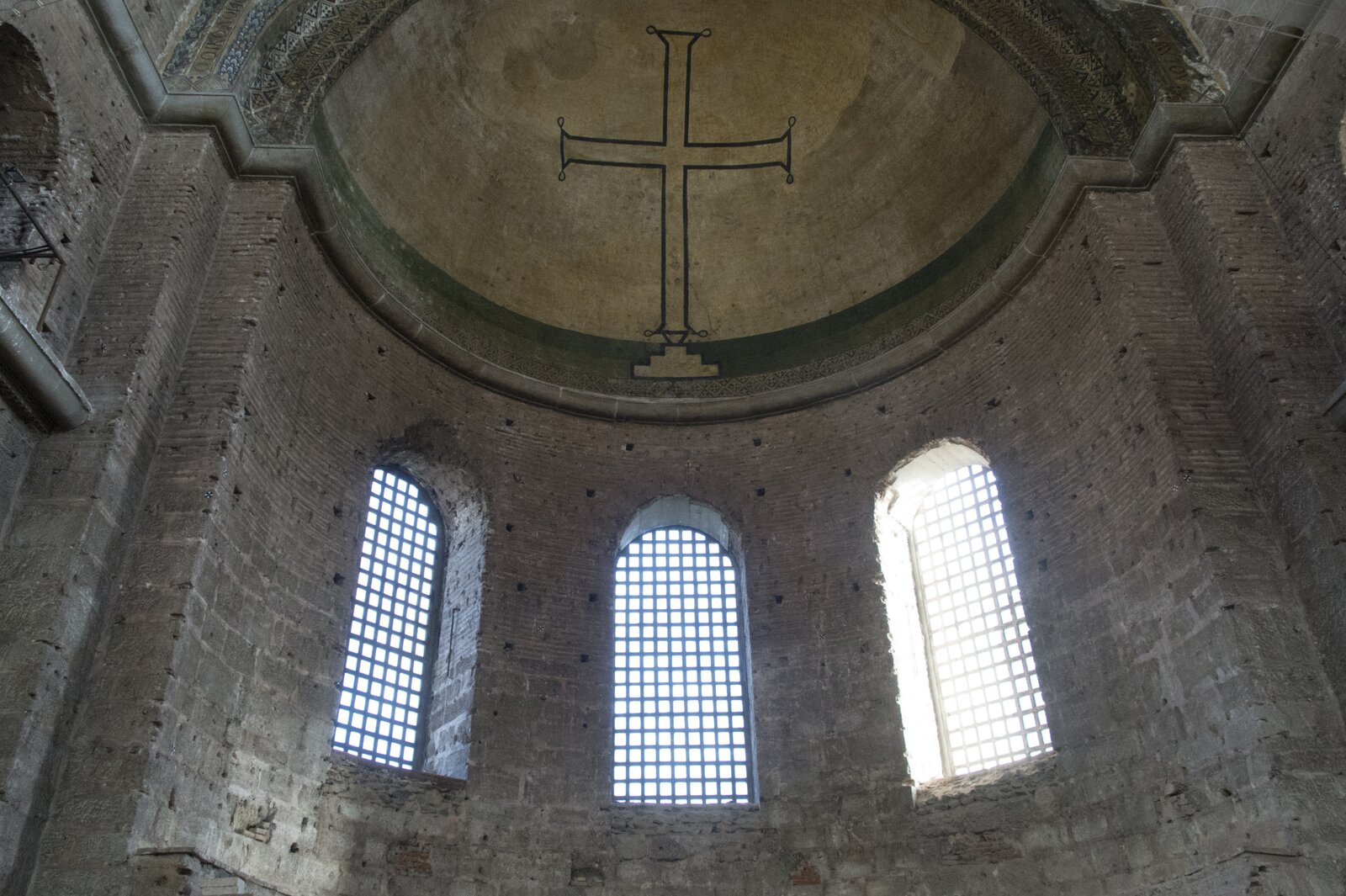
The Iconoclastic Cross
Apse Mosaic, Hagia Eirene (Saint Irene), Constantinople
Doctrinal reflection
An empty cross. A naked apse. No figure. No face. No saint.
The apse of Hagia Eirene — the Church of Holy Peace, built by Constantine I in the 4th century, rebuilt by Justinian in 532, rebuilt again after the 740 earthquake — carries something rare in the Byzantine corpus: an iconoclastic mosaic, made during the imperial campaign against figural Christian art that ran from c. 730 to 843. Where the apse normally holds a Theotokos with the Christ-child or a Pantocrator, Hagia Eirene's apse holds only a large jeweled cross on a gold ground. No human figure. No iconographic identification beyond the cross itself. The mosaic was made under Constantine V (r. 741–775), the most theologically committed of the iconoclast emperors.
This is one of very few surviving iconoclast-period mosaics. Most were destroyed when the iconodules returned to power in 843, replaced by figural programs of the post-iconoclasm Macedonian Renaissance. Hagia Eirene's escaped because it was already image-free; there was nothing to remove.
The iconoclasts had a real concern. Idolatry is a real biblical category and a real spiritual danger. Exodus 20:4–5 forbids the worship of images. The Old Testament records God's people repeatedly sliding from commanded images (the cherubim above the ark, Exodus 25:18; the bronze serpent of Numbers 21:8) into idolatrous worship of those images. Hezekiah destroyed the bronze serpent because Israel had begun burning incense to it — "and called it Nehushtan" (2 Kings 18:4), a piece of brass. A God-commanded image had become an idol when veneration accumulated. The iconoclasts looked at 8th-century Byzantine icon-veneration and said: this is heading toward Nehushtan.
They were not wrong about the trajectory. The Eastern Christian icon-veneration of the 8th century was already drifting toward functional idolatry — kissing icons in worship contexts, addressing prayer to icons, attributing miraculous powers to specific painted panels. The iconoclasts were watching the Nehushtan trajectory unfold and trying to stop it.
But the iconoclasts overreached. They banned all religious imagery, destroyed centuries of Christian art, persecuted iconodule monks and laity, and attempted to legislate away an iconographic tradition that went back to the catacomb-art of the pre-Constantinian church. The cure was worse than the disease. The Council of Hieria in 754 attempted to give the iconoclasm theological footing, but its arguments were thin: the council reasoned that since Christ's divinity cannot be circumscribed, no image of Christ is legitimate — but this misreads the incarnation, which makes Christ visibly circumscribed in his humanity (the iconodule defense at Nicaea II in 787 was right on this point).
GLM holds a third position. We are not iconoclast — the corpus itself is evidence; you do not build a Byzantine art archive if you reject religious art categorically. We are not iconodule in the Nicaea II sense — the named-decline rule from Collection 7 makes the rejection of veneration explicit. We hold religious art as didactic, devotional, and witnessing — but never as a vehicle for veneration or petition. Icons can teach the gospel; icons cannot be venerated, kissed, processed in liturgy as objects of devotion, or addressed in prayer.
The Hagia Eirene apse cross is not the right answer, but it asked the right question. Are we burning incense to a brass serpent? Every generation of the church has to answer it. When veneration accumulates around any image — icon, statue, relic, devotional object — the Hezekiah question is the right question. Bring the hammer if you have to. But don't smash the cherubim above the ark.
The line is not between image and no-image. The line is between teaching tool and devotional object.