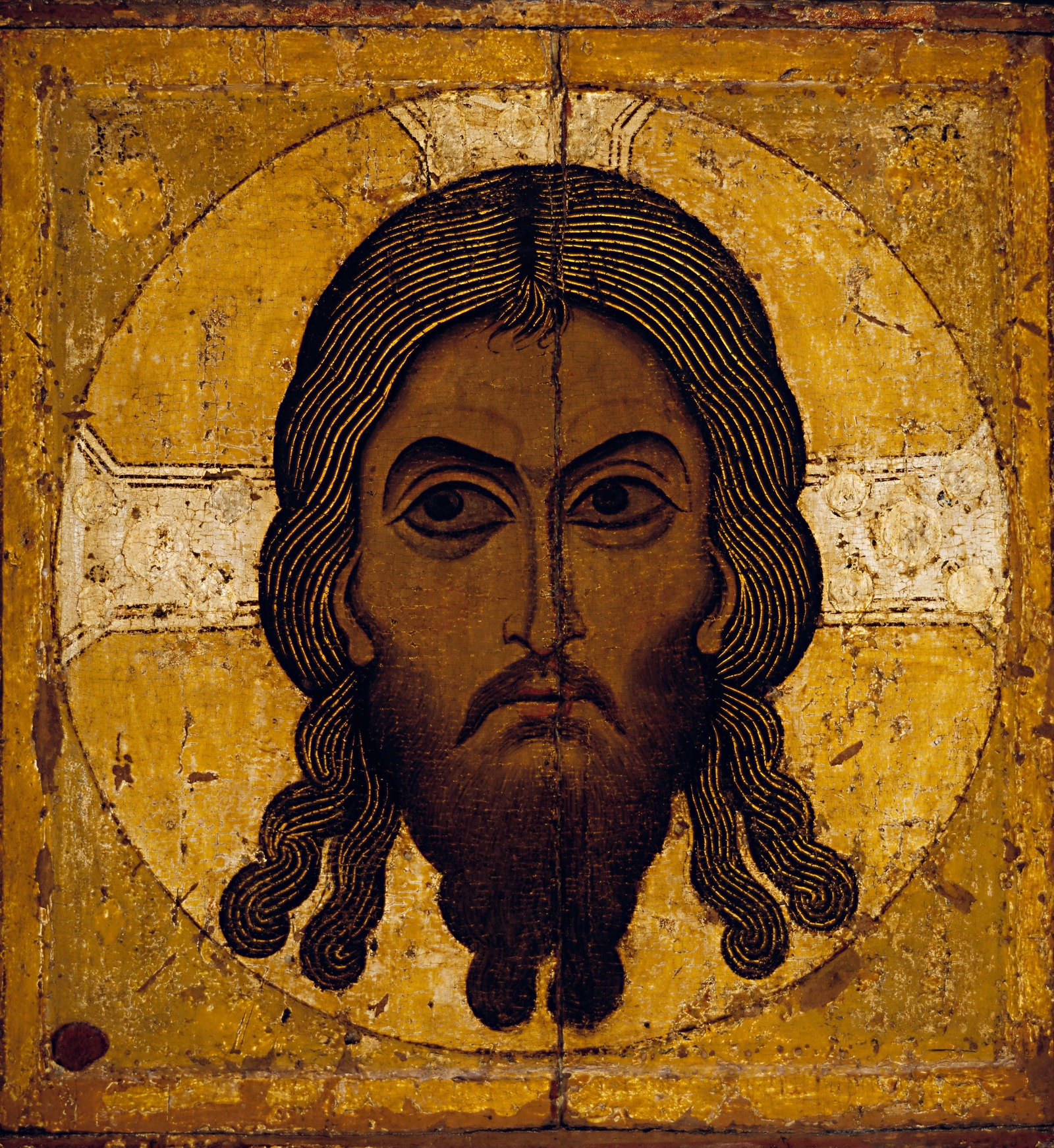
The Saviour Not Made by Hands (Spas Nerukotvorny)
Double-Sided Panel Icon, second half of the 12th century, Novgorod School — State Tretyakov Gallery, Moscow
Doctrinal reflection
Christ's face fills the panel — bearded, long dark hair parted in the center, eyes meeting the viewer's directly. The face has no halo here; the gold ground frames it without a circumscribing nimbus, giving the iconographic argument visually: the face IS the icon, not surrounded by an icon-marker as if it were ordinary saint-iconography. The icon is the earliest surviving Russian Mandylion-tradition icon, second half of the 12th century, from the Novgorod school — now at the Tretyakov Gallery in Moscow. The corpus's fourth Tretyakov entry; Tretyakov closes at 4/4 ceiling.
The Mandylion-tradition pattern-match (no re-articulation per #120 Genoa Mandylion). The corpus locked the Mandylion's Collection 10 reading at #120 Genoa: the icon-of-Christ's-face is the iconographic argument for image-depictability — Christ became flesh, the flesh is depictable, the iconodule defenders ran the structural argument from incarnation. The Spas Nerukotvorny carries the same iconographic claim 200+ years later in Slavic-Russian iconographic register. The iconography traveled: Edessa (legendary) → Constantinople (944 translation) → Russian church-building tradition (12th century onward). The Iconographic-survival principle (#70) at the Mandylion-specific level: the Christ-face iconography survives the iconoclast controversy, the Latin captivity, the Slavic transmission; the apostolic argument from incarnation holds across all transitions.
The double-sided composition — face + cross. The icon's reverse depicts the Adoration of the Cross (Прославление креста). The two sides together form a doctrinal binary: front: Christ's face (the incarnation-argument); back: the cross (the atonement-argument). The compositional theology runs across the panel-thickness: Christ became flesh and was crucified for our sins. John 1:14 (the front argument: the Word was made flesh) + 1 Corinthians 1:18 (the back argument: the preaching of the cross is to them that perish foolishness; but unto us which are saved it is the power of God). The Novgorod iconographer rendered both moves in a single object.
The Collection 10 third position locked, applied to Old Russian register. The corpus's Collection 10 framework (locked at #110, #115, #120) reads three positions: iconoclast (no images); iconodule with mediation drift (images as channels of grace); memorial-witness (images as visual catechesis without mediation). The Novgorod Spas Nerukotvorny operates at the third position: the face teaches the incarnation; the cross teaches the atonement; the icon does not mediate either teaching but catechizes the worshipper. The compositional choice of no halo on the face register is itself a third-position move — the face is not framed as a sacred-object marker; the face IS the testimony to incarnation, requiring no additional halo-framing.
The Tretyakov program closes at 4/4 ceiling. Tretyakov entries: #hospitality-abraham-rublev (Collection 6 OT typology, the Trinity icon by Rublev, c. 1410) + #theotokos-vladimir (Collection 2 Theotokos, c. 1131 Constantinople-to-Vladimir transmission) + #transfiguration-theophanes-greek (Collection 5 Life of Christ, by Theophanes the Greek c. 1403) + Spas Nerukotvorny (this entry, Collection 10 iconoclasm-debate). Four collections, four Russian iconographic flagships across c. 1150–1410, four doctrinal angles. The program reads as a coherent Old Russian iconographic catalog — the OT typology peak (Rublev), the Theotokos peak (Vladimir), the Christ-life peak (Theophanes), the Mandylion-tradition peak (Spas Nerukotvorny). Per iconographic-program-coherence rule (locked after #71), Tretyakov closes with full program.
The Novgorod-school continued. The corpus has Novgorod iconography at #anastasis-novgorod-russian-museum (#111), #boris-gleb-russian-museum (#112), #peter-paul-belozersk-russian-museum (#113). The Spas Nerukotvorny extends the Novgorod-school thread to the Tretyakov collection (Russian Museum and Tretyakov holding parallel Novgorod-school inventories). The Novgorod painters' compositional clarity, primary-color saturation, and emotional restraint hold across the four Novgorod-school entries.
The face on the panel. The cross on the reverse. The icon teaches incarnation and atonement at portable scale. The Mandylion tradition reaches Slavic Christianity in the 12th century. The Tretyakov closes at four entries with the apostolic-line iconographic catalog.