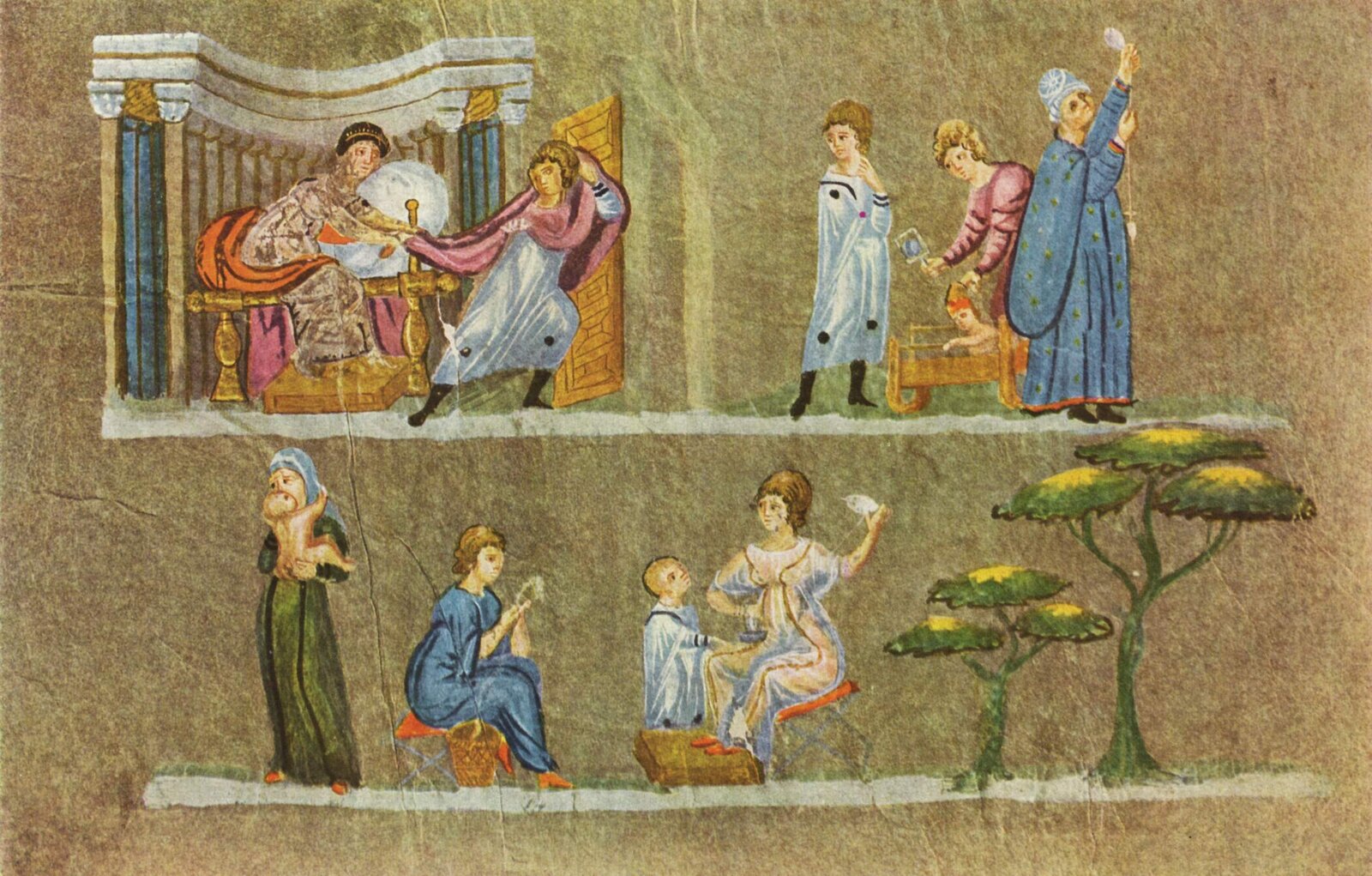
Joseph and Potiphar's Wife
Vienna Genesis, fol. 16r — late 6th-century Byzantine illuminated manuscript (Austrian National Library)
Doctrinal reflection
Joseph at the doorway, Potiphar's wife reaching for his cloak, Joseph pulling away. The lower register continues the narrative — Joseph hands her the garment as she releases her grip, Joseph flees out the doorway. The Vienna Genesis (Codex Vindobonensis Theol. gr. 31), late 6th century, was painted on purple-dyed vellum in silver and colored inks, likely in an Antioch workshop. It is one of the oldest surviving illuminated Christian manuscripts, with twenty-four miniatures spanning Genesis from creation to the death of Jacob. The Joseph cycle occupies the latter quarter; this folio renders Genesis 39 in two stacked registers.
The scene is Genesis 39:7–18. Joseph, sold into Egypt by his brothers, has risen to oversee Potiphar's household. Potiphar's wife casts her eyes on him; Joseph refuses her advance with the line that defines the episode: "How then can I do this great wickedness, and sin against God?" (Gen 39:9). She seizes his garment; he flees, leaving the cloth in her hand; she uses the garment as false witness to accuse him of attempting what she had attempted on him. Joseph is imprisoned for refusing the sin he is accused of committing.
Mode 1 typology pattern-match. The Joseph cycle is the canonical Old Testament Christ-typology, apostolically authorized in two registers: Stephen's speech in Acts 7:9–18 names Joseph's path explicitly; Hebrews 11:22 names Joseph among the cloud of witnesses. Joseph as type runs through the whole cycle — sold by his brothers (echoing Christ's betrayal by his own), unjustly imprisoned (echoing Christ's unjust trial), exalted to the right hand of Pharaoh (echoing Christ's session at the right hand of the Father), reconciled with his brothers (echoing the church's reconciliation with the Lord they had rejected). The Vienna Genesis folio renders one episode in the larger arc — the temptation-and-flight that precedes the unjust imprisonment.
The Joseph-as-faithful-witness layer. This particular episode adds the tempted-yet-without-sin register that Hebrews 4:15 names of Christ: "For we have not an high priest which cannot be touched with the feeling of our infirmities; but was in all points tempted like as we are, yet without sin." Joseph's refusal to sin against God (Gen 39:9) types Christ's wilderness refusal of Satan's temptations (Matt 4:1–11) and Gethsemane's prayer-rather-than-flight obedience (#87). The Vienna Genesis iconographer renders the moment of refusal-and-flight; the doctrinal payload is faithful-witness-under-temptation, foreshadowing the One who would be tempted in all points and yet sin not.
Mode 1, not theophany-Christophany. Per the corpus's locked distinction (#92): Genesis-historical figures operating as types remain inside the five-mode framework (#38 Rublev) without 14th-flagship overlay. Joseph at Potiphar's house is Genesis-historical action, not vision-of-glory or visible-divine-encounter. The 14th flagship (theophany-as-Christophany at #82 Hosios David) does not apply here. Standard Mode 1 typology pattern-match: Joseph types Christ where the apostolic writers (Stephen, Hebrews) authorize the typology.
The Vienna Genesis itself. The manuscript is one of three surviving 6th-century purple-vellum biblical manuscripts (alongside the Rossano Gospels, corpus #74, and the Sinope Gospels). Together they witness to the late-antique imperial-luxury manuscript tradition that decorated the most authoritative biblical texts in silver-on-purple to mark them as imperial-rank objects. The Vienna Genesis is in the same medium-tradition as the Rossano Gospels — purple vellum, silver ink, narrative Christological-typological illumination cycles. Both witness to the early-Byzantine confidence that the biblical narrative bore Christ in every register, from Genesis's first chapters through the Gospels.
Joseph fled. Potiphar's wife held the garment. The unjust accusation followed. The exaltation came after. The cycle ends at Genesis 50:20: "But as for you, ye thought evil against me; but God meant it unto good." The corpus reads this as the typological seed of Romans 8:28 — and, beyond it, of the cross.