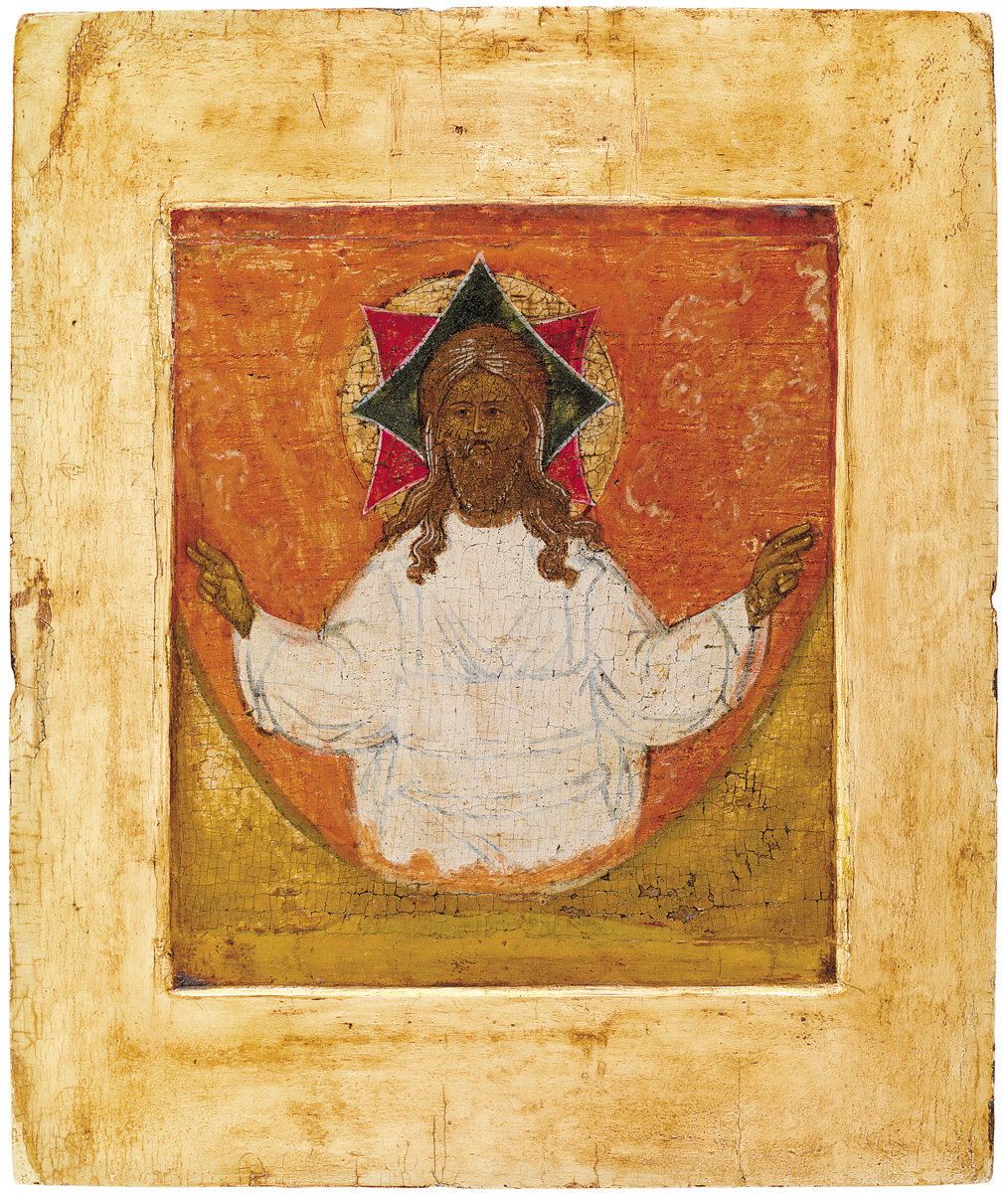
The Lord Sabaoth
Russian Old Believer Icon, Moscow, c. 1650 — Father-Conflation of the Ancient of Days
Doctrinal reflection
The white-haired figure on the throne is not Christ. The inscription says so.
Where the IC XC monogram and tripartite halo would have been on a 12th-century Russian icon of the Ancient of Days, this c. 1650 Moscow icon shows the inscription "Lord Sabaoth" (Господь Саваоф). The Christ-identifiers have been deleted; in their place, the figure is named God the Father. The composition's debt to the older Иисус Христос Ветхий Денми type — Jesus Christ Ancient of Days, as inscribed on the 1199 fresco at Nereditsa — is unmistakable. The white hair, the throne, the visionary register are inherited. What changed is the identification. The 12th-century iconographer wrote Christ. The 17th-century iconographer wrote Father. That single edit is the case study this entry exists to address.
This is a routine activation of the 14th flagship (theophany-as-Christophany; anchor entry #82 Hosios David), demonstrating the decline-fence of the three-fence rule in actual iconographic practice. The flagship's job at #82 was to articulate the rule. The entry's job here is to show the rule working against an icon that violates it.
Affirm — the apostolic Christophany reading. Daniel 7:9–14 contains both an Ancient of Days and a Son of Man receiving dominion. At Mark 14:62, before the Sanhedrin, Jesus quotes Daniel 7:13 in the first person: "And Jesus said, I am: and ye shall see the Son of man sitting on the right hand of power, and coming in the clouds of heaven." Christ applies the Daniel 7 Son-of-Man title to himself. The apostolic Christophany hermeneutic (anchored at #82 in John 12:41 and Hebrews 1:1–3) extends naturally: if Daniel saw Christ as the Son of Man, the Ancient of Days from whom the Son of Man receives the kingdom is also a Christological vision — pre-incarnate Word, the visible Lord whom the prophets saw. The 1199 Nereditsa iconographer wrote what the apostolic chain supplies: Jesus Christ, Ancient of Days. The inscription got it right.
Decline — the Father-conflation. The Vresok icon makes the move the apostles do not authorize. John 1:18: "No man hath seen God at any time; the only begotten Son, which is in the bosom of the Father, he hath declared him." If no one has seen the Father, the Father cannot be the visible figure of any OT theophany. The white-haired figure Daniel saw was not the Father; he was the pre-incarnate Son. To re-label the Ancient of Days Lord Sabaoth is to make iconographically visible what John 1:18 says cannot be seen. The Russian iconographic drift from the 16th century onward — the Lord Sabaoth type — performs this displacement systematically.
The Eastern church itself corrected it. At the Great Synod of Moscow (1666–1667), sixteen years after this icon was painted, the Russian church formally forbade depicting God the Father in iconography — John 1:18 made operative. The decline-fence here is not a Protestant innovation; it is what the Eastern church itself decided. Old Believer communities (where this icon survived) maintained the pre-Synod practice anyway, which is why a c. 1650 Lord Sabaoth icon survives in Old Believer hands rather than in synodically-correct collections.
Refuse — the modernist literary reduction. The third fence forbids the move that treats Daniel 7 as merely apocalyptic-literary device with no real referent. Daniel saw something. Christ said I am at Mark 14:62. Both ends — Father-conflation and reductionist-literary — are wrong; the apostolic middle is the doctrine. The icon is iconographically powerful; the rule is honored as the iconographic decision the Eastern church reached for itself.
Nereditsa got it right. Vresok got it wrong. The Synod corrected the drift. Old Believer tradition kept the icon anyway. The corpus reads against the conflation today.
Daniel saw. Christ said I am. We receive what the apostolic chain delivers — the Ancient of Days is the Son, before he became flesh.