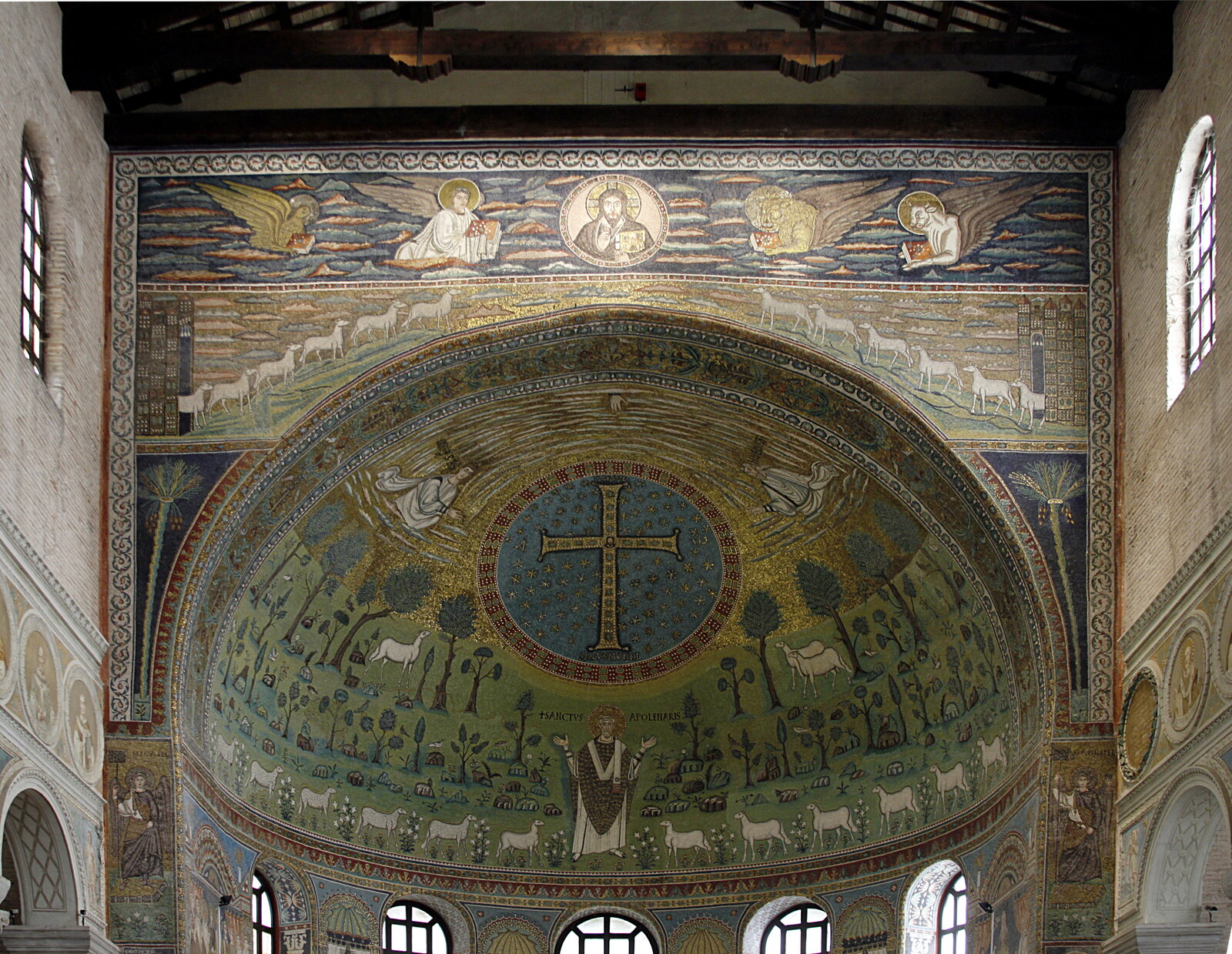
The Heavenly Jerusalem
Triumphal Arch, Sant'Apollinare in Classe
Doctrinal reflection
There is a city ahead, and it is real.
Above the apse of Sant'Apollinare in Classe, on the triumphal arch, a small bearded Christ sits in a medallion at the center. Below him, two cities: HIERVSALEM on the left, BETHLEEM on the right. Out of each city's gate comes a flock of sheep, six on each side, walking toward Christ. The Latin labels are still legible 1,400 years later. The sheep are believers. The cities are not metaphor.
Revelation 21:2: "And I John saw the holy city, new Jerusalem, coming down from God out of heaven, prepared as a bride adorned for her husband." The 6th-century mosaicists at Classe did not treat that verse as imagery. They treated it as a place. They put it on the arch and they put the believers walking toward it.
Notice the pairing. Jerusalem and Bethlehem. The city where Christ was crucified and the city where Christ was born. The mosaicists understood that the believer's path runs through both. You cannot get to the heavenly Jerusalem without passing through Bethlehem (the incarnation) and through Jerusalem (the cross). The sheep emerge from both gates because the journey requires both gates.
Hebrews 11:13–16 describes the saints of Israel: "These all died in faith, not having received the promises... they desire a better country, that is, an heavenly: wherefore God is not ashamed to be called their God: for he hath prepared for them a city." He hath prepared for them a city. Past tense. The city is already built. The arch at Classe is its picture.
When you preach the believer's hope, do not flatten it to "going to heaven" in some abstract sense. The Bible promises a city. A real city. With gates and walls and a King at its center who knows your name.
The sheep at Classe were going somewhere specific. So are we.