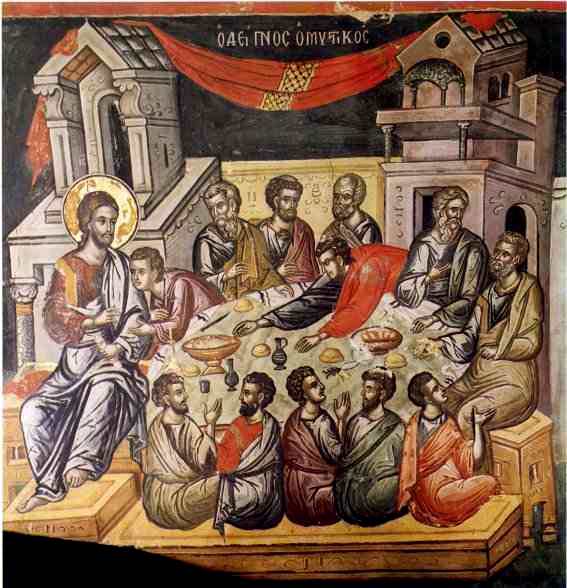
The Mystic Supper (Last Supper)
Fresco / Icon Panel by Theophanes the Cretan, 1546 — Stavronikita Monastery, Mount Athos
Doctrinal reflection
Christ sits at the center of a curved table, the twelve apostles around him. John leans on Christ's chest (John 13:23 — the disciple whom Jesus loved... lying on Jesus' bosom); Judas across the table reaches into the dish (Matt 26:23 — He that dippeth his hand with me in the dish, the same shall betray me). Bread and chalice on the table. The composition is post-Byzantine Cretan-school by Theophanes Strelitzas, 1546, at Stavronikita Mount Athos — the corpus's third Stavronikita entry alongside #foot-washing-stavronikita (#62) and #christ-before-pilate-stavronikita (#93). Stavronikita 3/4. This is the corpus's first dedicated Collection 9 (Liturgical) entry from the Stavronikita program.
The Collection 9 framework anchored — three rules in alignment. The corpus's locked Collection 9 reading (memorial-view + ministering-not-mediating + ordinance-not-sacrament) applies cleanly to Last Supper iconography. Memorial view (1 Cor 11:26 — as often as ye eat this bread, and drink this cup, ye do shew the Lord's death till he come): the Last Supper iconography is the visual memorial of the institution; the bread and cup proclaim Christ's death. Ministering not mediating: the apostles around the table are receiving from Christ, not mediating Christ to one another. The icon does not put any apostle in a priestly-mediating role; Christ alone distributes. Ordinance not sacrament: the Cretan-school painter renders the institution-moment, not a re-presentation of the sacrifice; what's instituted is a do this in remembrance of me practice (Luke 22:19), not an ongoing sacrificial mediation.
The three-step move (locked at #30 Hosios Loukas Theotokos). Identify the Byzantine/Catholic real-presence claim implicit in the iconography (the Last Supper iconography is read across Eastern and Western traditions as the ontological-instituting moment of the Eucharistic-real-presence sacrament). Distinguish GLM's memorial view (1 Cor 11:26 — proclamation; the Spirit, not the elements, mediates Christ's presence). Affirm the shared foundation (the incarnation is real; Christ truly instituted the table; the table belongs to the gathered community as ordinance).
The compositional theology — Christ at the center, Judas across. The compositional structure is doctrinally precise. Christ sits at the visual center; eleven apostles flank him in trust-fellowship; Judas alone reaches across the table from the outside of the close-fellowship semicircle, his iconographic position registering his inward-betrayal. The eye-line-as-doctrine principle (locked at #72 Climacus) operates here: viewer's eye runs to Christ at the center; the betrayer's gesture pulls attention to the dish; the institution-moment proceeds despite the betrayer's presence. Christ instituted the supper knowing the betrayer was at the table. Luke 22:21–22 makes this explicit — "Behold, the hand of him that betrayeth me is with me on the table".
Theophanes the Cretan's iconographic restraint. Theophanes (c. 1490–1559) is one of the most-documented post-Byzantine masters; the Stavronikita program is his fully-attributed catholic-decoration. His compositional discipline holds the Byzantine iconographic core (Christ at the center; the institution-moment; the betrayer iconographically marked) while allowing some Western Renaissance influence in the figural modeling (noted by historians as visible in the apostles' faces and drapery). The corpus reads the Western influence as iconographic-vocabulary import (analogous to the Vienna Genesis classical-personifications, locked at #108 Paris Psalter): the iconographer borrowed visual conventions without compromising the doctrinal content.
The Stavronikita program at 3. The corpus's three Stavronikita entries form a Passion-Liturgical triad: foot-washing (Collection 9, the institution of mutual-service in John 13) → Last Supper (Collection 9, the institution of the table in Matt 26 / Luke 22) → Christ before Pilate (Collection 5, the betrayer's act consummated in the trial). The doctrinal arc runs from John 13's foot-washing through the supper's institution to the trial's verdict — the foot-washing happens; the supper happens; the trial happens; all in the same night. Lock A's three-entry-gap activates after this 3-from-non-consecutive cluster.
Christ is at the center. The apostles are around him. The bread and cup are on the table. The betrayer is at the table. The supper is instituted. This do in remembrance of me; the memorial view holds the institution intact across 2000 years.