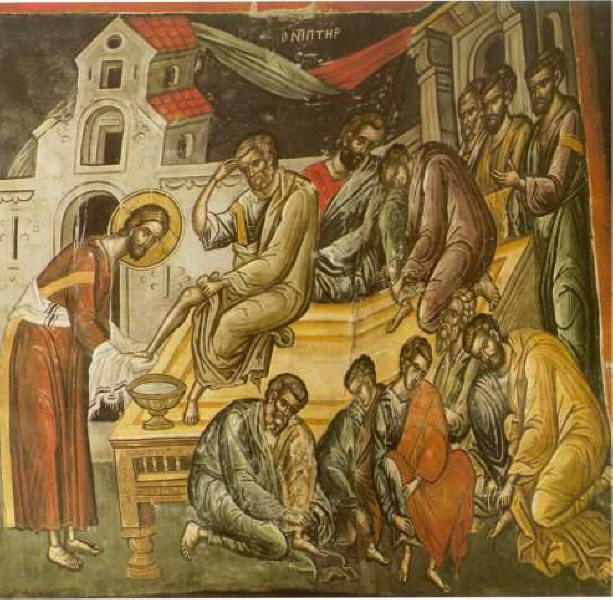
Christ Washes the Disciples' Feet
Fresco by Theophanes of Crete — Stavronikita Monastery, Mount Athos, 1546
Doctrinal reflection
Christ kneels. The disciples sit. He bends to the basin at his feet, hand on the foot he is washing. The disciples watch — Peter half-rising in protest, the others variously in postures of attention, confusion, deference. The composition is iconographically inverted from every other entry in this collection. Christ is the lowest figure in the scene.
This 1546 fresco at Stavronikita Monastery (Mount Athos) was painted by Theophanes the Cretan (1490–1559), the major painter of the Cretan school whose work continued the Byzantine iconographic tradition after Constantinople fell in 1453. Theophanes's frescoes at Stavronikita and the Lavra are reference templates for the Cretan school's continuation of the Macedonian Renaissance manner.
The scene depicts John 13:1–17. The night before his arrest, at the supper table, Christ rose, took off his outer garments, wrapped a towel around his waist, poured water into a basin, and began to wash the disciples' feet. Peter resisted: Thou shalt never wash my feet. Christ answered: If I wash thee not, thou hast no part with me. Peter then over-corrected: Lord, not my feet only, but also my hands and my head. Christ explained the sign and concluded with the institution sentence: If I then, your Lord and Master, have washed your feet; ye also ought to wash one another's feet. For I have given you an example, that ye should do as I have done to you (John 13:14–15).
Collection 9 has been building toward this. The disputed-sacrament arc has declined four medieval-Latin elaborations (auricular confession, sacramental matrimony, extreme unction, sacerdotal ordination), each structured as priestly figure conferring grace on the believer. The foot-washing inverts the structure. Christ on his knees with a towel and basin is the doctrinal opposite of the bishop in his cathedra with chrism and crozier. The lowest figure in the room is the Lord.
Same-ladder at maximum extremity. The corpus has located the Christian minister beside the believer rather than above. Here, Christ is beneath. Whosoever will be great among you, shall be your minister... For even the Son of man came not to be ministered unto, but to minister (Mark 10:43–45). The minister is not a higher rank; the minister is a servant. The Lord himself models it.
Horizontal-address, deepened. Brother Saul (#75) showed the apostolic vocabulary among believers. The foot-washing goes further: I have called you not servants... but I have called you friends (John 15:15). Christ's self-positioning is friendship, with himself in the lower place.
Asymmetric attention. Peter cannot receive what Christ initiates. Thou shalt never wash my feet — Peter resists the inversion. Christ persists: If I wash thee not, thou hast no part with me. Grace is initiated by Christ; the disciple's resistance does not negate it. Peter's over-correction (not my feet only, but also my hands and my head) shows the human instinct to multiply asymmetric grace into a transaction we can manage. Christ refuses the over-management: one washing. The grace is sufficient.
Built-on-top-of decline. Some traditions ritualize foot-washing approaching sacramental status (Roman Catholic Maundy Thursday, Eastern Orthodox episcopal observance, some Anabaptist communities). The corpus affirms the biblical command (ye also ought to wash one another's feet, John 13:14) without ratifying any tradition's elevation of it into a grace-conferring sacrament. The command is what remains: do as I have done to you.
Compositional theology. The eye-line descends. The disciples look down at Christ; Christ looks down at the foot in his hand. The downward gaze is doctrine. Where every other Collection 9 iconography directed the viewer's eye up to the apex Lamb (#68), or toward the table (#69, #71), or toward Christ healing (#74) and commissioning (#75) — the foot-washing directs the eye down to where Christ has gone for us. The lowest place is where the Lord is.
The disputed-sacrament arc closes with Christ on his knees. Eight Collection 9 entries name what every Christian ordinance is for: do as I have done to you. Every sacrament-claim built on top of every biblical practice, this scene unmakes by inversion. The Lord stooped. The Lord washed. The Lord said do likewise.
We come to the table on our feet. Christ kneels at our feet. We rise from the table to kneel at one another's.