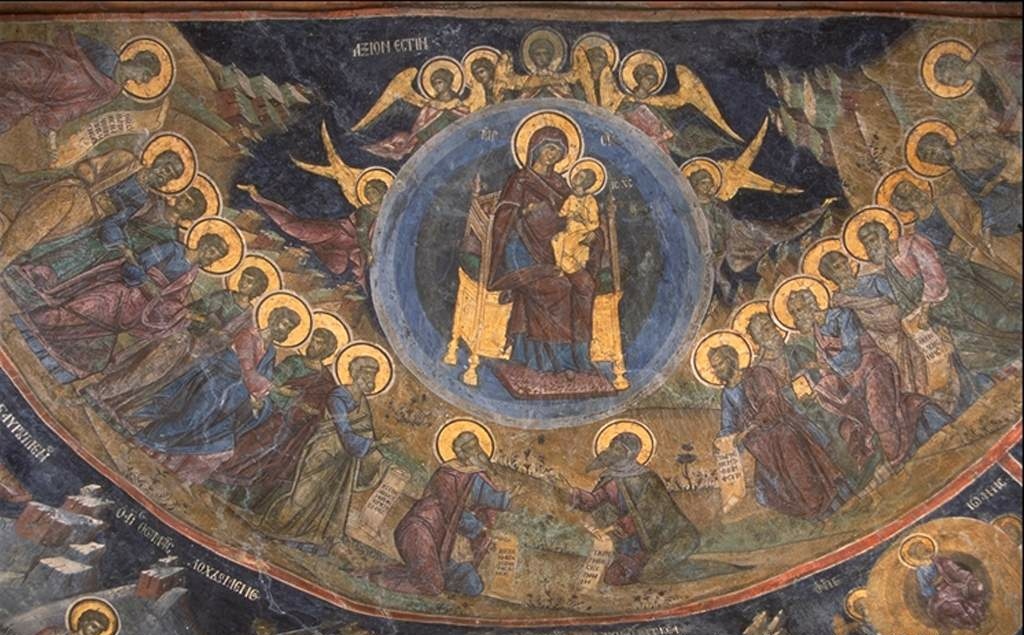
The Cozia Monastery Mural Program
Late 14th-Century Frescoes (with 16th-c. Renewal), Cozia Monastery, Wallachia, Romania
Doctrinal reflection
Cozia Monastery's fresco program was begun under Voivode Mircea I the Elder (r. 1386–1418), the founder of the Wallachian principality's first major iconographically-decorated church, and was continued through the 16th–18th centuries. The composition shown here renders one register of the program — a section of the wall-painting that combines Christological narrative scenes with portraits of saints in the apostolic-witness register. The corpus's fifth Romanian entry alongside Voroneț (×2) and Sucevița. Cozia opens as fresh Romanian site; Romania broadens to 3 sites.
Wallachian iconographic transmission. Mircea I the Elder's late-14th-century reign was the foundation period of Wallachian Orthodox iconographic patronage. Cozia was the period's first major monastic foundation; the iconographic program was executed by Constantinopolitan-trained or Constantinople-trained masters — Wallachia's iconographic tradition was iconographically continuous with the late-Byzantine center. The corpus reads this transmission under the iconographic-survival principle (#70): late-Byzantine iconography survived in Wallachian rural-monastic context through the period of Ottoman pressure on Constantinople (Constantinople fell 1453, just 35 years after Mircea's reign). The Cozia program is one of the few late-14th-century Wallachian iconographic programs to survive — most contemporary Wallachian iconography was destroyed by later wars or rebuildings.
The Cozia Epitaphios — Collection 9 anchor (referenced). Cozia is also famous in scholarship for its epitaphios — the embroidered liturgical cloth gifted to the monastery by Mircea I (c. 1396), now considered the oldest dated epitaphios with historical figures incorporated alongside the celestial figures. The corpus's Collection 9 framework reads epitaphios iconography under the locked three-rule reading (memorial-view + ministering-not-mediating + ordinance-not-sacrament). The epitaphios is a Eucharistic-related liturgical object — used during the Holy Friday and Pascha services to render Christ's burial visible to the gathered congregation. The corpus reads it as memorial-view: the iconography proclaims Christ's death and burial; the cloth does not re-perform his death-and-burial sacramentally. The Pillar 2 framework (locked at #30 Hosios Loukas Theotokos) holds.
Mircea I's patronage and the Collection 7 named-decline applied. Mircea I's iconographic donations to Cozia (the church program, the epitaphios, the relic-frames) were the typical aristocratic-elite-patronage register that the corpus has handled through the named-decline rule. The corpus reads patronage iconography (donor-portraits, founder-frescoes) carefully: affirm the historical-witness of patrons who funded iconography that taught the gospel; decline the doctrinal expansion that turns the patron's iconographic self-inclusion into mediating-presence in the church's liturgy; refuse the iconoclast counter-overreach that would erase patrons from iconography altogether. The Cozia program includes Mircea I's portrait holding a model of the church — donor-iconography rendered in the apostolic-historical-witness register without sliding to mediating-cult.
Romania at 3 sites. The corpus's three Romanian sites (Voroneț, Sucevița, Cozia) span the late-14th to early-17th century — three generations of Wallachian and Moldavian iconographic patronage. The painted-monastery exterior tradition documented at Voroneț and Sucevița (#106 Lion-Dragon, #134 Sucevita-program) is partly contemporary with Cozia's interior fresco tradition. Romania region count: 4 entries / 3 sites. Within site-ceiling discipline.
The transmission moment. Mircea I's reign was the consolidation of the Wallachian principality as an Orthodox Christian polity under Ottoman pressure. The iconographic program at Cozia was both theological catechesis and political-religious identity-formation — Wallachia under Mircea declared itself an Orthodox-Byzantine successor-state. The corpus reads this carefully: the iconographic content was apostolically grounded; the political framing (Mircea-as-Orthodox-defender) was secondary. The corpus does not lionize Mircea as a Christian hero (his rule included violence as Ottoman vassalage required); the corpus reads the iconographic patronage's doctrinal substance.
Cozia was founded in 1387. Mircea endowed the church program. The iconography rendered the gospel for a generation of Wallachian Orthodox under Ottoman pressure. The painted walls survived 600+ years. The Iconographic-survival principle operates again at the regional-political-transition level.