The Heavenly Liturgy
Main Dome Fresco, Gračanica Monastery, Kosovo (Serbia) — c. 1320
Doctrinal reflection
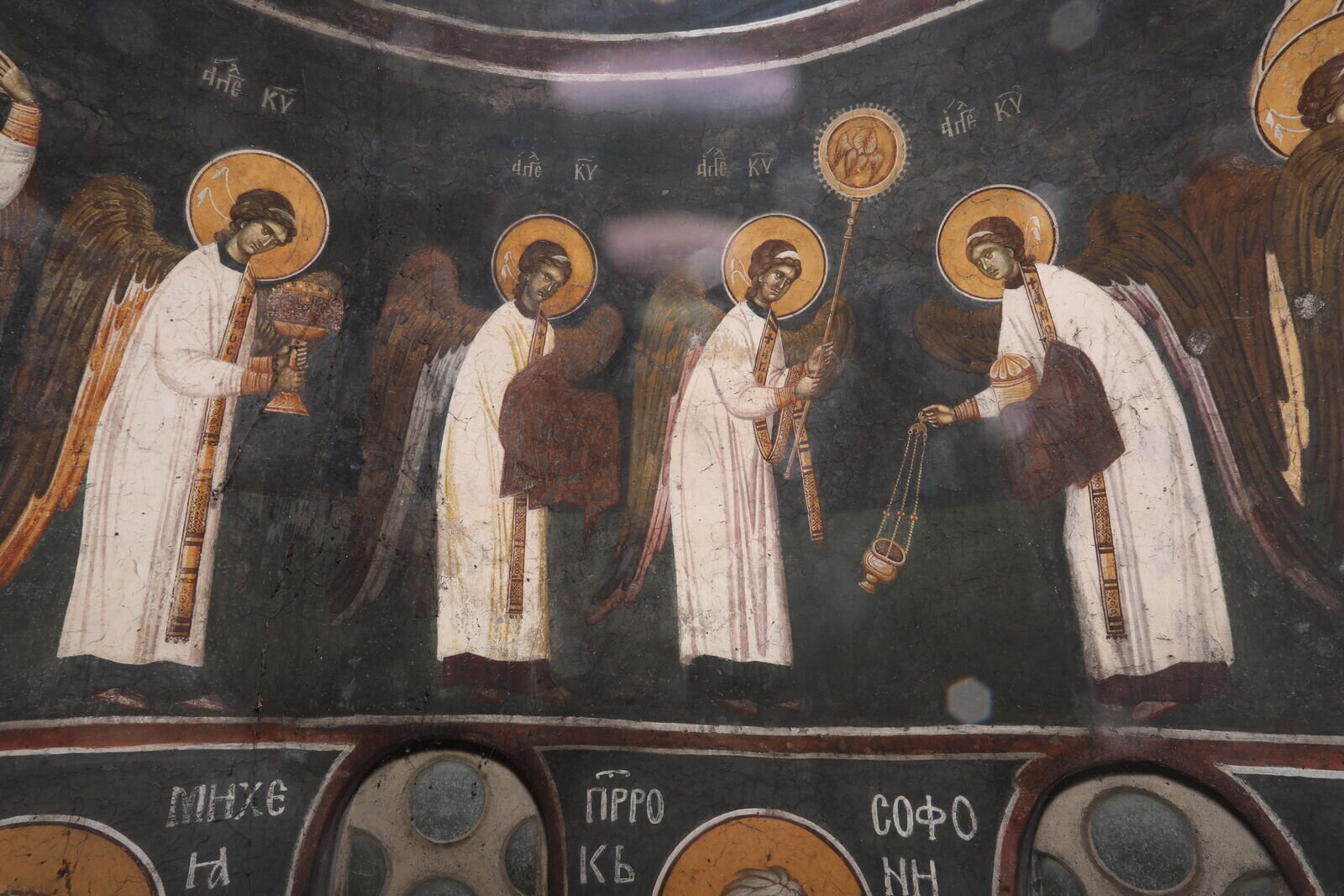
The dome curves over the church's central crossing. At the apex, Christ as high priest in priestly vestments stands behind a heavenly altar, the chalice and paten before him. Around the dome, in concentric procession, angels move toward the altar — angels in white deacons' robes with liturgical fans, angels carrying the gospel-book, angels swinging censers, angels bearing the prepared eucharistic gifts. The composition is the Heavenly Liturgy (Greek Theia Leitourgia), the iconographic type that renders Christ at the altar of heaven concelebrating with the angelic host. Gračanica's main-dome fresco, c. 1320, is one of the most extensive surviving examples in the Byzantine and Slavic-Orthodox tradition.
Collection 9 framing rules cascade. The corpus's tripartite Collection 9 framework (locked at #68 Santi Cosma e Damiano apex Lamb): memorial-view (the heavenly liturgy is the eternal reality of which the earthly memorial proclaims a participation by faith — 1 Cor 11:26 until he come; the dome composition holds the future-eternal alongside the present-earthly); ministering-not-mediating (the angels in deacons' robes serve at the altar but do not mediate; Heb 1:14 ministering spirits, sent forth to minister for them who shall be heirs of salvation; locked at the Collection 8 framing rule and the #91 Mileševa White Angel anchor); ordinance-not-sacrament (Christ-as-high-priest is the high priest, Hebrews 7:24–28; the Heavenly Liturgy iconography preserves this — there is one priest at the altar of heaven, not a class of priests; the medieval Latin in persona Christi sacerdotal-mediation apparatus was built on top of this scene rather than carried by it).
Hebrews 8:1–2 anchors the composition. "We have such an high priest, who is set on the right hand of the throne of the Majesty in the heavens; a minister of the sanctuary, and of the true tabernacle, which the Lord pitched, and not man." The Gračanica iconographer renders the true tabernacle — the heavenly sanctuary where Christ ministers as high priest — and places it overhead in the dome, above the gathered congregation in the church below. The compositional argument is architectural: the church's earthly liturgy is gathered under the heavenly liturgy; the priestly action below is participation by faith in the priestly action above; the altar in the church and the altar in the dome are the same altar in two registers.
Christ as the only high priest (Heb 7:24–28). "But this man, because he continueth ever, hath an unchangeable priesthood. Wherefore he is able also to save them to the uttermost that come unto God by him." The Heavenly Liturgy iconography refuses any reading that would multiply Christ's priesthood. The angels do not concelebrate as fellow-priests; they assist as ministering spirits. The earthly church does not concelebrate as a fellow-priesthood; it participates by faith in the priesthood already accomplished. Hapax (Heb 7:27) — once for all — is the corpus's standing word against any priestly-multiplication apparatus.
Anti-sacerdotal pattern-match. The corpus's four-piece anti-mediation architecture (locked at #88 Met Koimesis) declines the human-mediation expansion across saints, Theotokos, and angels. The Heavenly Liturgy iconography functions as the positive-construction companion: not who is mediating but who is the only priest. Christ is the high priest of the heavenly altar; everyone else — angels, apostles, congregation — receives, ministers, attends. The Gračanica fresco is the iconographic argument for what the corpus has been articulating verbally.
Serbia at 3. Mileševa White Angel (#91), Visoki Dečani Cleansing of the Temple (#101), Gračanica Heavenly Liturgy (#102). Three of the four major medieval Serbian fresco programs the curated candidate list named. The Serbian Orthodox iconographic tradition — Palaeologan in style, Slavic in cultural register — preserves Byzantine doctrinal continuity across two centuries (c. 1230–c. 1340) of high-quality fresco production.
Christ stands at the heavenly altar. The angels minister. The earthly church receives the gifts of the once-for-all sacrifice. We do not concelebrate; we worship.