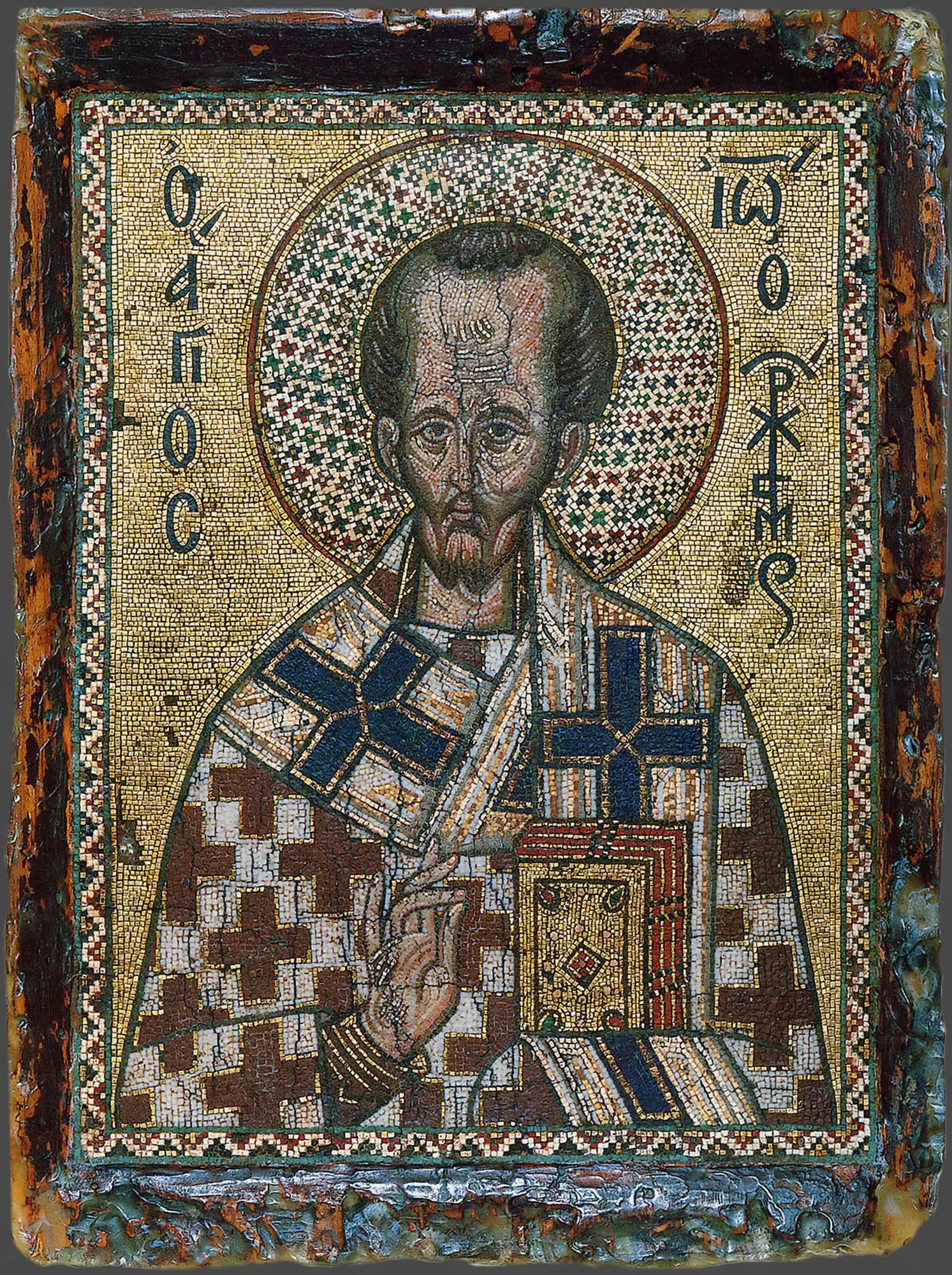
Saint John Chrysostom
Micro-Mosaic Icon, 14th century, Constantinople — Vatopedi Monastery, Mount Athos
Doctrinal reflection
Saint John Chrysostom is rendered in episcopal vestments — the sakkos (the imperial-derived bishop's tunic) embroidered with cross-patterns; the omophorion (the bishop's pallium-equivalent) draped over the shoulders. He holds a gospel-book in his left hand; his right hand is raised in the speaking-gesture characteristic of Byzantine episcopal iconography. Greek inscription identifies him: Ο ΑΓΙΟC ΙΩΑΝΝΗC Ο ΧΡΥCΟCΤΟΜΟC (the Holy John the Golden-Mouthed). The icon is a micro-mosaic — a 13 × 18 cm panel where the iconography is rendered not in paint but in tiny vitreous-paste tesserae set in wax. The micro-mosaic medium was the most luxurious portable-iconographic medium of the Palaiologan era. The icon is at Vatopedi Monastery, Mount Athos. Vatopedi 2/4. Mt Athos region growing. Micro-mosaic opens as a fresh medium category in the corpus.
Chrysostom-as-Liturgist anchors Collection 9 routing. John Chrysostom (c. 347–407) is canonically remembered for two things: his preaching (the Greek epithet Chrysostomos = Golden-Mouthed) and his liturgical composition — the Divine Liturgy of Saint John Chrysostom is the standard Eucharistic liturgy of the Byzantine Orthodox tradition since the 5th century, used in roughly 80% of Sundays and weekdays in Eastern Orthodox worship. The corpus's Collection 9 framework reads the iconography under the Chrysostom-as-Liturgist register: the saint who shaped how the church gathers at the table.
The corpus's locked Collection 9 reading applied. The three-rule framework (memorial-view + ministering-not-mediating + ordinance-not-sacrament): Chrysostom's liturgical work was systematizing and transmitting the apostolic Eucharistic tradition; his liturgical text is itself memorial-and-thanksgiving framed (the Anaphora prayer remembers Christ's sacrifice and asks the Spirit's descent on the gathered community). The corpus reads Chrysostom's iconography respectfully — affirm the historical-witness of his liturgical leadership; decline the medieval-Catholic-and-Eastern-Orthodox doctrinal expansion that turned the Chrysostom-liturgy as celebrated into a re-presentation of Christ's sacrifice; refuse the iconoclast erasure that would remove Chrysostom from iconography altogether.
Chrysostom's preaching — the apostolic-witness register. Chrysostom's homiletic legacy includes hundreds of expository sermons on Pauline letters, the gospels, Acts, and OT books. His exegesis is overwhelmingly plain-meaning and Christ-centered; his sermons regularly reach the congregation with practical-ethical application of the apostolic text. The corpus's locked sola Scriptura framework reads Chrysostom's exegetical legacy positively: he is one of the patristic-tradition authorities who did the work of expounding scripture in a manner the Reformation could affirm without major reservation. The 14th-century iconographer's compositional choice — gospel-book in left hand, speaking-gesture in right hand — renders Chrysostom's apostolic-witness role: he held the apostolic text, he spoke it to the church.
The micro-mosaic medium and the Collection 7 named-decline. Micro-mosaic icons were luxury-portable devotional objects produced for elite patronage. The corpus's named-decline rule (locked corpus-wide since #43) handles the elite-patronage register: the icon's iconographic content is doctrinally legitimate (Chrysostom-as-witness, gospel-book-as-apostolic-text); the cult-veneration that grew at the elite-monastic context can slide into the Nehushtan-trajectory (the icon-as-relic-of-power) which the corpus declines. The Vatopedi monastic context is where this discipline matters most — Mt Athos is the historical center of Byzantine icon-veneration intensity, and the corpus's Reformation-aligned discipline reads what the iconography teaches without participating in the veneration-cult that grew around the icons.
Athos region note for end-of-day review. Mt Athos at 5 entries / 2 sites (Vatopedi 2 + Stavronikita 3). Region count assessment depends on whether Athos = single region (then 5/4 = inflation) or each Athonite monastery = independent site (then each within site-ceiling). Surface for Pastor Charlie's adjudication; the Athos region question parallels the Italy and Constantinople region questions deferred earlier.
Chrysostom held the gospel-book. He spoke its meaning. He composed the liturgy that the church still prays in his name. The micro-mosaic at 13 × 18 cm preserves the apostolic-witness-register portrait. He being dead yet speaketh (Heb 11:4) — Chrysostom's preaching speaks through 1600 years to whoever opens his sermons or worships through his liturgy.