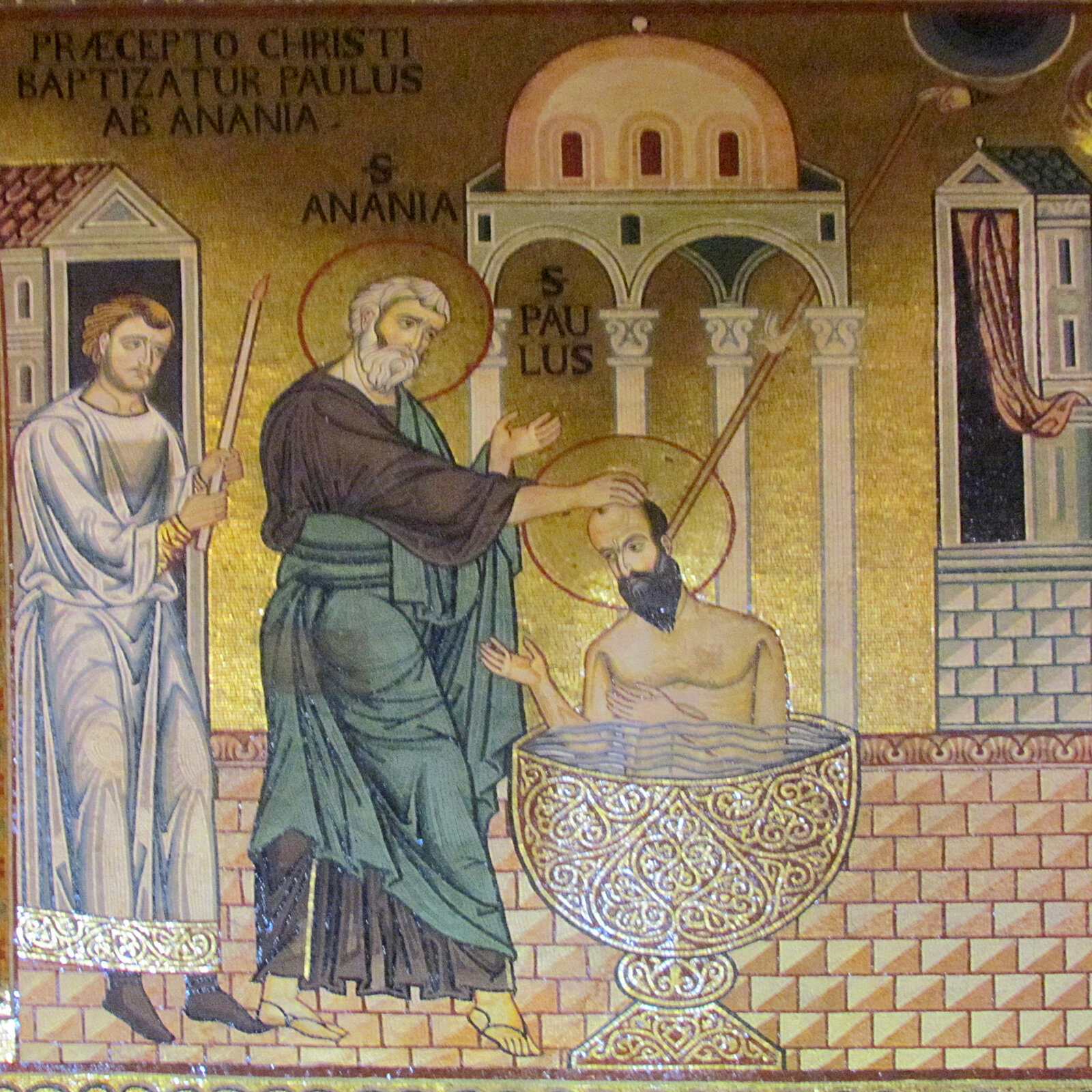
Ananias Lays Hands on Saul
Cappella Palatina, Palermo — c. 1140–1170 (Pauline cycle, south aisle)
Doctrinal reflection
Ananias stands on the left, hand outstretched, fingers on Saul's head. Saul kneels in the center, blinded, in a baptismal posture beside a font. Disciples watch behind. The mosaic is from the Pauline cycle in the south aisle of the Cappella Palatina, the royal chapel of Roger II of Sicily, c. 1140–1170 — Byzantine and local mosaicists working in concert.
The scene depicts Acts 9:17–18: "And Ananias went his way, and entered into the house; and putting his hands on him said, Brother Saul, the Lord, even Jesus, that appeared unto thee in the way as thou camest, hath sent me, that thou mightest receive thy sight, and be filled with the Holy Ghost. And immediately there fell from his eyes as it had been scales: and he received sight forthwith, and arose, and was baptized."
This is the iconography that closes Collection 9's disputed-sacrament arc — and it does so by undercutting the strongest claim the medieval Latin tradition built on the laying-on of hands. Ananias was not an apostle. Acts 9:10 names him with the Greek tis mathētēs en Damaskō, onomati Ananias — "a certain disciple at Damascus, named Ananias." Not an apostle. Not a bishop. Not part of any apostolic-succession chain. A certain disciple. And yet this disciple — by direct command of the Lord (Acts 9:11–16) — went to Saul, laid hands on him, restored his sight, prepared him for the Spirit's filling, and baptized him. Saul of Tarsus, the persecutor, became Paul, the apostle to the Gentiles, after a non-apostle's laying-on of hands.
The mosaic is iconographically faithful to the text. No halo of office on Ananias. No other apostles supplying his authority. No episcopal vesture marking him as a hierarch. He is a certain disciple doing what the Lord told him to do for a brother. The Palermo mosaicists, working a century after the East-West schism in Catholic Sicily, depicted Acts 9 as Acts 9 says it.
Translation-becomes-doctrine. The Greek cheirotonia (literally extending the hand) became Latin ordinatio by the Middle Ages, carrying hierarchical weight the Greek doesn't supply. New Testament cheirotonia is the church's recognition of those God has already called (Acts 14:23); medieval ordinatio became the priestly act transmitting indelible sacerdotal character through the bishop's hands in succession from the apostles.
Telos-reorientation. Biblical laying-on of hands is forward commissioning — sending someone for ministry (Acts 13:2). Medieval ordinatio is backward inheritance — receiving indelible character from the past chain. Same physical action; opposite telos. The biblical practice points outward toward the work; the sacramental apparatus points inward toward the lineage.
Built-on-top-of. Scripture commands laying-on of hands as recognition of God's calling, with the Holy Spirit as the actual giver of gifts (1 Cor 12:11). What was built on top: the doctrine that valid ordination requires an unbroken bishop-to-bishop chain back to the apostles, conferring character indelebilis on the soul. The text does not supply this; the apparatus was added.
The Ananias case is the structural counter-argument. If Ananias — a certain disciple, not an apostle, not in any chain — could lay hands on Saul and prepare him to become the greatest apostle, then the chain-of-touch doctrine fails on its own terms. The Lord chose to make his apostle through a non-apostle's hands. Apostolic-succession-by-touch is not the gospel structure. The Spirit goes where he wills (John 3:8); the Lord calls whom he wills (Acts 9:15); the laying-on of hands recognizes the calling, but the calling itself is the Lord's.
Same-ladder. Ananias is on the same ladder as Saul — Brother Saul, he says, not son or catechumen. The horizontal address is the doctrine. Priesthood-of-all-believers (1 Pet 2:9; Rev 1:6): the whole Christian community is priestly. Ordination is the church's recognition of those gifted for specific ministry (Eph 4:11–12), not elevation into a separate sacerdotal class.
The Cappella Palatina mosaicists put it on the wall plainly. A certain disciple went to Brother Saul and laid hands on him. Christ called Saul. Ananias ministered the sign. The work was the Lord's.
We lay hands on those the Lord calls. We do not transmit grace. The grace is from him.