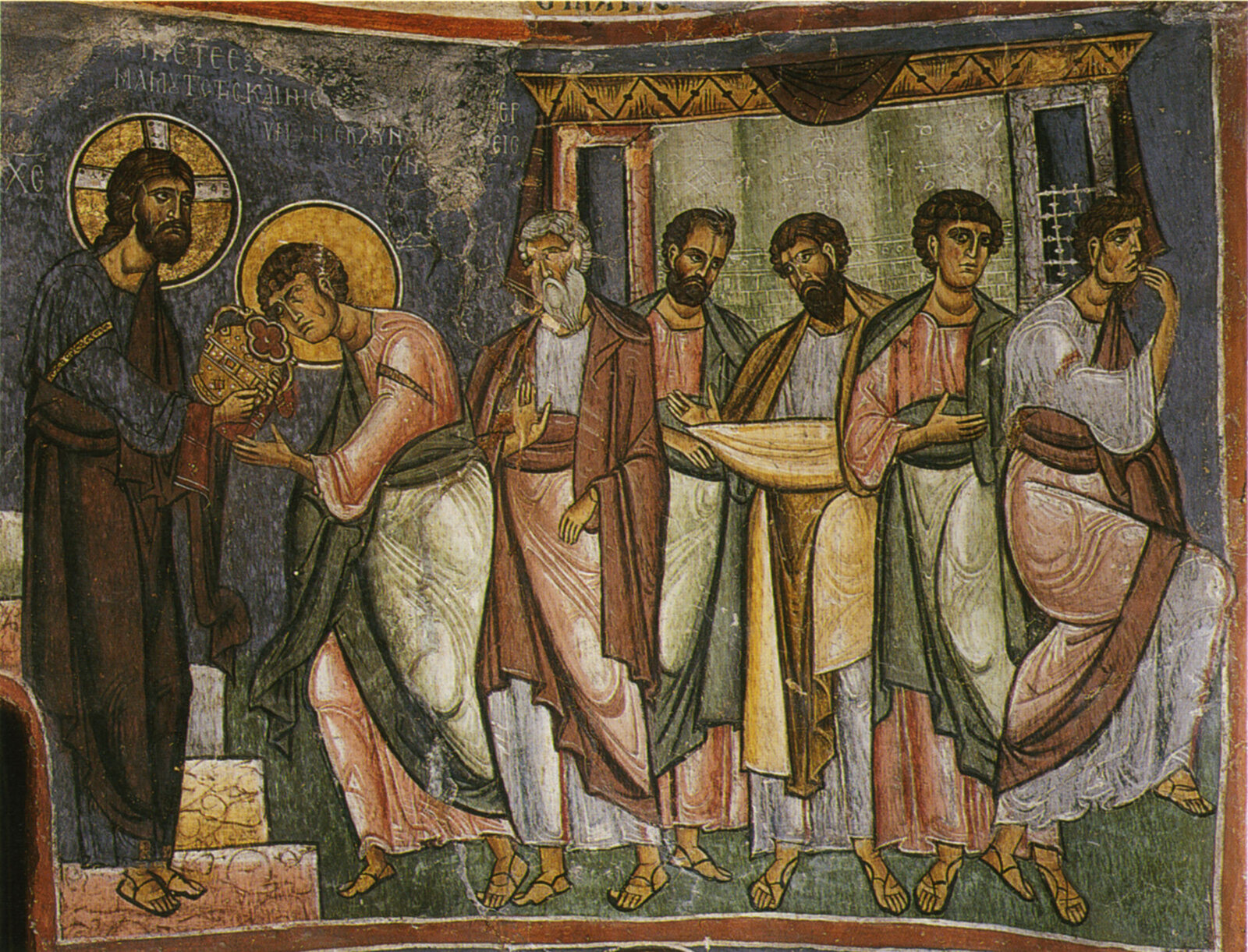
The Communion of the Apostles
Apse Fresco, Panagia tis Asinou (Panagia Phorbiotissa), Cyprus — 1106
Doctrinal reflection
Christ stands twice at the center of the apse. On the left side of the composition he distributes bread to a line of approaching apostles led by Peter; on the right side he distributes wine to a second line led by Paul. The altar between the two figures-of-Christ is covered with a fringed cloth, with the chalice and paten at the center. Six apostles approach from each side. Two angels in deacon's robes assist behind the altar, swinging censers. The fresco is in the apse of Panagia tis Asinou (Panagia Phorbiotissa) in the Troodos foothills of Cyprus, painted in 1106 — the consecration year inscribed in a donor inscription naming Nikephoros Magistros as the patron.
The iconographic type is Communion of the Apostles (Greek koinōnia tōn apostolōn). The corpus has already engaged it once at the 11th-century Saint Sophia, Kyiv apse (#apostles-communion-kyiv). Asinou renders the same composition in fresco rather than mosaic, in a small village church rather than an imperial cathedral, but the iconographic argument is structurally identical: Christ depicted twice — once distributing bread, once distributing wine — to apostles in two converging processions, with the altar between his two figures.
Collection 9 framing rules apply. The corpus's tripartite Collection 9 framework (locked at #68 Santi Cosma e Damiano apex Lamb) cascades cleanly: memorial-view (1 Cor 11:23–26 — do this in remembrance of me; the apostles receive in remembrance, not in re-presentation); ministering-not-mediating (the angels-as-deacons assist; they do not mediate; #91 Mileševa established the angel-as-messenger framework); ordinance-not-sacrament (Christ commanded the practice; the apostles received; the medieval-Latin in persona Christi sacerdotal-mediation apparatus was built on top of this scene rather than carried by it). Asinou shows the gospel scene; subsequent eucharistic theology was layered over it.
Christ-twice as compositional argument. Why does the iconographer show Christ twice? Not because there are two Christs, but because the iconographic composition compresses two distinct gospel actions (bread-distribution and wine-distribution) into a single panel. The same Christ gives the bread; the same Christ gives the cup. The duplication renders the simultaneity of the institution. The 16th flagship's unity-of-attributes logic (#84 Bawit) silently applies — one Christ across both halves of the composition — though the entry does not foreground the flagship.
Memorial-view origin. The 10th flagship (memorial-view as original-not-recovered, anchored at #71 Sant'Apollinare Nuovo Last Supper) holds: eis tēn emēn anamnēsin (1 Cor 11:24) is the institution sentence for the entire memorial position; memorial-view did not begin with the Reformation; it began at the table itself. The Asinou fresco is the iconographic continuation of that institution. The apostles in the fresco receive in remembrance — they do not mediate, they do not concelebrate the sacrament, they are not depicted as the foundational priestly class through whom the eucharist must descend. They receive what Christ gives. The corpus reads what the iconography depicts.
Cyprus opens to 2. The corpus's first Cyprus entry was Panagia tou Arakos Pantocrator (#pantocrator-panagia-arakos). Asinou is the second. Both are 12th-century Komnenian Byzantine programs in Cypriot rock-and-mountain monastic settings; both are UNESCO World Heritage. Cyprus's iconographic tradition extends Byzantine center-to-island geographically without doctrinal innovation — what was rendered at Constantinople and Kyiv was rendered at Asinou and Panagia tou Arakos in continuous tradition.
Iconographic continuity across two centuries. The same scene rendered at Saint Sophia, Kyiv (corpus #apostles-communion-kyiv) in the 11th century and at Asinou in 1106 testifies to the stability of the iconographic vocabulary across geographic and political distance. What Constantinople taught, Kyiv received, Asinou rendered, the corpus reads.
Christ gave the bread. Christ gave the cup. The apostles received. The church received from the apostles. The corpus receives from the church.