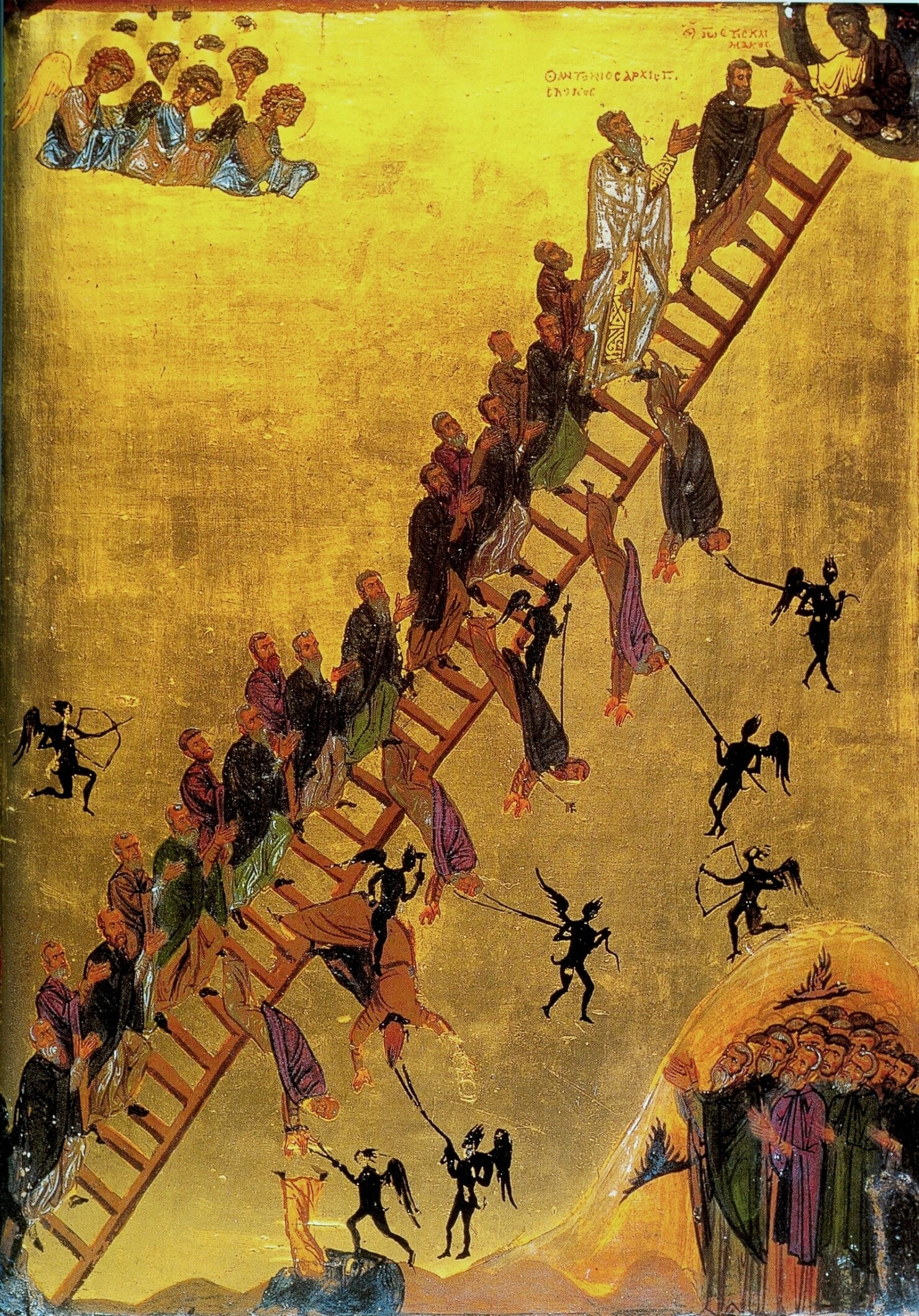
The Ladder of Divine Ascent
12th-Century Icon — Saint Catherine's Sinai (after John Climacus, c. 600)
Doctrinal reflection
A ladder of thirty rungs slants upward to Christ at the upper-right, who reaches out his hand to receive the climbing monk at the top. Monks in dark habits climb, eyes upward. Demons with hooks and ropes claw at them from beneath, pulling some off. Angels ring around Christ at the upper register, witnessing. At the foot, John Climacus stands robed, gesturing the climbers upward. "Brethren, the way is up."
This 12th-century icon at Saint Catherine's, Sinai, visualizes the Ladder of Divine Ascent (Klimax tou Paradeisou), written c. 600 by John Climacus, abbot of Sinai. The treatise is divided into thirty steps — one for each year of Christ's hidden life — each a vice to be put off or a virtue to be put on. It has been read in Eastern Orthodox monasteries every Lent for fourteen centuries.
Climacus teaches the monk to confess sins openly to a spiritual father — an experienced monastic who hears the confession, prays for healing, and offers counsel. The practice is real, ancient, and has produced genuine spiritual fruit across centuries. Climacus did not invent it; he received it from earlier desert tradition descending from scripture itself.
Confess your faults one to another, and pray one for another, that ye may be healed (James 5:16).
This verse is the institution sentence for Christian confession. **It commands mutual confession — one to another — not priest-mediated confession.** The Greek allēlois exomologeisthe is reciprocal: confess back and forth among one another. The verse is in a paragraph (James 5:13–16) about elders praying over the sick with anointing oil, and the one to another of confession sits in the same horizontal-fellowship register. The Christian community is priestly together (1 Peter 2:9; Revelation 1:6); confession is a practice between brothers and sisters in Christ.
The built-on-top-of distinction. The Klimax tradition of confession to a spiritual father is faithful to James 5:16 in its core: a brother in Christ hears, prays, counsels, witnesses healing. What was built on top — slowly, across centuries, then formally codified in the medieval Latin tradition (Lateran IV, 1215) and in parallel Eastern practice — was auricular confession to an ordained priest as the grace-conferring sacrament of penance, with the priest's absolution as the channel of divine forgiveness. The verse itself does not supply this; it was added.
What the corpus keeps: confession is real (sins concealed accumulate; sins confessed are dragged into the light and prayed over); the mature elder — pastor, mentor, fellow believer with proven discernment — is a gift to the believer's repentance; open confession produces healing (James 5:16 promises this).
What the corpus declines: confession to a priest as the necessary channel of forgiveness (1 John 1:9: "if we confess our sins, he is faithful and just to forgive us our sins" — the he is God, not the confessor); the doctrine of priestly absolution (Christ alone forgives sins, Mark 2:7); the Lateran-IV-mandated auricular confession to a parish priest as binding practice.
Ministering-not-mediating. The spiritual father stands where John the Baptist stood at #70 — beside the believer, attending the practice, not above the believer mediating grace. The spiritual father is a fellow climber on the ladder, perhaps further up, but on the same ladder. Christ at the top reaches out his hand. The forgiveness is from him.
Look at the icon again. Notice who the climbers are looking at. Not at Climacus at the foot of the ladder. Not at the angels around Christ. At Christ at the top. The composition's eye-line is doctrine: every monk on the ladder has his face turned toward the Lord at the top. The spiritual father at the foot teaches them to climb; the angels witness; the demons claw. But the ascent is to Christ, and the welcoming hand is his.
We confess to one another. We pray for one another. We climb together. The hand at the top is Christ's.
(Sinai 5-entry exception: Climacus was abbot at Sinai when he wrote the Ladder; the icon and the site are inseparable. Per the Hagia Sophia Seraphim precedent.)