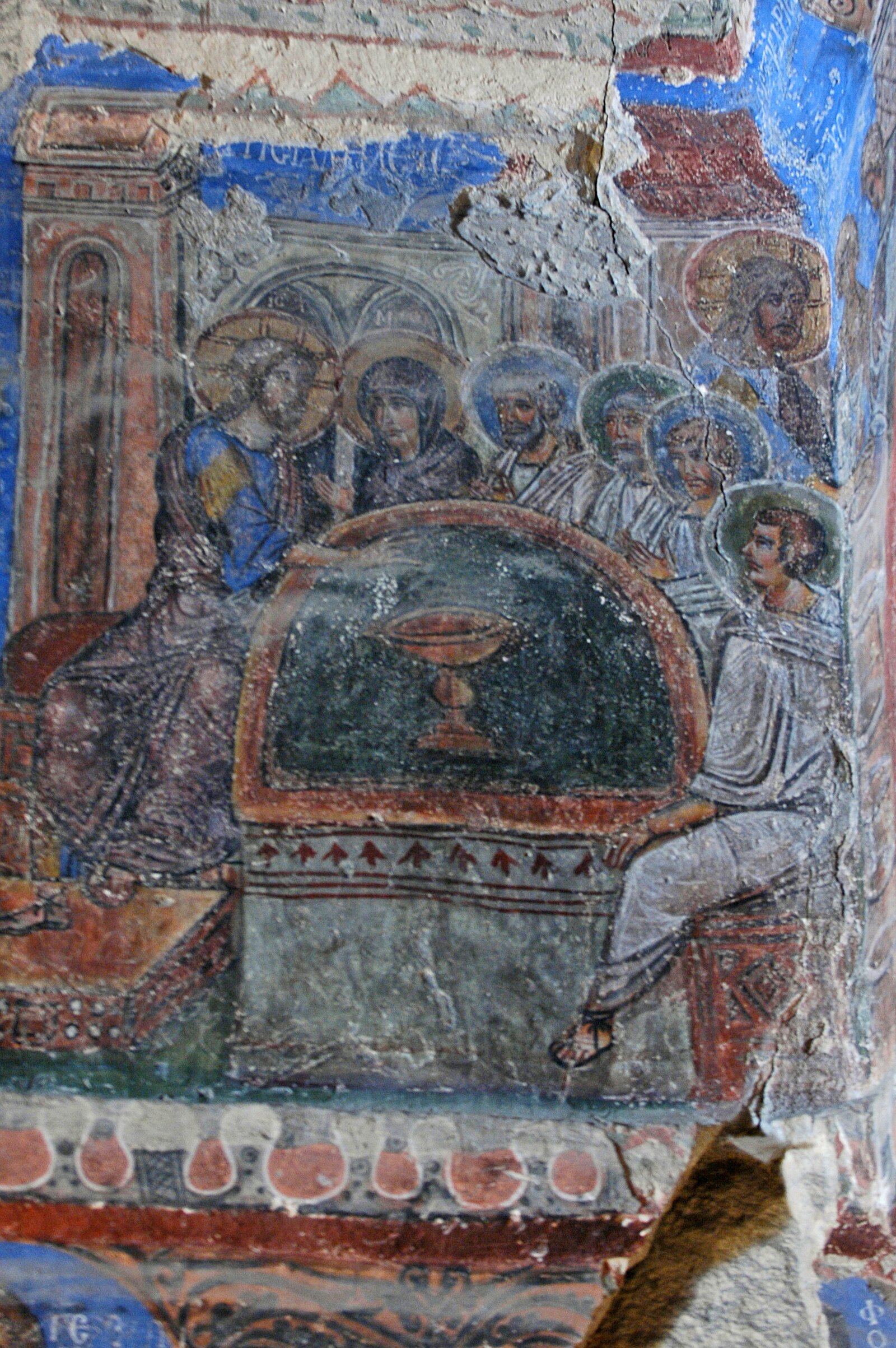
The Wedding at Cana
Fresco, Tokalı Kilise (the Buckle Church), Göreme, Cappadocia — c. 950–1000
Doctrinal reflection
Christ sits at the center of the table. The Theotokos sits at his right, leaning toward him. The bridegroom and bride are at the left end of the table, smaller in scale, eating. Six stone water-jars stand in the foreground; servants bend over them. To the side, the steward of the feast lifts a cup to his lips, tasting. The fresco is at the New Tokalı (Buckle) Church in Göreme, c. 950–1000 — a rock-carved Cappadocian basilica whose vivid pigments have survived a thousand years of cave-cool darkness.
The gospel scene (John 2:1–11) is the institution narrative for Christian marriage iconography. Christ went to a wedding. His mother told him the wine had run out. He turned six pots of water into wine. "This beginning of miracles did Jesus in Cana of Galilee, and manifested forth his glory; and his disciples believed on him" (John 2:11). The first sign of the public ministry was performed at a wedding, in honor of marriage.
Look at the composition's eye-line. The bride and groom are at the table, but they are not the center. Christ is. The fresco does not direct the viewer's eye to the marrying couple — it directs the eye to the Lord who came to honor the marriage. The compositional theology is exact: marriage is real, marriage is honored, but the One whose presence sanctifies the table is Christ. The wedding is for the bride and groom; the meaning is in the One who came.
What the corpus keeps from the iconography of marriage. Marriage is real, lifelong, and theologically weighty. They twain shall be one flesh (Genesis 2:24, quoted by Christ at Matthew 19:5). Marriage is a mystērion — the Greek word at Ephesians 5:32 — a great mystery — pointing beyond itself to the union of Christ and his church ("this is a great mystery: but I speak concerning Christ and the church," Eph 5:32 KJV). Christ's presence at Cana sets the seal on the entire institution. Where Christ honors a thing, the church honors it.
What the corpus declines. Mystērion is not sacramentum. The Vulgate translated mystērion as sacramentum at Eph 5:32, and the medieval Latin tradition built on that translation the doctrine that marriage between baptized Christians is a grace-conferring sacrament administered through the priest's blessing ex opere operato. The Greek supplies mystērion — sacred sign, hidden meaning, type pointing beyond itself — not sacramentum in the medieval grace-conferring sense. The translation became the doctrine; the doctrine was built on top of the translation.
Marriage biblically: a covenant between a man and a woman witnessed by God (Malachi 2:14); a type of Christ and the church (Eph 5:31–32); a gift Christ honored at Cana; a vocation of mutual love and lifelong fidelity (Eph 5:21–33). What it is not: a grace-conferring sacrament whose validity depends on sacerdotal action.
The minister at a Christian wedding is a witness to the covenant, not a mediator of marital grace. Same-ladder: the officiating minister is on the same ladder as the couple — perhaps further up in pastoral wisdom, perhaps a real gift — but on the same ladder. Christ at the top is the actual presence sanctifying the union. The minister attends.
Ministering-not-mediating. The Theotokos sits at Christ's right, leaning toward him — the one who told him the wine had run out (John 2:3) and told the servants whatsoever he saith unto you, do it (John 2:5). She names the need; Christ acts. Mary is not mediator of the miracle; she is the prototype of the praying friend who tells others to obey her Son. The composition keeps the order right.
The water in the stone jars becomes wine because Christ commanded it. The marriage between this couple becomes a Christian marriage because Christ honors it. In both cases the action is his, not the institution's, not the priest's, not even the bride and groom's at the deepest level — what God hath joined together (Matt 19:6). The verb is God hath joined.
We come to the table empty. Christ honors our covenant. The wine he gives is better than the wine before.