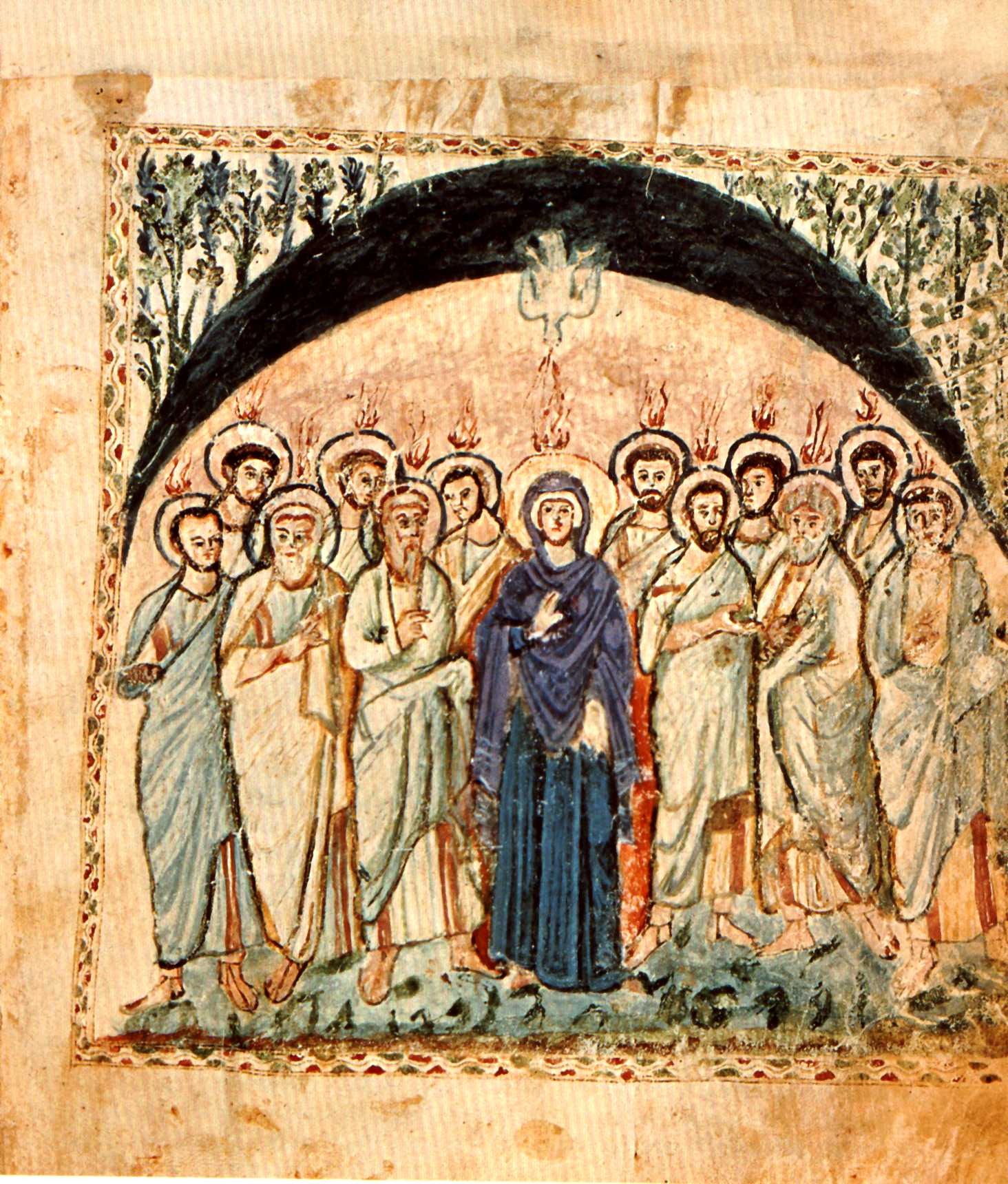
The Pentecost
Rabbula Gospels, fol. 14v — 586 AD, Zagba (Mesopotamia / Syria) — Biblioteca Medicea Laurenziana, Florence (MS Plut. 1.56)
Doctrinal reflection
The twelve apostles stand in a tight semicircle, the Theotokos at the center. Above them, the dove of the Holy Spirit descends through an arc of heavenly light; tongues of fire rest on each apostolic head. The composition renders Acts 2:1–4 with iconographic precision: "And there appeared unto them cloven tongues like as of fire, and it sat upon each of them. And they were all filled with the Holy Ghost." The folio is dated 586 by the manuscript's colophon, produced at the Monastery of Saint John of Zagba in Mesopotamia/Syria — the earliest surviving illustrated Pentecost iconography. The corpus's second Rabbula entry alongside the four-evangelists folio (#four-evangelists-rabbula). Rabbula manuscript at 2/3.
Collection 9 framework anchored at the iconographic origin. The Rabbula Pentecost is iconographically foundational — every later Byzantine Pentecost composition (the corpus has Hosios Loukas #pentecost-hosios-loukas and Georgian-enamel #pentecost-georgian-enamel) develops from this 586 prototype. The compositional vocabulary (apostles in semicircle, dove descending, tongues of fire) was already iconographically standardized by the late 6th century. The Iconographic-survival principle (#70) operates at the prototype-and-variation level: the doctrinal content was iconographically locked early, and 1500 years of subsequent iconography varies the surface details while preserving the doctrinal core.
The Theotokos at the center — an iconographic question. The Rabbula Pentecost places Mary at the center of the apostolic semicircle. Acts 1:14 names her among those gathered for prayer in the upper room before Pentecost; whether she was specifically present at Pentecost itself is not specified in Acts 2 but is patristic-tradition extension. The corpus's discipline applies the three-fence rule: affirm Mary's presence in the prayer gathering (Acts 1:14 names it); decline the doctrinal expansion that turns Mary's iconographic-central position into Mary's mediating role at Pentecost (the Spirit descended on each apostolic head, not on Mary alone or through Mary); refuse the iconoclastic erasure that would remove Mary from the iconography altogether. The Rabbula iconographer's compositional choice puts Mary at the geometric center, but the event — the Spirit's descent on each — is the iconographic content. Mary is in the room because Acts 1:14 places her there.
The ministering-not-mediating rule applied. The corpus's locked Collection 9 reading (memorial-view + ministering-not-mediating + ordinance-not-sacrament) operates here. The dove of the Spirit descends to each apostle directly; no apostle is shown receiving the Spirit and passing it to another. The compositional theology: the Spirit ministers to each individually; no one mediates the Spirit to anyone else. This is exactly the iconographic illustration of the priesthood-of-all-believers observation the corpus locked at #77 Georgian Pentecost enamel (cross-tradition convergence sub-observation). The 6th-century Rabbula iconographer rendered the doctrine compositionally 900 years before the Reformation articulated it verbally.
The Acts 2 anchoring. "And when the day of Pentecost was fully come, they were all with one accord in one place. And suddenly there came a sound from heaven as of a rushing mighty wind... And they were all filled with the Holy Ghost, and began to speak with other tongues, as the Spirit gave them utterance" (Acts 2:1–4). The Rabbula iconographer rendered three of the four key elements: the gathered apostles, the descending Spirit, the tongues of fire. The fourth (the speaking-in-other-tongues) is implied iconographically by the apostles' speaking-gestures and outward-facing stances — the gospel about to go forth from the upper room into the multilingual crowd outside.
The Syriac iconographic tradition — fresh institutional context noted. The Rabbula Gospels was produced in the Syriac Christian tradition (the manuscript's text is in Estrangela script, the classical Syriac liturgical script). The corpus has documented the Syriac thread (john-prochorus-armenian Xoranasat at #79 in Armenian-tradition; christ-menas-louvre at #128 in Coptic-tradition; this Rabbula entry in Syriac-tradition). The cross-tradition convergence sub-observation (locked at #77 Georgian Pentecost enamel) operates: scripturally-disciplined iconography in any tradition converges on the same doctrine because it is reading the same text. The Rabbula painter was Syriac; the iconography is apostolic; the doctrine is received across all subsequent Christian iconographic traditions.
The apostles were all in one place. The Spirit descended. The tongues of fire rested on each. The gospel went forth in tongues. Mary was in the room because Acts 1:14 puts her there. The Rabbula painter rendered what Acts says happened in the year 586 AD — the earliest surviving Pentecost iconography in Christian art.