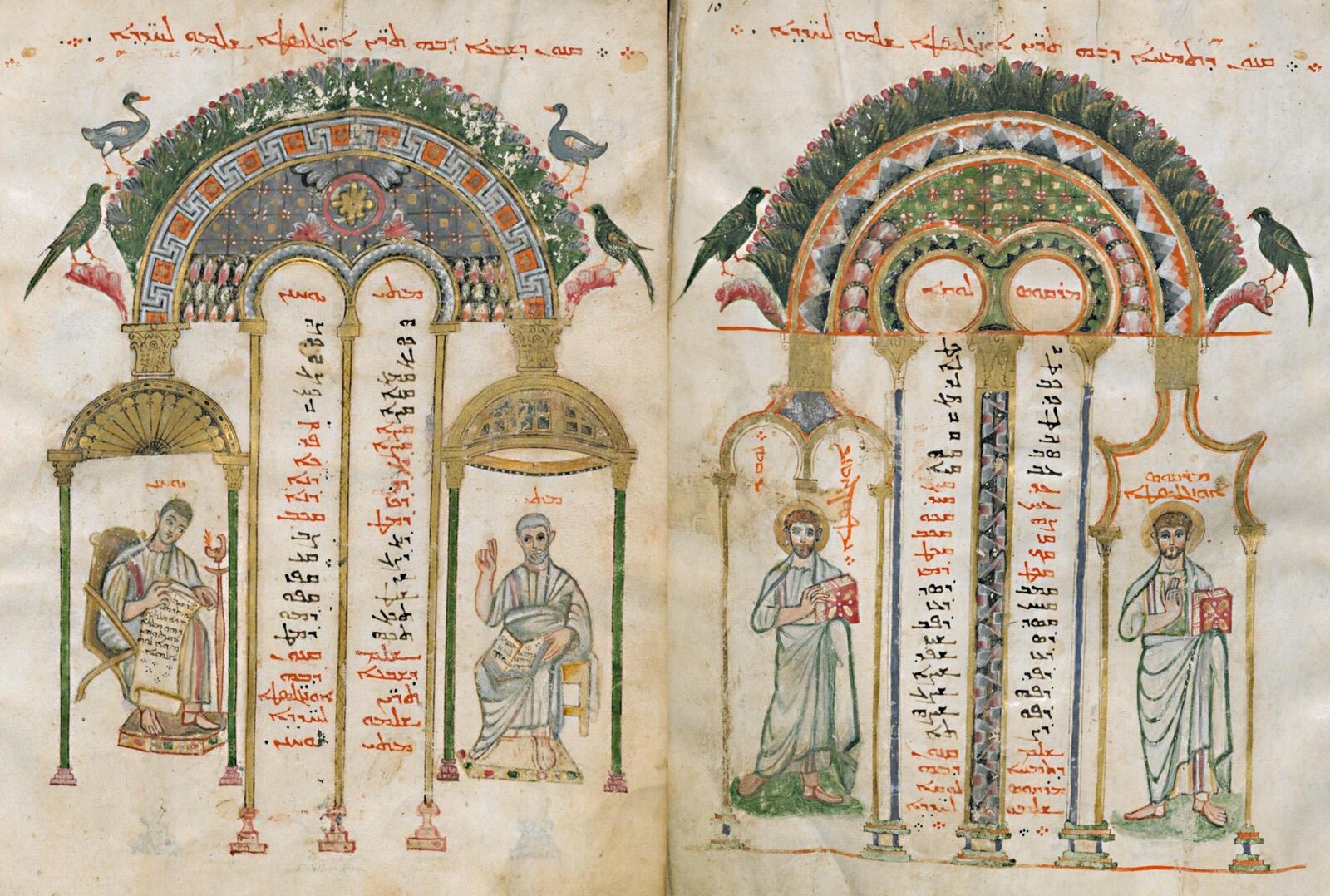
The Four Evangelists
Rabbula Gospels (586 AD), Folios 9v–10r
Doctrinal reflection
Look at the names. Then look at the gospels.
The Rabbula Gospels is a Syriac illuminated manuscript completed on February 6, 586 AD by a scribe named Rabbula at the Monastery of Saint John of Beth Zagba in Mesopotamia. The colophon dates it to the day. It is one of the earliest substantially illustrated Christian manuscripts to survive intact, and folios 9v and 10r contain portraits of the four evangelists — John, Matthew, Luke, and Mark — flanking columns of the Eusebian canon tables (the cross-reference system Eusebius of Caesarea developed around AD 320 to map parallel gospel passages).
Each evangelist is shown in a stylized standing pose, holding the gospel he authored, named in Syriac script. Above each, in some variants of the Byzantine tradition, his symbol appears: Matthew the man, Mark the lion, Luke the ox, John the eagle. The four-symbol typology was articulated by Irenaeus of Lyon (Tier 1 Patristic) in Against Heresies III.11.8, c. 180 AD. The symbols are derived from Ezekiel 1:10 (the four living creatures with four faces) and Revelation 4:7 (the four creatures around the throne). They have stable Christian usage by the late 2nd century and become iconographically standard in Byzantine art by the 6th.
We affirm the typology because Irenaeus articulated it within the apostolic-witness window (Irenaeus had been taught by Polycarp, who had been taught by John). The typology has Tier 1 Patristic standing.
But we read the symbols carefully. Each symbol points to Christ through the gospel that bears the evangelist's name. Mark is not a lion. Christ is the Lion of Judah (Revelation 5:5), and Mark's gospel proclaims him with the urgency and authority of royal proclamation — immediately, immediately, immediately — Mark's signature word. The lion is the gospel's distinctive Christological note made visible. Likewise:
- Matthew the man: Christ as the Son of Man, whose human genealogy Matthew's gospel traces (Matt 1:1–17). The man-symbol points to Christ's incarnation, made specifically Davidic by Matthew's family-tree.
- Luke the ox: Christ as the sacrificial offering, whose body is given ("this is my body which is given for you," Luke 22:19) and whose temple-and-altar imagery Luke's gospel sustains.
- John the eagle: Christ as the high-soaring Logos, "In the beginning was the Word" (John 1:1), the gospel that ascends into the doctrinal heights.
The Rabbula scribe in 586 understood this. He painted the four men holding the four books they wrote, with the four symbols pointing through them toward the one Christ. The evangelists are not the subjects of their iconography. The Christ they wrote about is.
We do not pray to the evangelists. We do not invoke them as patrons of writers, of cattle, of birds of prey, or of theological inquiry. The mediation belongs to Christ alone (1 Timothy 2:5). But we read what they wrote with the seriousness Rabbula did. He took six years to make this manuscript. Most modern readers won't spend six minutes on the same gospels.
When you preach the gospels, preach them as the apostles handed them to you. Mark wrote what Peter remembered. Luke wrote what he could verify (Luke 1:1–4). Matthew wrote what he was. John wrote what he saw. Four men. Four pens. One Christ. The evangelists pointed at him; the symbols point at him; the manuscript points at him. So should our preaching.