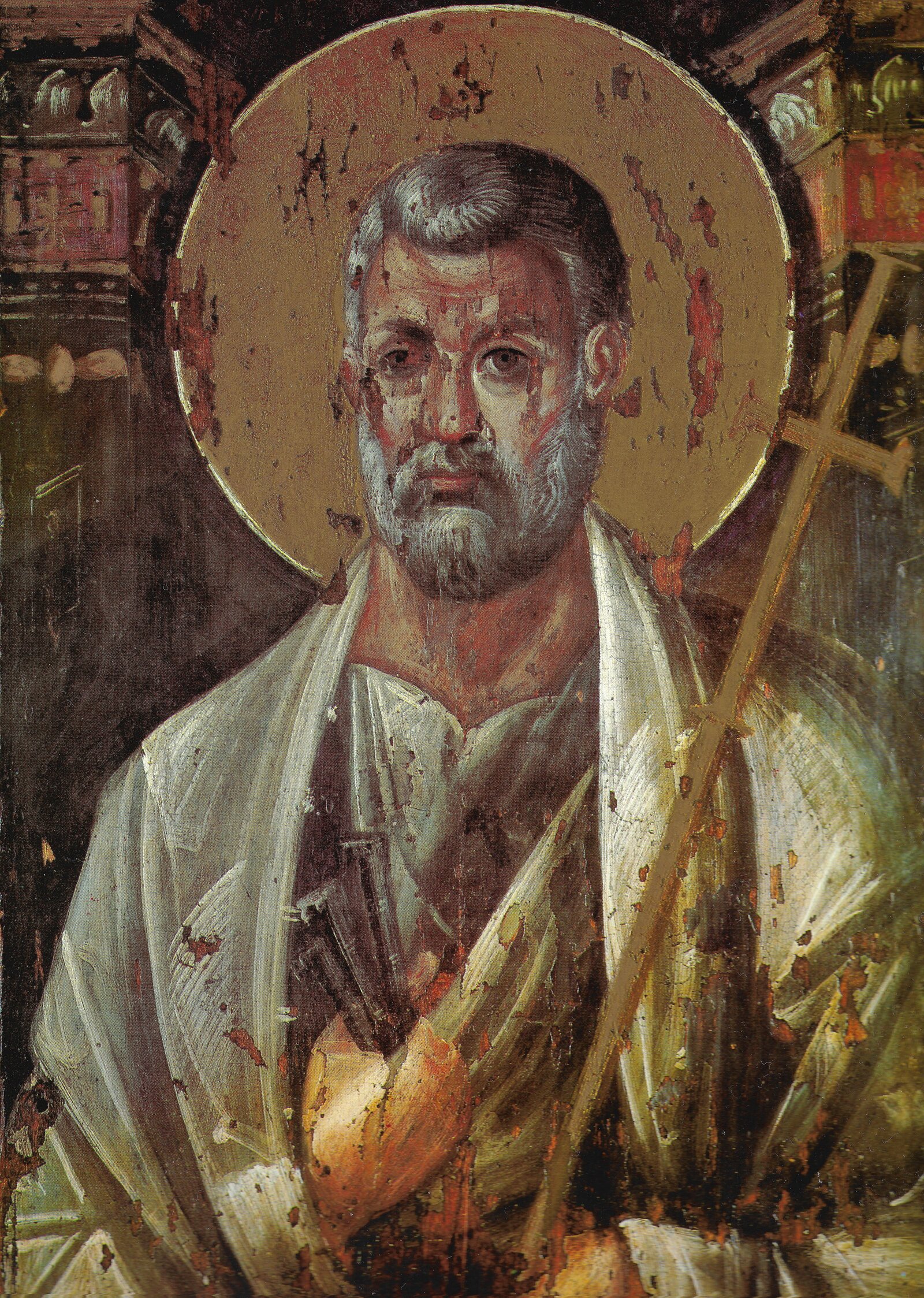
Saint Peter
6th-c. Encaustic Icon — Saint Catherine's Sinai
Doctrinal reflection
He denied Christ three times. Then he died crucified upside down for refusing to deny him.
This encaustic icon of Saint Peter, painted at Saint Catherine's Sinai in the mid-6th century, is one of the very few apostle-portrait icons that survived iconoclasm. The composition is austere. Peter stands frontally, holding a cross-staff in one hand and a key-like scroll in the other. His face is unmistakably the canonical Byzantine Peter — the white-haired old man with the close-cropped beard. Three small medallions across the top of the icon contain the busts of three other figures: Christ in the center, the Theotokos on his right, John the Apostle on his left. Peter is below them, looking out at the viewer, holding the keys.
The medallions are the entire iconographic theology. Peter is not an isolated saint. He is positioned beneath three figures: the Lord he denied and was forgiven by; the mother of that Lord; the brother-disciple John. Peter's apostolic authority is located between his Lord and his fellow apostle, derivative of Christ above and shared with John on the right. The Byzantine artist is correcting the temptation — already present in the 6th century — to read Peter as supreme over the other apostles. The icon's geometry refuses Petrine supremacy as a stand-alone reading.
The biblical Peter is one of the most three-dimensional characters in the New Testament. Matthew 16:16 — "Thou art the Christ, the Son of the living God" — the great confession that earned him the rock-name (Matt 16:18). Three chapters later, Matthew 19:27 — "Behold, we have forsaken all, and followed thee; what shall we have therefore?" — the over-eager question. John 13:8 — "Thou shalt never wash my feet" — followed three verses later by "Lord, not my feet only, but also my hands and my head." Mark 14:71 — "Then began he to curse and to swear, saying, I know not this man of whom ye speak." Three denials at the cock-crow. John 21:15–17 — three counter-affirmations after the resurrection: "Lovest thou me?... Feed my sheep." This is a man.
The historical end: by long Christian tradition Peter was crucified at Rome under Nero, c. 64 AD, and asked to be crucified head-down because he was unworthy to die in the same posture as his Lord. The earliest attestation is 1 Clement 5:4 (c. 95 AD), which names Peter as a martyr without giving the upside-down detail; the upside-down tradition is in Origen (3rd c.) and is accepted as ancient and credible without being canonical.
We do not pray to Saint Peter. We do not invoke him as patron of the Roman bishopric or of any other office. We particularly do not affirm the doctrine of papal supremacy that grew out of Petrine cult — Christ alone is the foundation of his church (1 Cor 3:11; Eph 2:20 names the apostles and prophets in the plural; the church is built on apostolic witness, not on a singular Petrine succession).
But we read Peter the way scripture reads him: as a man whose denial was forgiven, whose preaching opened the gospel to Cornelius (Acts 10), whose two letters are canonical scripture, and whose death was the death of a faithful servant. The icon shows him below Christ — that is the right ordering.
When you preach Peter, do not preach him as the first pope. Preach him as the man who denied his Lord, was restored, fed the sheep, and died upside-down for the gospel.
The restoration is the doctrine.