The Apostolic Flock
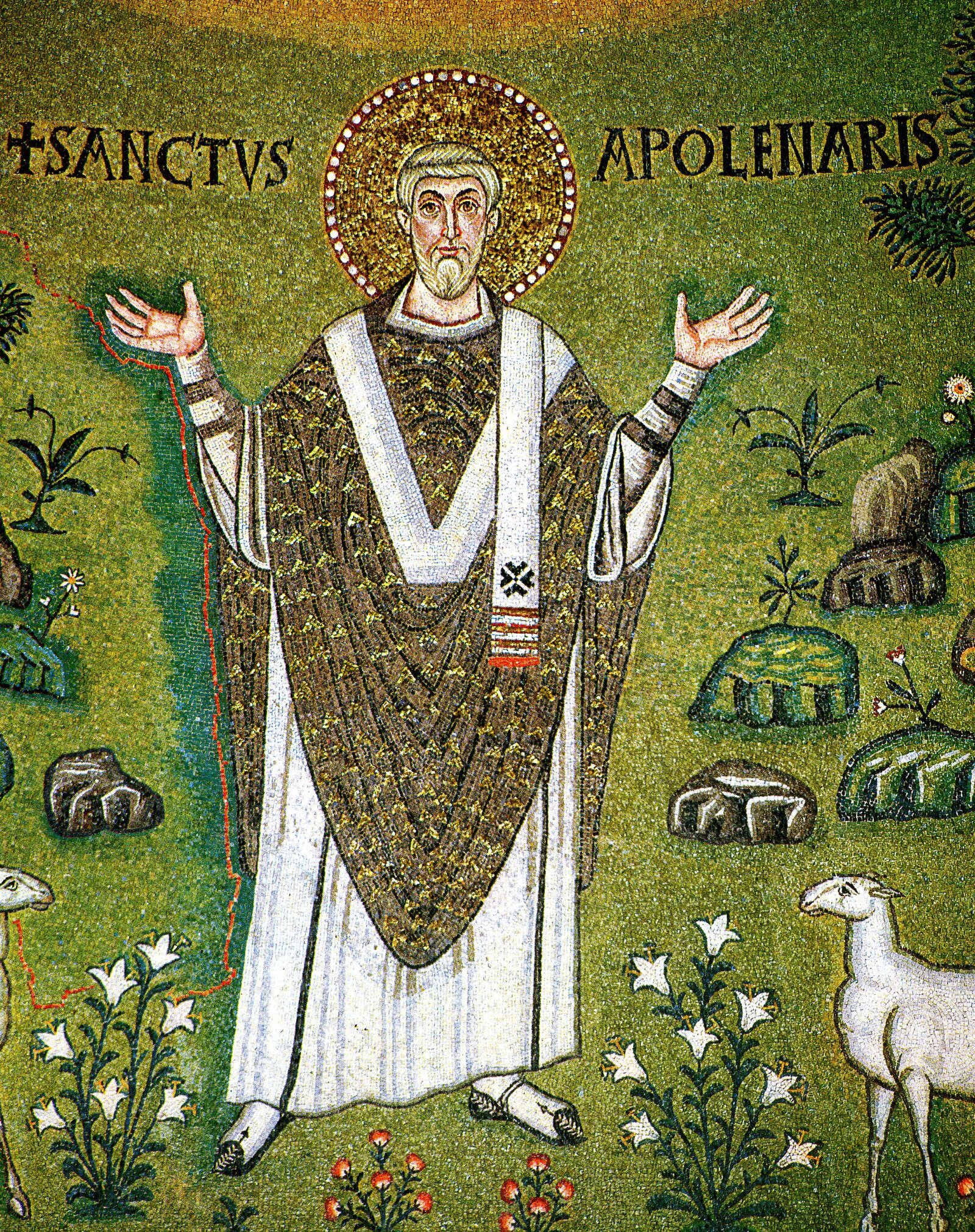
Apse Lower Register — Saint Apollinaris with the Twelve Lambs, Sant'Apollinare in Classe
Doctrinal reflection
The apostles are sheep.
The lower register of the apse at Sant'Apollinare in Classe shows Saint Apollinaris, first bishop of Ravenna, standing in orant posture (hands raised in prayer) at the center of a green meadow. To his left and right, six lambs on each side — twelve in total — face him in symmetrical procession. Each lamb is rendered identically: white wool, gold halo, the same gentle posture. The twelve are the apostles. The Byzantine artist has reduced them to a flock and given them — all twelve, identically — the same gold halos.
This is a profound piece of ecclesiology, and it has been somewhat hidden in the corpus until now. We have already covered Sant'Apollinare in Classe twice: the cosmic cross above the lambs (#21) and the Heavenly Jerusalem on the triumphal arch (#18). Returning to the lambs as a separate entry was Pastor Charlie's call after a flag in batch 008 — and the call was right. The lambs are doing theological work that the other two entries did not surface.
What is the work? Three things.
First, uniformity. The twelve lambs are visually identical. The Byzantine artist refused to differentiate them by attribute. There is no Peter with keys, no Paul with sword, no Matthew with book. They are simply the apostolic flock, indistinguishable in the gaze of the Lord above. This corrects against any reading of Petrine supremacy or apostolic hierarchy. "There is neither Greek nor Jew, circumcision nor uncircumcision, Barbarian, Scythian, bond nor free: but Christ is all, and in all" (Colossians 3:11). The apostles in the apse stand in the same posture, share the same halo, receive the same blessing.
Second, the flock metaphor itself. Christ called himself the Good Shepherd (John 10:11) and called his disciples "my sheep" (John 10:27). When the Byzantine artist depicts the apostles as lambs, he is taking the gospel's own self-description literally. The apostles are not above the flock; they are the first generation of it. They were the original twelve sheep who heard the shepherd's voice and followed.
Third, Apollinaris among them. The bishop is shown standing at the center of the lambs, not above them or beside them. His hands are raised in prayer; he is not commanding the flock, he is interceding for it alongside it. This is the iconographic theology of Christian pastoral office: the local successor stands among the flock, leading their prayer, not standing apart from them as a different kind of being. Apollinaris is one of the sheep, designated by the Lord to keep the others. Pauline ecclesiology, mosaicked in 6th-century Ravenna.
We do not pray to Apollinaris or to the symbolic apostles of the apse. The mediation belongs to Christ alone (1 Timothy 2:5). But we read the iconography for what it teaches about the church's foundation and shape: an apostolic flock under the shepherd Christ above the cross-and-cosmos, with local pastors among them keeping the prayer.
When you are pastoring a congregation, this is the model. Be Apollinaris. Stand in the green field with the sheep. Pray with them. The Lord above will recognize all the same halos.
Be Obedient. Be Bold.