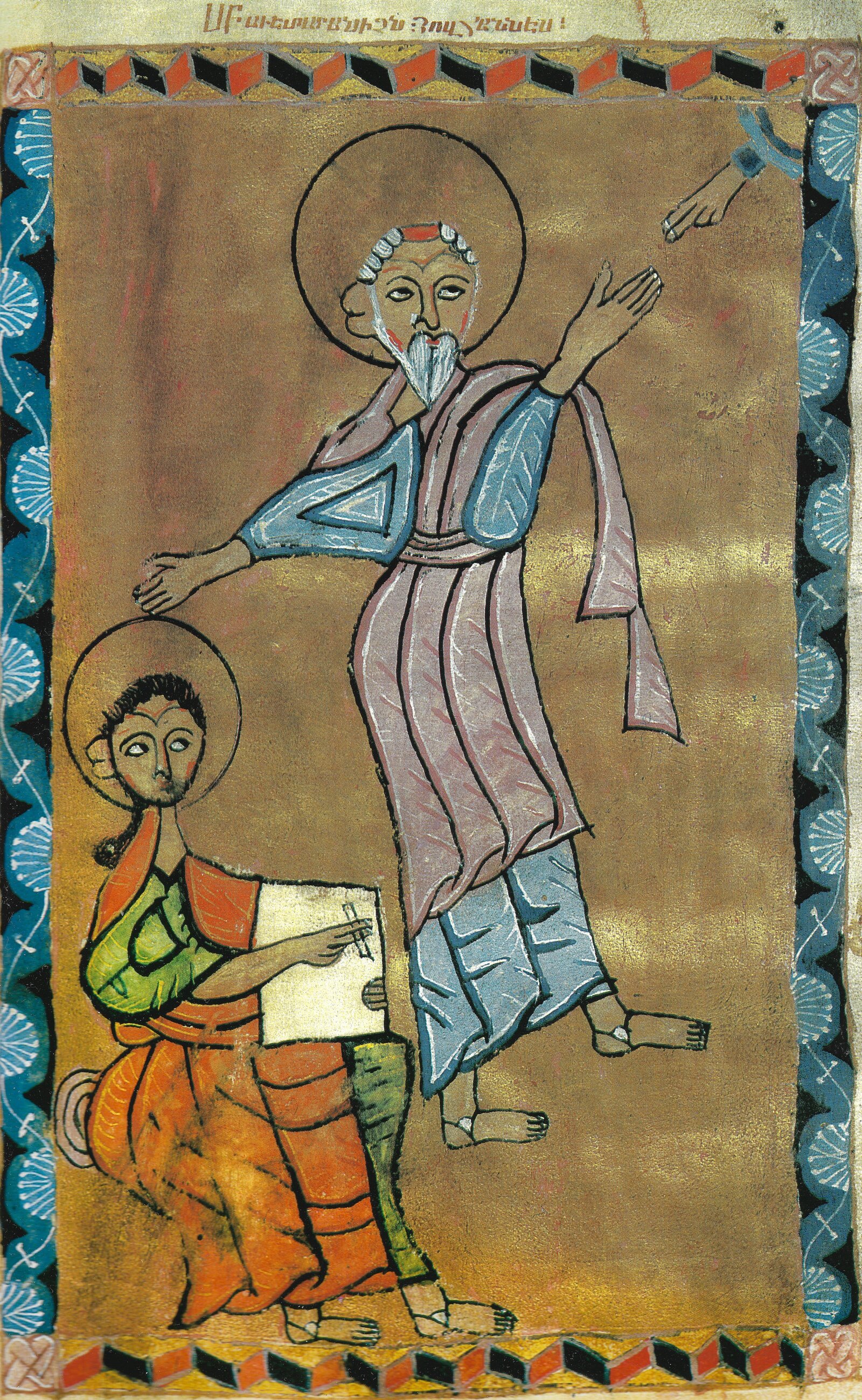
John the Theologian Dictating to Prochorus
Xoranasat Gospel, fol. 247 — Armenian, 1224 (Matenadaran, Yerevan)
Doctrinal reflection
John sits on the right, white-haired, leaning forward in concentration. His right hand gestures upward; his left holds an open codex. Across from him, Prochorus sits at a writing desk, quill poised over a scroll, head bent to receive what John speaks. A small mountain rises behind them — Patmos. Above, a band of heavenly light or arc indicates the source of the words John is speaking. The scene is the iconographic standard the Byzantine and Armenian-Caucasian traditions developed for the writing of Revelation: John dictates; Prochorus writes; the canonical text descends through both of them.
This miniature is from the 1224 Xoranasat Gospel, made in the Armenian province of Artsakh and now at the Matenadaran in Yerevan. The Armenian iconographic tradition is in continuous conversation with the Byzantine, sharing the same types and reading the same gospels. The Patmos-dictation type is older than this manuscript by centuries and would still be reproduced in 16th-century Mt. Athos workshops (Theophanes of Crete). What the Armenian artist received and transmitted is the church's witness to how Revelation was written.
Iconographic-survival principle. The Patmos-dictation type has survived every doctrinal transition in 1,800 years of Christian art-making — pre- and post-iconoclasm, pre- and post-Schism, pre- and post-Reformation; Catholic, Orthodox, Coptic, Armenian, Syrian, Russian, Greek. The composition keeps appearing because it reads what the text says: I John... was in the isle that is called Patmos... heard behind me a great voice... What thou seest, write in a book (Rev 1:9–11). The iconography is the verse rendered.
Same-ladder formulation, applied to canonical authorship. Notice what the iconography insists on. John does not write Revelation alone. He dictates; Prochorus writes. The canonical text descends through two believers working together — one apostle (John) and one disciple (Prochorus, traditionally identified with the Prochorus named among the Seven of Acts 6:5, though early-church tradition is sometimes uncertain). The apostolic authority is John's; the human labor of writing is shared. Even canonical scripture is collaborative ministry. The iconography refuses the picture of the lone inspired writer in solitary confinement with the divine voice. Two with one accord, in proportionate roles. The horizontal fellow-elder register from #78 (Peter as sympresbyteros) is preserved here in the writing of scripture itself.
Compositional theology. The eye-line in the miniature is doctrine. John looks up; Prochorus looks down at the scroll. John is the conduit; he is not the source. The source is the heavenly voice indicated by the arc above. The text is descending. John receives; he speaks; Prochorus writes. Three positions, three directions of gaze, one canonical product. The composition refuses the inversion that would make John himself the source — that would be apostolic authority swallowing divine authorship. The iconographer keeps the order right: God speaks; the apostle hears and speaks; the disciple writes; the church receives.
Collection 3 cross-tag — Revelation as post-trib eschatology. The book Prochorus is writing is the corpus's primary post-trib parousia text. Behold, he cometh with clouds; and every eye shall see him (Rev 1:7). The same apostle who wrote In the beginning was the Word (John 1:1) wrote Behold, he cometh. One voice, one Christology, one eschatology. The corpus's post-trib position (#16 Torcello, #37 Thessaloniki Ascension) descends from this scene. The matching of every eye shall see him (Rev 1:7) with after the tribulation of those days (Matt 24:29–31) makes the timeline unambiguous.
Honor to Prochorus. The early church preserved his name (Acts 6:5). He is not an apostle; he is a fellow believer who took dictation from one. Without him, the iconography says, the Revelation does not get written. The work of the kingdom requires the apostle and the scribe together — pastors and faithful laypeople, preachers and faithful prayer-warriors. The horizontal register of apostolic ministry is the corpus's recurring witness, and Prochorus at his writing desk is its quietest figure.
We receive the canonical scriptures the apostles wrote. We do not receive them as a chain of magical transmission. We receive them as the church received them — through apostles and through faithful disciples working together with quill and scroll, dictation and writing, prayer and labor. Behold, he cometh.