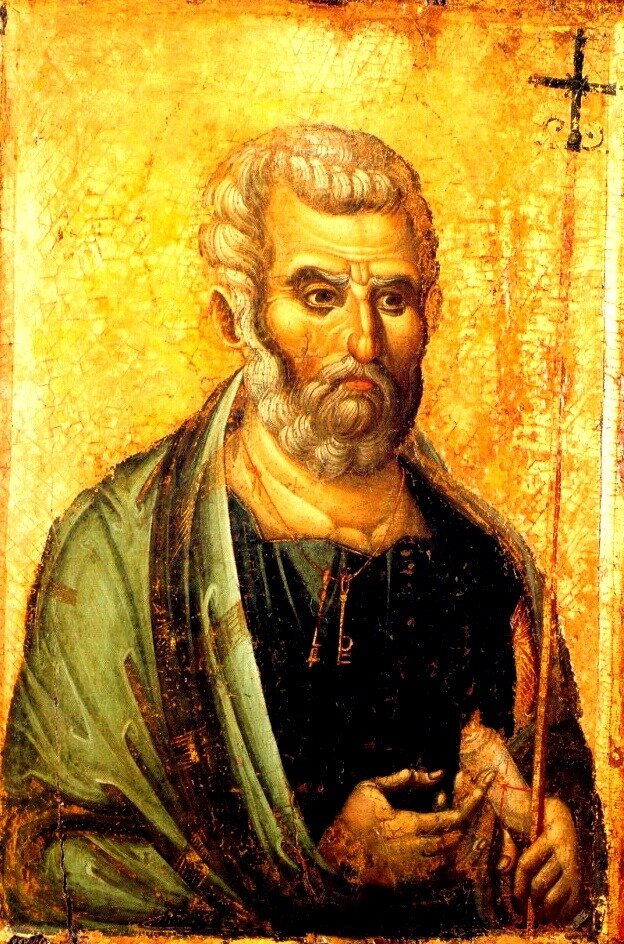
The Apostle Peter
13th-Century Byzantine Icon — Dumbarton Oaks, Washington D.C.
Doctrinal reflection
Peter stands frontal, three-quarter length, robed in his blue undertunic and gold-ochre cloak. White hair. Close-cropped white beard. The right hand holds a long horizontal scroll across his chest, partly unrolled. The left hand grips the keys — the iconic Petrine attribute, two large keys held vertically against his chest like a staff. The face is the canonical Byzantine Peter we have already met at #20 (Sinai, 6th c.) and #56 (Sinai medallion). Seven centuries later, the same man.
This 13th-c. Dumbarton Oaks panel comes after the Schism of 1054 — after the iconographic argument had fully developed in both the Latin West (Peter as foundation of Roman papal supremacy) and the Byzantine East (Peter as coryphaeus / first-among-equals, but not universal pontiff). The icon is what the East kept of Peter once the West's papal claims had become a defining issue.
Translation-becomes-doctrine. Matthew 16:18. Sy ei Petros, kai epi tautē tē petra oikodomēsō mou tēn ekklēsian. The Greek wordplay is exact: Petros (masculine, Peter's name; a stone) and petra (feminine, the rock-bed). The grammatical shift from masculine to feminine is not accidental. The rock on which Christ builds his church is not Peter the man; it is the confession Peter just made (Matt 16:16: Thou art the Christ, the Son of the living God). That Rock was Christ (1 Cor 10:4); other foundation can no man lay than that is laid, which is Jesus Christ (1 Cor 3:11).
The Vulgate renders both Greek words as forms of the same Latin word: tu es Petrus, et super hanc petram aedificabo ecclesiam meam. The Greek's masculine/feminine distinction collapses in Latin. The medieval Latin tradition then read Petrus and petram as identifying Peter himself with the rock-foundation — and built the doctrine of Petrine supremacy and papal infallibility on that translation.
Built-on-top-of. Peter's apostolic ministry is real (Pentecost preaching, the Cornelius mission, two canonical epistles, martyrdom at Rome under Nero). What was built on top: Peter as first Pope, Roman bishops as his successors by direct chain, universal jurisdiction, infallibility ex cathedra. None of this is in the New Testament. Acts 15 shows Peter at the Jerusalem council deferring to the apostles and elders (15:6); James gives the verdict (15:13–21); Galatians 2:11 shows Paul rebuking Peter to his face. The biblical Peter is first among equals at most — not the head of the church.
Anti-apostolic-succession (paired flagship: #75 + #77). The chain-of-touch logic that supplies papal succession from Peter onward fails twice: Ananias commissioned Paul without being in any chain (#75); Pentecost descended on the gathered church without a chain (#77). Whatever Peter received at Caesarea Philippi, he did not receive the keys to a papal office that he then transmitted through a chain of bishops. The keys he received were the keys of the kingdom (Matt 16:19), and Christ gave the same binding-and-loosing authority to all the disciples a chapter later (Matt 18:18 — whatsoever ye shall bind on earth shall be bound in heaven; the ye is plural).
Same-ladder formulation. The icon's compositional choice helps. The 13th-century Byzantine artist depicted Peter alone, frontal, full-bodied — but at standing height, eye-level to the viewer. Not enthroned. Not elevated above the worshipper. Not seated on a cathedra Petri in glory. Just standing. Brother Peter, the icon's posture says — Peter as the apostle who fed Christ's sheep, not Peter as the pontiff who rules the church. The horizontal address is the iconographic posture.
The corpus reads Peter as scripture reads him: confessor (Matt 16:16), denier-and-restored (#56), Pentecost preacher, Cornelius-mission opener, writer of two epistles addressing the church as fellow-elders (1 Pet 5:1, sympresbyteros — fellow-elder, not chief shepherd), crucified upside-down at Rome. The Petrine-supremacy doctrine was built on top of him; the man underneath is the apostle of fellow-elders and brethren.
We honor Peter. We do not subordinate the church to him. The keys are the keys of the gospel; the rock is Christ; the apostle is a brother who fed the sheep and died upside-down. Feed my sheep (John 21:17) is what he received. He fed his sheep. He did not become the universal pastor of all sheep.