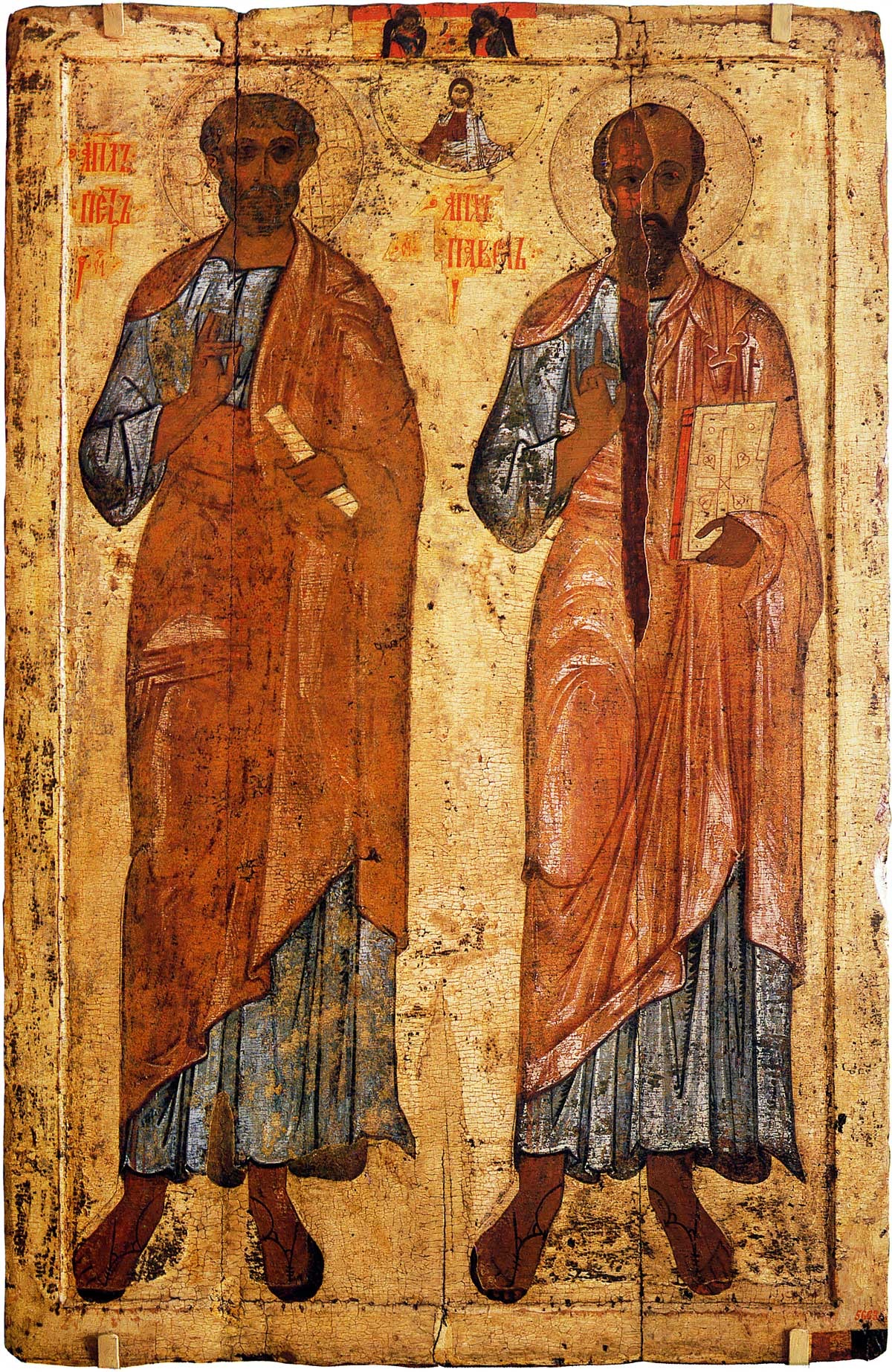
The Holy Apostles Peter and Paul
Panel Icon, late 12th–early 13th century, Novgorod School (originally from Belozersk Cathedral) — State Russian Museum, St Petersburg
Doctrinal reflection
Two apostolic figures stand side by side, frontal, robed in himation and tunic. Peter on the left holds a scroll (or keys, in some iconographic registers); Paul on the right holds the codex of his epistles. Names in Slavonic Cyrillic above their haloes: ΠΕΤΡЪ and ПАѴЕЛ. The icon is c. 1190–1210, Novgorod school, painted for the Cathedral of the Transfiguration in Belozersk — one of the earliest surviving Old Russian panel icons, painted roughly 200 years after Vladimir of Kiev's 988 conversion. Now in the State Russian Museum, St Petersburg. The corpus's third Russian Museum entry (after the Novgorod Anastasis at #111 and the Boris-and-Gleb panel at #112) — Russian Museum 3/4.
The two-apostle iconographic register. Peter and Paul rendered together is the canonical Byzantine and Old Russian iconographic type for the apostolic foundation of the church. The two figures are not merged or balanced as equals in some abstract apostolic pair — the iconography preserves Galatians 2:7–9 carefully: "the gospel of the uncircumcision was committed unto me [Paul], as the gospel of the circumcision was unto Peter... they gave to me and Barnabas the right hands of fellowship; that we should go unto the heathen, and they unto the circumcision." The two missions (Jews / Gentiles), the two apostles, the one gospel. The icon renders Galatians 2 visible.
The Peter triangulation pattern locked. The corpus has handled Peter at three earlier locations: Sinai (#20), Dumbarton Oaks (#56), and Pammakaristos (#78 James-as-James, with Peter contextually). The triangulation pattern declines the Catholic Peter-as-Rock-of-the-Papacy reading at every site. Matthew 16:18 — "upon this rock I will build my church" — is read with the rock as Peter's confession ("Thou art the Christ, the Son of the living God" — Matt 16:16), not Peter's person. 1 Peter 2:6–8 confirms: Christ is the chief corner stone; believers are living stones built on him. Ephesians 2:20 confirms: the foundation is the apostles and prophets, Jesus Christ himself being the chief corner stone. Peter is among the foundation; he is not the foundation. The Belozersk icon, painted in early-Christian Russia where the Catholic-petrine doctrinal apparatus had not yet fully developed, renders Peter alongside Paul as fellow-apostle — not as the singular hierarchical foundation Roman Catholicism would later claim.
The Pauline corner held. Paul holding the codex of his epistles registers the apostolic-writing canon. The corpus's locked Sola Scriptura framework reads Paul's letters as authoritative Mode 1 doctrinal exposition: 13 epistles in the canon, the doctrinal architecture of justification by faith (Romans, Galatians), the Christology of Colossians and Philippians, the ecclesiology of Ephesians, the eschatology of 1–2 Thessalonians. Peter holds the keys; Paul holds the letters. Both icons of the apostolic ministry, both subordinate to the Christ they preached.
Acts 1:8 in Slavic flesh. The icon's existence is itself the gospel-trajectory continuing: "ye shall be witnesses unto me both in Jerusalem, and in all Judaea, and in Samaria, and unto the uttermost part of the earth." Peter and Paul preached to Jerusalem and Rome; the gospel reached north into Slavic territory; the Belozersk Cathedral commissioned this icon to ground its own community in the apostolic foundation of the universal church. The Old Russian iconographer's two apostles standing side by side at Belozersk are the visual proof that Acts 1:8 had reached the northern forests.
Russian Museum at 3. The corpus's third Russian Museum entry. The Belozersk icon's c. 1200 dating makes it one of the earliest documented Russian icons in any institution — preceding the famous Theotokos of Vladimir's arrival in Russia (1131) only by a generation, and roughly contemporary with the Theotokos of Belozersk also at the Russian Museum.
Peter and Paul. The Jewish mission and the Gentile mission. The keys and the letters. The one gospel preached in two registers. Christ alone the chief corner stone.