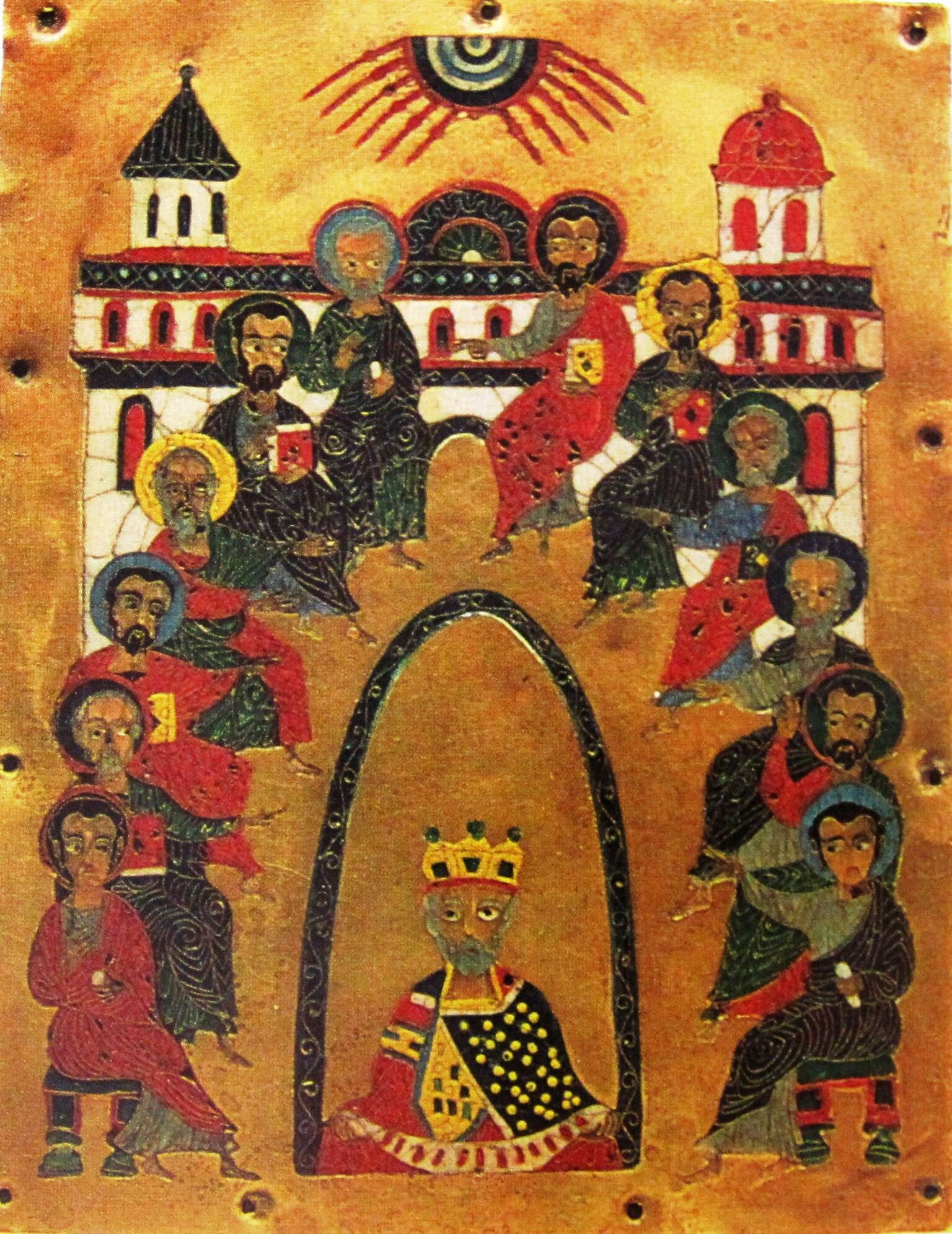
The Descent of the Holy Spirit
12th-Century Cloisonné Enamel — National Museum of Georgia, Tbilisi
Doctrinal reflection
Twelve seated figures arc around a curving bench, six on each side, faces turned slightly inward toward one another and outward toward the viewer. Above them, tongues of fire descend from a small heavenly arc. A central older figure — sometimes identified as the personification of Cosmos (the world receiving the gospel) — sits beneath the apostles in a darkened lower compartment, holding a cloth bearing twelve scrolls. The whole icon is enamel on gold, no larger than a hand-span, made in 12th-century Georgia in the cloisonné technique that the Byzantine and Caucasian traditions perfected.
This is Pentecost as apostolic commissioning. The corpus has already engaged Pentecost as charismatic outpouring at #35 (Hosios Loukas dome). That entry's reading was right: the same fire that fell on the apostles' heads in Acts 2 falls on believers' heads in every generation that asks for it. This entry reads the same scene differently. Acts 2 is also the moment when Christ's risen-and-ascended ministry hands itself to the church. The gathered believers in the upper room (Acts 1:14: "These all continued with one accord in prayer and supplication, with the women, and Mary the mother of Jesus, and with his brethren") are the church receiving its commission. The fire and the rushing wind are the Spirit's authorization; what follows is apostolic ministry to the nations.
Horizontal address constitutive of the apostolic moment. Acts 1:14 names the upper-room gathering as a koinōnia of equals — apostles, women, Mary, Christ's brethren — not a hierarchy of office but a fellowship of believers in prayer. When Acts 2:1 says they were all with one accord, the all includes the women. Peter's sermon (Acts 2:14–36) interpreted what had happened by quoting Joel: "I will pour out of my Spirit upon all flesh: and your sons and your daughters shall prophesy." The priesthood of all believers (1 Peter 2:9) is not a Reformation recovery; Acts 2 itself supplies it.
Anti-apostolic-succession via the gathered church. The corpus's argument against apostolic-succession-by-touch (#75 Ananias) gets its broader confirmation here. Pentecost is not the Twelve receiving an indelible character to transmit through a chain. Pentecost is the Spirit poured out on a gathering of about 120 (Acts 1:15) — all with one accord. The 3,000 baptized at Peter's sermon (Acts 2:41) become the church — adelphoi and adelphai together — without a separate sacerdotal stratum.
Confirmation/chrismation, declined. Eastern and Western traditions located in this scene the institution of chrismation (Eastern) or confirmation (Western) as a post-baptismal sacrament conferring the Spirit through episcopal anointing. Acts 2 supplies the Spirit's coming; it does not supply a priestly anointing that conveys the Spirit. Ministers receive the Spirit with the gathered church, not on its behalf. The medieval apparatus of confirmation-as-second-stage-sacrament was built on top of Acts 2 rather than carried by it.
Compositional theology. The cloisonné places the apostles in a curved bench — circling rather than ranking. No senior apostle is elevated; no priestly authority is iconographically marked. The arc is a circle of equals receiving the Spirit together. Brethren (Acts 2:29) is what the composition shows.
Marian cross-collection. The Georgian icon's lower compartment shows Cosmos / the world rather than Mary — the apostolic commissioning is for the world. When Mary does appear in Pentecost compositions, she sits as a believer among believers (Acts 1:14, with the named-decline rule transferring from Collection 2). Mary receives the Spirit with the rest. She is not the central figure dispensing the descent.
Continuationist cross-reference. Paired with #35 Hosios Loukas Pentecost (charismatic-outpouring reading). One scene, two readings: the same fire that fell on the apostles' heads in Acts 2 falls on believers' heads in every generation that asks for it (#35); the apostolic ministry the Spirit authorized at Pentecost is given to the gathered church without a sacerdotal stratum (here). Both are scripture; both are the corpus's witness.
The Georgian enamel is small. Small enough to hold in two hands. The whole apostolic commissioning fits in a hand-span — because it is the gathered church receiving the Spirit, not an institutional hierarchy receiving its scepter. We are all with one accord. The Spirit comes. We go.