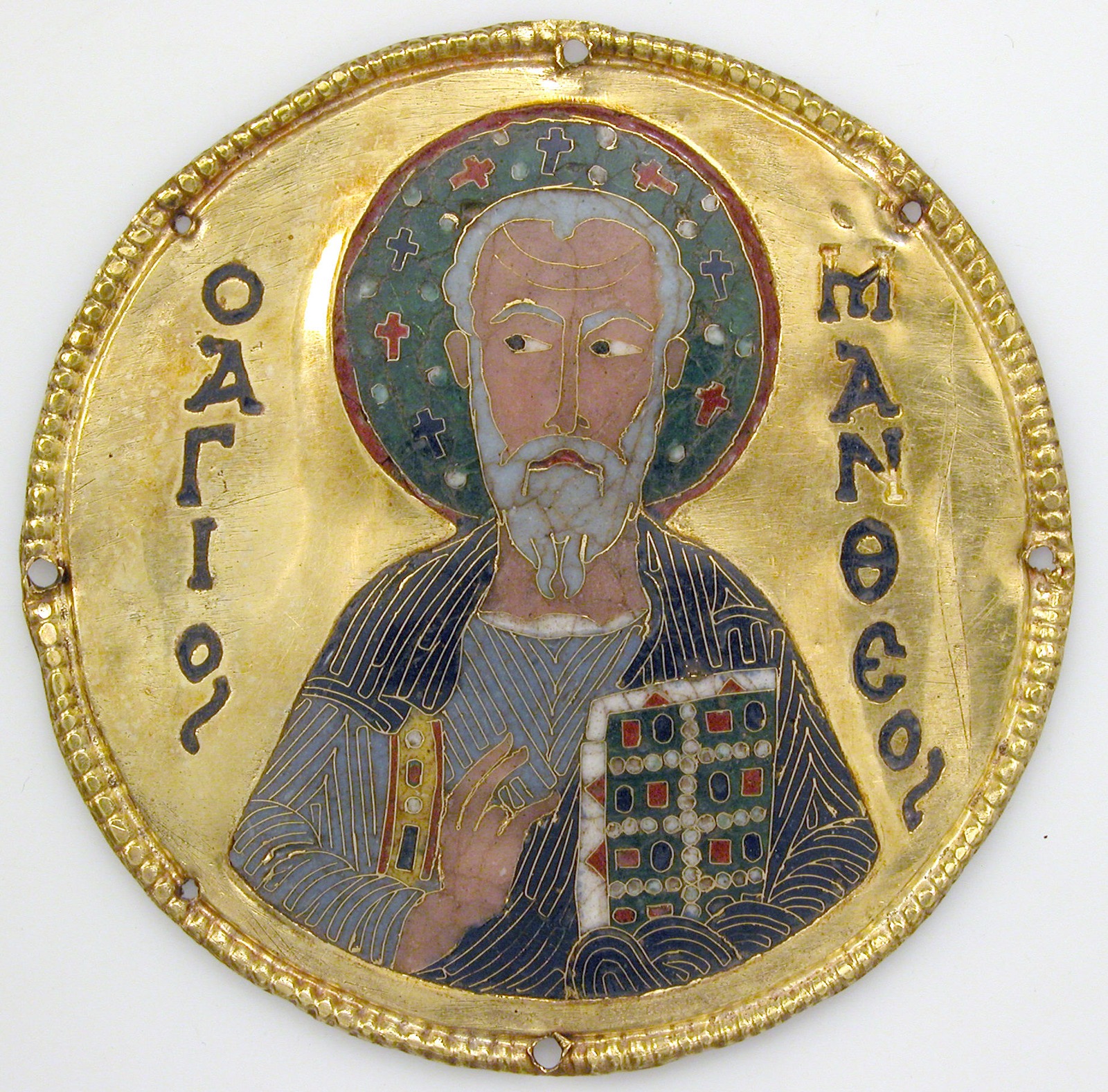
Medallion with Saint Matthew from an Icon Frame
Cloisonné Enamel on Gold and Silver, c. 1100, Constantinople — Metropolitan Museum of Art (Acc. 17.190.672)
Doctrinal reflection
A circular cloisonné enamel medallion, 8.3 cm in diameter, glowing with the colors of Byzantine high craft — gold ground, blue and green enamels, fine silver wire-cell partitions. Saint Matthew sits frontal, a codex (his gospel) on his lap, his right hand raised in the speaking-gesture, his halo gold-ringed. Greek inscription identifying him: Ο ΑΓΙΟC ΜΑΤΘΑΙΟC. The medallion is one of nine surviving from an original set of twelve that bordered an Archangel Gabriel icon — possibly a diplomatic gift from the Byzantine court to neighboring Christian Georgia, c. 1100. The medallion is now at the Met (Acc. 17.190.672). The corpus's fourth Met entry — Met Museum closes at 4/4 ceiling.
Met museum-housed program closure (per iconographic-program-coherence rule, locked after #71). The Met's four-entry program now reads as a coherent portable-Byzantine-art catalog: Saint Paul medallion (#saint-paul-met-medallion, c. 1100, cloisonné — apostolic letters tradition) + Koimesis ivory (#koimesis-met-ivory, c. 980, ivory — 17th flagship Theotokos-not-Mediatrix anchor) + Two-Sided Pendant with Michael and Daniel (#pendant-michael-daniel-met, c. 1200, serpentine — angelology + OT typology) + Saint Matthew medallion (this entry, c. 1100, cloisonné — apostolic-gospel-witness tradition). The four entries cover four medium categories (cloisonné, ivory, carved-serpentine, cloisonné), four iconographic registers (apostle-with-letters, Theotokos at death, angel-prophet pairing, evangelist-with-gospel), and four Byzantine workshop traditions across the c. 980–1200 period. A complete portable-Byzantine-art program rendered through the lens of one museum's collection.
Matthew with the codex — apostolic-gospel-witness register. The medallion renders Matthew in the canonical evangelist-with-gospel composition: codex on the lap, speaking-gesture right hand. The four-evangelist program at Rabbula Gospels (#four-evangelists-rabbula) and the Matthew-and-others tradition across Byzantine iconography roots in the apostolic-witness pattern: the Twelve see and hear; the four record what they saw and heard; the church receives the gospel through the four. Matthew specifically is rendered as the evangelist of the Jewish Christian tradition (his gospel opens the book of the generation of Jesus Christ, the son of David, the son of Abraham — Matt 1:1) and the witness of the Sermon on the Mount and the Great Commission.
The Collection 4 cousin frame — apostolic-witness in the cloud-of-witnesses register. The 15th-flagship cloud-of-witnesses pattern (locked at #83 Rotunda) reads saint-iconography as memorial-witness, not mediation. The Matthew medallion fits exactly: the saint's iconographic function is to bear visible witness to what he wrote — the gospel is the testimony; Matthew witnessed Christ; his image witnesses to his witness. The medallion's compositional theology: viewer → Matthew → codex (the gospel) → Christ-the-Word the gospel testifies to. The eye-line-as-doctrine principle (locked at #72 Climacus) operates at miniature cloisonné scale: the viewer's attention runs through Matthew to what Matthew wrote, not to Matthew himself.
The icon-frame medallion-program tradition. The Met's Matthew medallion belonged to a frame surrounding an Archangel Gabriel icon — a Byzantine compositional tradition in which a central iconographic figure was bordered by witnesses. The architectural theology: the central figure (Gabriel, in this case) does not stand alone; the central figure is testified to by the cloud of saints around the frame. The compositional tradition is itself a visual rendering of the cloud-of-witnesses framework — the saints in the frame stand as the surrounding cloud; the central figure is what they testify to. Hebrews 12:1 in goldsmith form.
The Constantinople-to-Georgia transmission. The original icon and its medallion frame were probably sent as a diplomatic gift from Byzantine Constantinople to Christian Georgia. The corpus has Georgian iconography at #incredulity-thomas-tsalenjikha and #pentecost-georgian-enamel — the Georgian tradition was iconographically continuous with the Byzantine center, and Byzantine workshops often produced gifts specifically for Georgian and Armenian Christian courts. The medallion's transmission across the political-tradition boundary is itself the gospel-trajectory continuing — Acts 1:8 unto the uttermost part of the earth operating in Komnenian-period diplomatic context.
The medallion is small. The codex on Matthew's lap is the gospel. The gospel testifies to Christ. The medallion testifies to the gospel. The witnesses surround the frame; the frame surrounds the central figure; the central figure stands in the cloud of witnesses. The Met's portable-Byzantine-art program closes at four entries with this evangelist's witness.