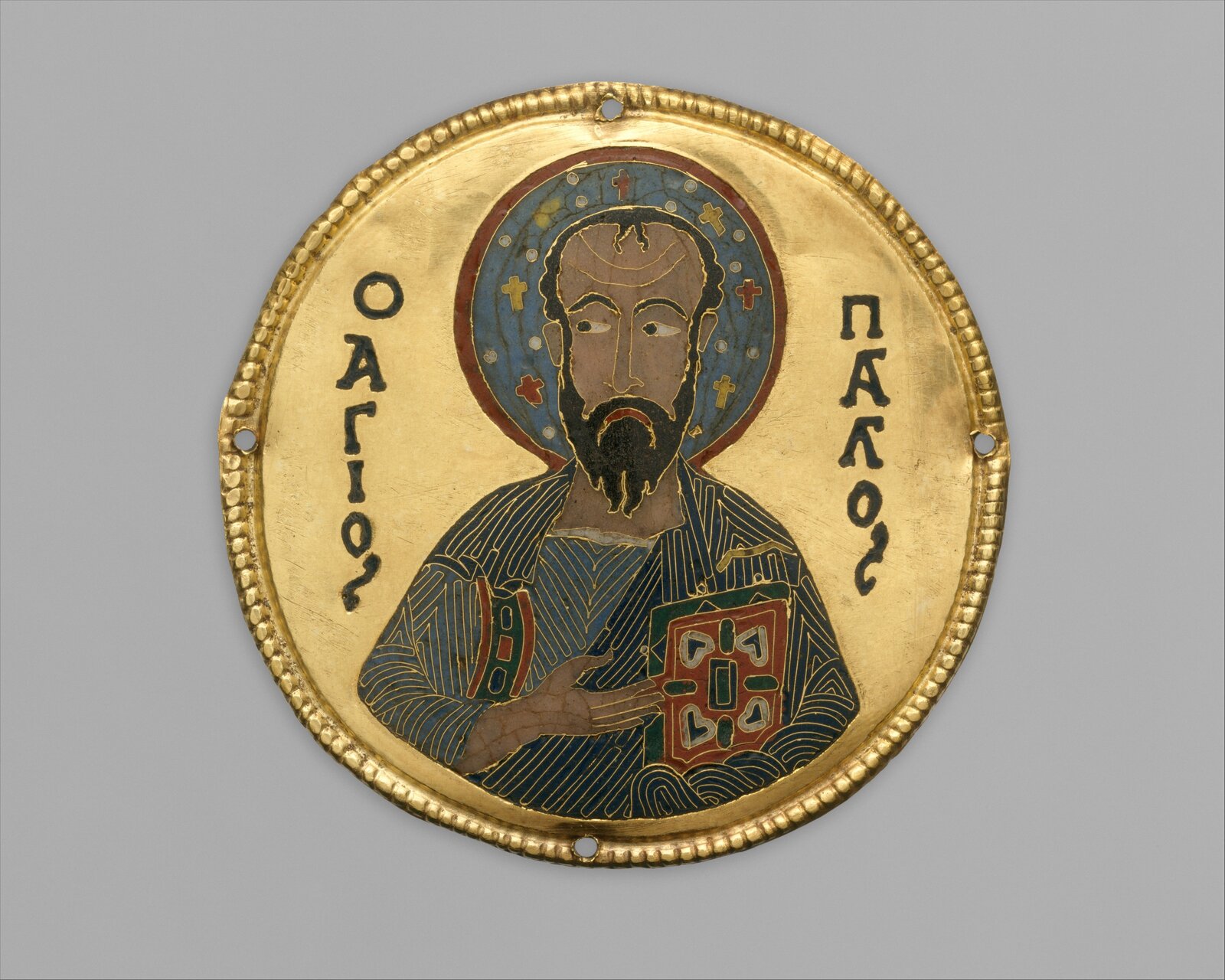
Saint Paul
Cloisonné Enamel Medallion, c. 1100 — Metropolitan Museum of Art
Doctrinal reflection
He was the man who held the cloaks.
This cloisonné enamel medallion of Saint Paul, made around 1100 in a Constantinople workshop and now in the Metropolitan Museum, shows the apostle in the standardized Byzantine type: high-domed bald head, pointed dark beard, gold-rimmed scroll-and-book in his hands, the inscription Ο ΑΓΙΟΣ ΠΑΥΛΟΣ (Saint Paul) framing his halo. The iconographic conventions are remarkably stable. Byzantine Pauls from the 6th to the 14th century all have the same head, the same beard, the same scroll. The painters were copying a face — possibly originally from a 1st-century portrait tradition we no longer have access to.
What is biblically known about Paul is more than what is known about almost any other historical figure outside Christ himself. Acts records his conversion (chapter 9), three missionary journeys (chapters 13–28), his sermons, his trials, his shipwrecks. Thirteen letters in the New Testament bear his name (with seven undisputed; six debated by some scholars but received as Pauline by GLM). He was, biblically, the apostle to the Gentiles (Galatians 2:7–8) — the Pharisee-turned-Christian whose mission carried the gospel from Jerusalem to Rome.
Acts 7:58 records Paul's first appearance in scripture: "And cast him out of the city, and stoned him: and the witnesses laid down their clothes at a young man's feet, whose name was Saul." He was holding the cloaks of the men who stoned Stephen. He was consenting unto his death (Acts 8:1). The first time Paul appears in the New Testament, he is approving the church's first martyrdom.
This matters because it sets up everything that follows. The man holding the cloaks at the stoning would become the apostle whose own writing would be canonical scripture. Acts 9: he is on the road to Damascus to arrest more Christians; the risen Christ confronts him; he is blinded; he is baptized; he begins to preach. The scope of his transformation is the scope of the gospel's claim. Anyone can be reached. Anyone can be remade. Anyone can be sent.
The Byzantine medallion shows Paul holding the books — the books that he wrote. That is the iconographic move. He is not depicted being knocked off a horse; he is not depicted in the Damascus blindness; he is not depicted preaching at Athens or shipwrecked at Malta. He is depicted as the author. The Byzantine tradition understood that what makes Paul foundational is not his biographical drama but the canonical text he produced under the Spirit's inspiration.
We do not pray to Saint Paul. We do not invoke him as patron of writers, missionaries, or theological controversy. The mediation belongs to Christ alone (1 Timothy 2:5). But we read his thirteen letters as canonical scripture and treat his apostolic authority as foundational (Eph 2:20). That distinction — receiving his words as Spirit-given canon, while not directing devotion at the man — is the GLM way of honoring an apostle.
When you preach Paul, do not make him the hero. Preach what he wrote. He would resist any other handling. "For we preach not ourselves, but Christ Jesus the Lord; and ourselves your servants for Jesus' sake" (2 Corinthians 4:5).
The medallion shows the books because the books are the ministry. Read them.