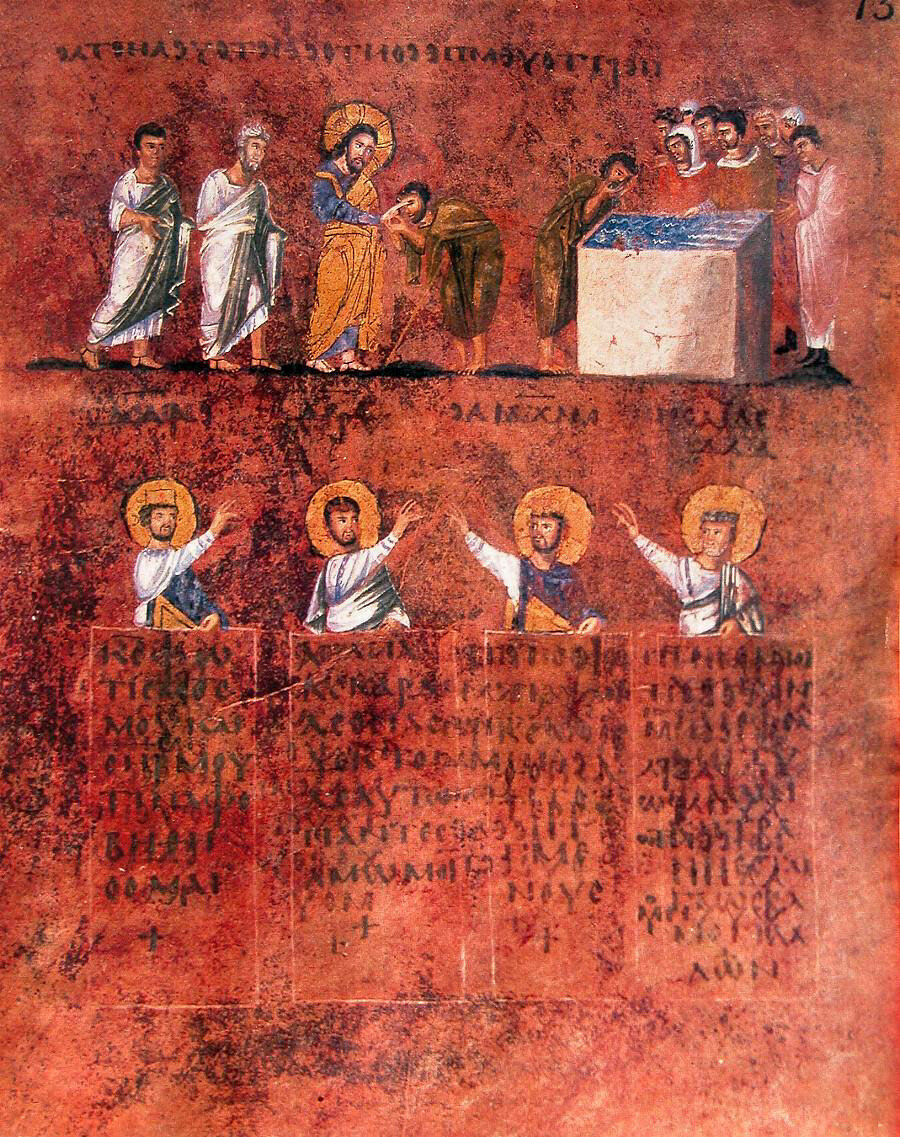
The Healing of the Blind Man
Codex Purpureus Rossanensis, fol. 7v — c. 550–600
Doctrinal reflection
Christ on the left, walking forward, hand extended. The blind man approaches from the right, head bent, eyes closed. Christ touches the man's face. Disciples follow Christ in a small cluster behind. Below the scene, four prophets in roundels — David, Isaiah, and two others — gesture upward with scrolls of prophecy that the healing fulfills. "Then shall the eyes of the blind be opened" (Isaiah 35:5). The illumination shows the prophecy fulfilled in the act.
The Codex Purpureus Rossanensis — c. 550–600 — is one of the oldest surviving illuminated gospels in any tradition, written in silver ink on purple-dyed vellum at the cathedral in Rossano, Calabria. The healing-of-the-blind-man miniature is one of fifteen surviving illuminations. The scene appears in all three synoptics (Matthew 9:27–31; Mark 10:46–52; Luke 18:35–43) and was a standard pre-iconoclasm Christian iconographic subject.
Christ heals. That is the iconographic claim. The hand on the eyes is not a ritual; it is the Lord touching what he made. The prophets in their roundels are witnesses — the healing fulfills what was written. The Spirit of the Lord is upon me, because he hath anointed me to preach the gospel... to preach deliverance to the captives, and recovering of sight to the blind (Luke 4:18, claimed by Christ at Nazareth). The blind-man healing is Christ doing what the Anointed One was anointed to do.
Which brings the Collection 9 question to the surface. The fifth disputed-sacrament case-type is the anointing of the sick — the Catholic and Orthodox traditions' elevation of James 5:14–15 into a grace-conferring sacrament. Is any sick among you? let him call for the elders of the church; and let them pray over him, anointing him with oil in the name of the Lord: and the prayer of faith shall save the sick, and the Lord shall raise him up. The biblical practice is unambiguous: elders pray over the sick, anoint with oil, and the Lord raises him up. The Greek phrase aleipsantes elaiō — anointing with oil — is the apostolic practice itself.
The translation-becomes-doctrine move. The Vulgate Latin renders aleipsantes elaiō as unguentes oleo, which entered medieval Latin sacramental theology as unctio. By the 12th century unctio had become extrema unctio (extreme unction, the last anointing) — and what James 5 had described as a practice for the sick that often resulted in their healing was reconfigured as the final rite for the dying, with the priest's anointing as the grace-conferring sacramental action. The shift is dramatic: from a practice oriented toward the Lord shall raise him up to a practice oriented toward preparing the soul for death. The biblical telos is healing; the medieval Latin telos is dying-well.
Built-on-top-of distinction. Scripture commands elders praying over the sick with oil, expecting the Lord to heal. What was built on top: a priestly grace-conferring sacrament oriented to death rather than to resurrection life. The biblical practice is affirmed; the medieval reorientation is declined. Healing prayer over the sick is a normal Christian ministry — every community can practice James 5:14–15 with maturity and faith. The prayer of faith shall save the sick.
Same-ladder formulation. The elders praying over the sick are fellow believers — perhaps further up the ladder in pastoral wisdom, but on the same ladder. Christ at the top is the actual healer (#72 spiritual father, #73 wedding minister, here praying elders — same pattern). The minister attends; Christ heals.
Compositional theology. Look at the eye-line of the Rossano illumination. The blind man's eyes are closed; he cannot see. The disciples behind Christ are looking at Christ. The prophets in the lower register are looking up. Every figure in the scene whose eyes can see is looking at Christ. The blind man cannot yet — but Christ is looking at him. The composition is the doctrine: when sight returns, what the man will see first is the One who healed him.
We pray for the sick. The elders anoint with oil. Christ heals. The prayer of faith saves. We do not need a priest's ritual to ask the Lord to raise our sick brother up. We do need the Lord.
We come blind. Christ touches our eyes.