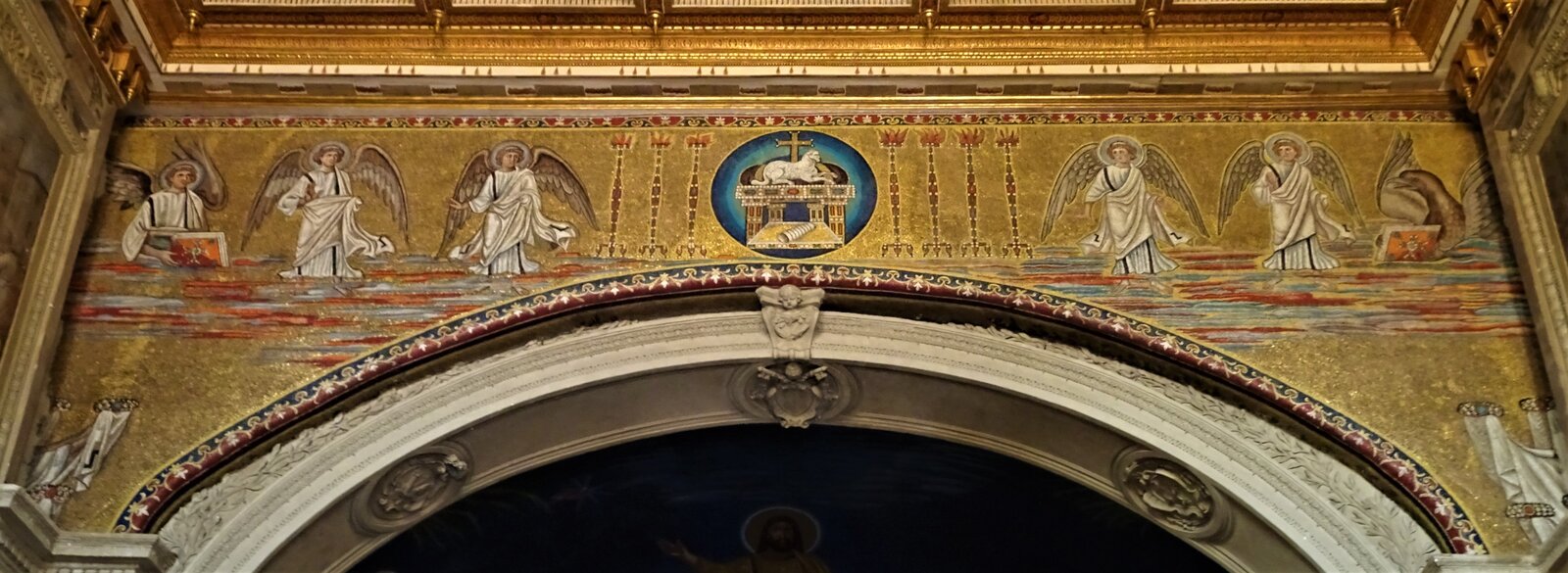
The Apex Lamb
Triumphal Arch Mosaic — Basilica dei Santi Cosma e Damiano, Rome
Doctrinal reflection
The Lamb is on a throne. The Lamb has been slain.
At the apex of the triumphal arch above the apse of Santi Cosma e Damiano in Rome — a 6th-century basilica with the arch program likely completed under Pope Sergius I (692–701) — the Lamb of God sits on a jeweled throne. A Latin cross stands above. A scroll with seven seals lies sealed beneath. Seven jeweled candlesticks flank the Lamb. Four winged creatures attend (the man of Matthew, the eagle of John; the lion of Mark and the ox of Luke completed the four originally). On the lower curve of the arch, the upraised arms of twenty-four crowned elders extend toward the throne, offering their crowns.
The iconographic source is unmistakable. "I saw a Lamb, looking as if it had been slain, standing in the center of the throne, encircled by the four living creatures and the elders" (Revelation 5:6). "Before the throne, seven lamps were blazing. These are the seven spirits of God" (Revelation 4:5). "The four and twenty elders fell down before him that sat on the throne... and cast their crowns before the throne" (Revelation 4:10). The arch does not represent the heavenly liturgy. The arch is the heavenly liturgy made visible at the threshold of the church's earthly liturgy.
Every eucharistic mosaic, every Communion-of-the-Apostles scene, every Heavenly Liturgy fresco descends from this scene at the throne. The Mass, the divine liturgy, the Lord's Supper at a Protestant table — every one of them looks back at the slain Lamb and forward to the marriage supper of the Lamb (Rev 19:9). The actor in the apex is Christ. The actors in the earthly liturgy are the church, remembering.
Memorial-view (1 Cor 11:23–26). The Lamb on the throne has been slain. The slaying happened once, at Calvary. "Christ being raised from the dead dieth no more" (Rom 6:9). The communion table proclaims the slain-and-now-living Lamb until he comes; the bread and cup do not re-offer his body and blood. They remember the once-for-all sacrifice and announce it. The Spirit, not the elements, mediates Christ's presence to the church around the table.
Ministering-not-mediating. The four creatures attend the throne; they do not stand between the throne and the worshipper. The seven candlesticks are the seven Spirits of God going forth into all the earth (Rev 5:6) — not lampstands of ascending human prayer. The angelic host in the heavenly liturgy ministers in the throne-room economy. It does not offer intercession that secures our hearing before God. We have one mediator between God and men, the man Christ Jesus (1 Timothy 2:5).
Ordinance-not-sacrament. The Lamb's death is the once-for-all sacrifice (Heb 7:27; 9:12; 10:10). The earthly priest does not re-offer it. The Lord's Supper is an ordinance commanded by Christ — a remembering, an announcing, a participation by faith in the body and blood already given. It does not reach forward into the apex and pull the slain Lamb back down to the altar. The throne is in heaven. The slain Lamb is on the throne. The earthly table is a memorial of what the throne already holds.
The medieval Latin tradition multiplied the moments where divine grace is conferred through priestly action. The Collection 9 rule is narrower: two ordinances commanded by Christ — baptism and the Lord's Supper. The other five practices the medieval church called sacraments are honored where they reflect biblical patterns (anointing the sick, James 5:14; confession to one another, James 5:16; marriage as Christ-and-church symbol, Ephesians 5:32; the laying on of hands, 1 Tim 4:14) — but not as grace-conferring sacraments in the metaphysical sense the Latin tradition claims. The actor is always God. The minister is a minister, not a mediator.
Look at the arch again. Christ on the throne is the slain-and-now-living Lamb. The cross above; the slaying is finished. The seven seals beneath; judgment will be opened in due time. The candlesticks burn; the creatures attend; the elders cast their crowns. Holy, holy, holy is the Lord God Almighty, who was, and is, and is to come (Rev 4:8). That is the whole liturgy. The earthly liturgy joins it by faith and remembrance — do this in remembrance of me.
(The lower apse — Christ in glory between Saints Cosmas, Damian, Peter, Paul, Theodore, and Pope Felix IV — does different theological work and may surface as its own future entry.)
The earthly liturgy proclaims what the apex already holds. We do not add to it. We remember it.