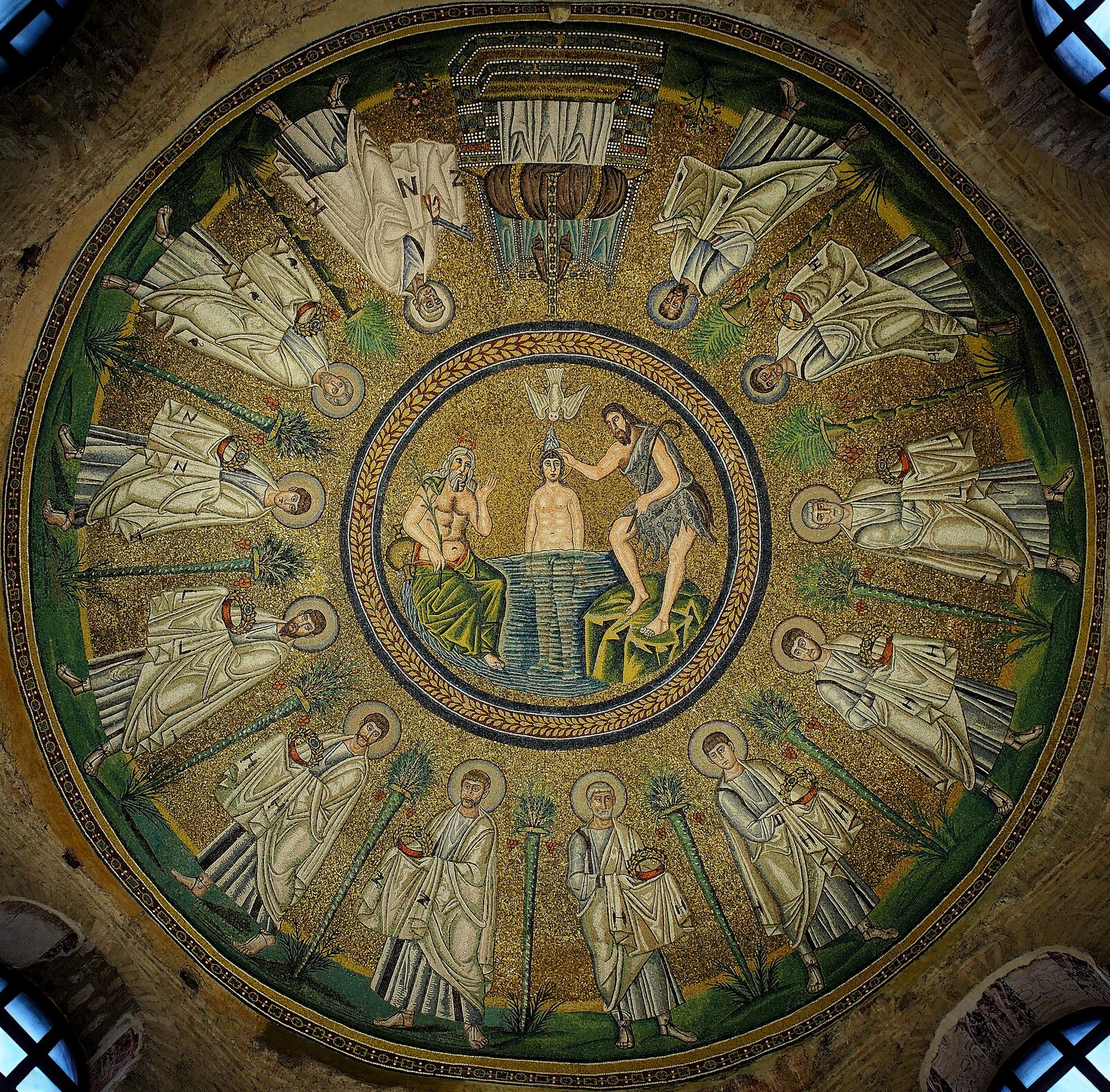
The Baptism of Christ
Dome Mosaic, Arian Baptistery (Battistero degli Ariani), Ravenna — c. 500
Doctrinal reflection
Christ stands waist-deep in the Jordan, beardless, young, naked. John the Baptist on the left, hand on Christ's head, a shepherd's staff in his other hand. The personification of the Jordan on the right, a green-bearded river-god holding an upturned reed, half-submerged. Above Christ, a dove descends. Around the central medallion, in a circular procession, the twelve apostles walk toward an empty jeweled throne — Peter and Paul leading the two halves of the procession, the throne crowned with a cross, an open scroll, and a purple cloth, with the four rivers of paradise flowing from beneath.
The octagonal baptistery was built under Theodoric the Ostrogoth (r. 493–526) for Ravenna's Arian Christian community — the Goths held the 4th-century doctrine that the Son was a created being subordinate to the Father (condemned at Nicaea I, 325). After Justinian's reconquest, the building passed to orthodox use in 565. The dome mosaic remained.
The iconography was orthodox enough to survive doctrinal transition. The Arians may have read Christ's youth and nakedness as signs of subordination, but the gospel baptism (Matthew 3:13–17) is the trinitarian moment of the canonical record — Father's voice, Son in water, Spirit as dove. When the orthodox took the building, they received the iconography as-is. The dove is the dove. The Son is the Son.
This is the second of the two ordinances Christ commanded — Go ye therefore, and teach all nations, baptizing them in the name of the Father, and of the Son, and of the Holy Ghost (Matthew 28:19). The corpus has now established both: #68 the Lamb at the throne (eucharistic apex), #69 the loaves and fishes (eucharistic institution), and #70 the baptism in the Jordan (the second ordinance).
Ordinance-not-sacrament. The water in the Jordan does not regenerate Christ. The water in the baptismal font does not regenerate the believer. The like figure whereunto even baptism doth also now save us, (not the putting away of the filth of the flesh, but the answer of a good conscience toward God,) by the resurrection of Jesus Christ (1 Peter 3:21). Peter's gloss is exact: baptism saves not by the physical water acting on the body but by the resurrection of Jesus Christ, with the believer's conscience answering toward God. The water is a sign-act, not a grace-conferring metaphysical instrument. Christ commanded the ordinance; the church practices it; the regenerative work is the Spirit's, accomplished in the believer through faith in the once-for-all atonement. Baptismal regeneration — the doctrine that the water itself confers regenerative grace by the priestly act — is the same overreach the eucharistic sacramental view makes about the bread and cup. Both confuse the sign with the thing signified.
Ministering-not-mediating. John stands at Christ's left, hand on his head. He is the prototype of the new-covenant minister: a forerunner who decreases that Christ may increase (John 3:30); a baptizer who bears witness I am not the Christ (John 1:20). He stands precisely where every minister of every ordinance should stand — beside Christ, attending the action, not above it. Not mediating grace but ministering the sign.
Memorial-view applies only by analogy. Baptism is not memorial in the eucharistic sense; it is participation-by-figure in Christ's death, burial, and resurrection (Romans 6:3–5). The water is the figure; the union with Christ's resurrection is the substance. The Spirit, not the water, accomplishes the union.
Look at the procession around the dome. The twelve apostles walk toward the empty throne. The throne is jeweled and waiting. Cross, scroll, cloth — but no occupant in this register; Christ is below in the Jordan; the throne in the upper register is the Father's. The apostles bring nothing of their own except their own selves, walking toward the place where the Lord sits. This is the iconographic image of every baptized believer's life — from the water of Christ's baptism, walking toward the throne, with apostolic company on either side, until the day when the throne is occupied and faith becomes sight.
The Arians lost their theology. The mosaic kept its gospel. The water is real. The dove descends. The Son is the Son.