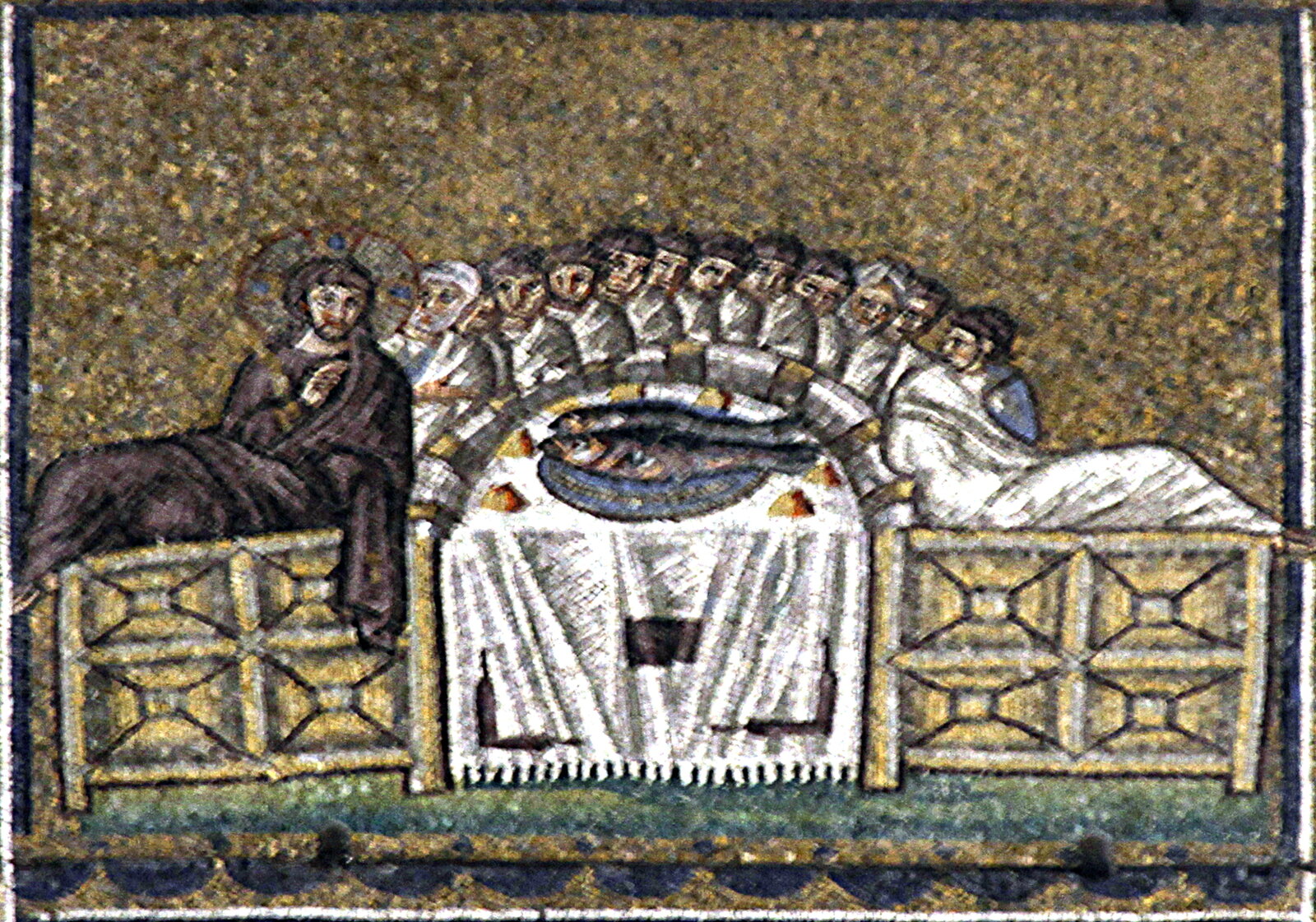
The Last Supper
Nave Mosaic, Sant'Apollinare Nuovo, Ravenna — c. 504
Doctrinal reflection
Christ reclines at the head of a curved sigma-shaped table. The twelve apostles recline beside him in the Roman dining posture, propped on left elbows. On the table, two large fish on a platter and seven loaves arranged at intervals — the same fish and bread the corpus has just seen at #69 in the same basilica. Christ's right hand is raised in blessing. The composition is stripped to essentials: no upper room, no servants, no cup yet visible. Just the table, the bread, the fish, the twelve, and the Lord.
This is the Last Supper as the early 6th-century Ravenna mosaicist saw it — and it completes the eucharistic triptych the corpus has been building. Sign-act: the multiplication of the loaves and fishes (#69) — Christ feeds the multitude, sign of the bread of life. Institution: this Last Supper (#71) — Christ at the table on the night before the cross, instituting the ordinance with twelve. Heavenly fulfillment: the apex Lamb on the throne (#68) — the slain-and-now-living Lamb at the heavenly liturgy. Three mosaics, three moments, one eucharistic theology. The earthly liturgy stands in the middle and looks both directions.
The institution narrative is in all four canonical witnesses (Matt 26:26–29; Mark 14:22–25; Luke 22:14–20; 1 Cor 11:23–26). The Pauline rendering is most explicit: "This do in remembrance of me" (1 Cor 11:24); "as often as ye eat this bread, and drink this cup, ye do shew the Lord's death till he come" (1 Cor 11:26). The verb eis tēn emēn anamnēsin — "into my remembrance" — is the institution sentence for the entire memorial position. Memorial-view did not begin with the Reformation. It began at the table itself.
Look at what the mosaic does not show. No priestly elevation. No chalice raised in consecration. No metaphysical transformation. Christ blesses; the apostles recline and receive. Bread is bread; fish is fish. The action is Christ giving and disciples receiving — exactly the stripped-down composition the same mosaicist used for the loaves-and-fishes scene, because exactly the same theology applies. Both scenes are the bread of life given to those who come empty-handed.
Memorial-view (1 Cor 11:23–26). The Last Supper is the memorial-view text. The bread and cup announce Christ's death until he comes; they do not re-offer it, do not transform metaphysically, do not contain Christ's body in any sense Paul would have recognized. Whosoever shall eat this bread... unworthily, shall be guilty of the body and blood of the Lord (1 Cor 11:27) — the warning is real because the table is sacred, but the sacredness is the Lord's, not the elements'. The Spirit, not the bread, mediates Christ's presence to the gathered church.
Ordinance-not-sacrament. Christ at this table is commanding a practice. This do. The medieval Latin tradition built an elaborate apparatus on top of this scene (transubstantiation, the sacrifice of the Mass, priestly consecration) that the scene itself does not carry. The Ravenna mosaicist of c. 504, painting before the scholastic apparatus existed, depicted the gospel reality plainly: a meal, a Lord, twelve men, bread and fish.
Ministering-not-mediating. No priest stands between Christ and the disciples in this composition. Christ himself is at the head of the table. The disciples receive directly from him, on the same horizontal plane, in the same dining posture, sharing the same meal. The new covenant priesthood is the priesthood of all believers (1 Peter 2:9; Revelation 1:6), with one mediator above (1 Tim 2:5) and no class of mediating priests below.
The sigma table is theologically perfect. A Roman dinner with the Lord at the head. Not a temple ritual, not a sacrificial altar, not a priestly consecration. A meal. The Christian Lord's Supper that descends from this scene should never become so liturgically encrusted that the meal-character is lost.
The corpus closes Sant'Apollinare Nuovo here at four entries: Pantocrator (Christ Lord), Theotokos (Christ honored through her), loaves and fishes (Christ feeding), Last Supper (Christ instituting). A complete early-Byzantine Christology in four scenes.
We come empty-handed and hungry. Christ at the head of the table hands us bread.