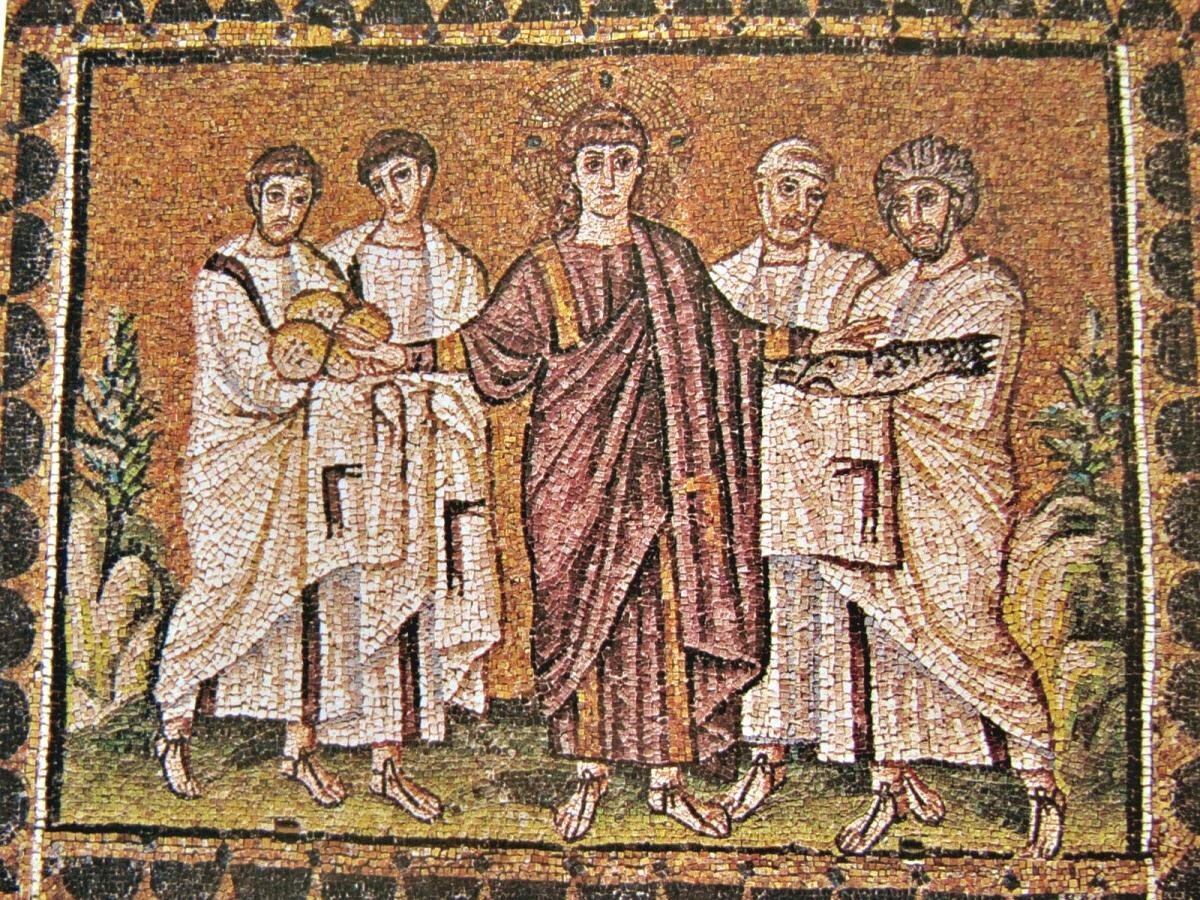
The Multiplication of the Loaves and Fishes
Nave Mosaic, Sant'Apollinare Nuovo, Ravenna — c. 504
Doctrinal reflection
Christ stands in the center, a young beardless figure in imperial purple, hands extended outward in offering. Two disciples flank him, each receiving from his hands. To the left, a disciple holds two fish on a tray. To the right, a disciple holds a stack of loaves. Behind them, gold ground. Above and around: nothing. No crowd. No five thousand. No grass. Just Christ at the center, the bread and the fish, and the two disciples receiving.
This is one of the oldest surviving Christian mosaics that depicts the multiplication of the loaves and fishes — c. 504, in the nave Christ-cycle of Sant'Apollinare Nuovo, built in Ravenna under Theodoric the Ostrogoth and converted from Arian to Catholic use after Justinian's reconquest. The composition is striking for what it leaves out. The gospel scene (Matthew 14:13–21; Mark 6:30–44; Luke 9:10–17; John 6:1–15) has thousands of hungry people, women and children, twelve baskets of leftovers, a boy with five barley loaves and two small fish. The Ravenna mosaicist gave us none of that. He gave us Christ, the bread, the fish, and the disciples receiving from Christ's hands.
The early Christian artistic tradition read the multiplication miracle eucharistically from the start. Catacomb artists at Domitilla and Callixtus painted bread and fish on burial-chamber walls; ICHTHYS (fish) was already the acrostic for Iēsous Christos Theou Huios Sōtēr. By 504 in Ravenna, the iconographic abbreviation has become so confident that the gospel narrative has dropped away and only the eucharistic distillation remains: Christ at the center, giving; disciples receiving.
What the mosaic teaches and what we keep: Christ feeds his people. The miracle in the gospels is not a magic trick performed for the credulous — it is a sign-act revealing who Jesus is. I am the bread of life: he that cometh to me shall never hunger (John 6:35). The multiplication is the prelude to the Bread of Life discourse in John 6. The eucharistic reading of the scene is canonical, not invented. The Ravenna composition is right.
Where the framing rules land:
Memorial-view. The bread Christ is distributing in the mosaic is not the eucharistic host as a re-presented sacrifice. It is the bread of his body, given once and now offered to faith. The communion table proclaims Christ's death until he comes (1 Cor 11:26). The bread is bread; the cup is the cup; the Spirit, not the elements, mediates Christ's presence to those who eat and drink in faith. The Ravenna mosaicist could not have known the medieval transubstantiation controversy was coming. But what he depicted — Christ giving, disciples receiving, by faith — is closer to the memorial view than to the metaphysical real-presence later medieval Latin theology would build.
Ministering-not-mediating. No angels, no intermediary class. The two disciples receive directly from Christ's hands — the iconographic image of the new covenant, one mediator between God and men, the man Christ Jesus (1 Tim 2:5). The disciples are the church's iconographic stand-ins; the church receives directly from Christ.
Ordinance-not-sacrament. The gospel scene is the institution of an ordinance, not the conferral of grace through priestly action. Christ commands, gives, feeds; the disciples receive and distribute (the gospel says they gave to the people — the apostolic distribution is delegated, not sacerdotal). What is happening is what Christ does; the disciples are stewards of what Christ has already accomplished.
The Ravenna mosaicist stripped the scene down for a reason: the bigger the supporting cast, the easier the eye drifts from Christ. Every later Communion-of-the-Apostles, every Last Supper, every eucharistic apse mosaic is doing variations on this theme. Christ at the center. The bread given. The disciples receiving.
The earthly liturgy does not feed five thousand. The earthly liturgy receives from the One who once fed five thousand and who is the bread of life forever.
We come to the table empty-handed and hungry. Christ at the center hands us bread.