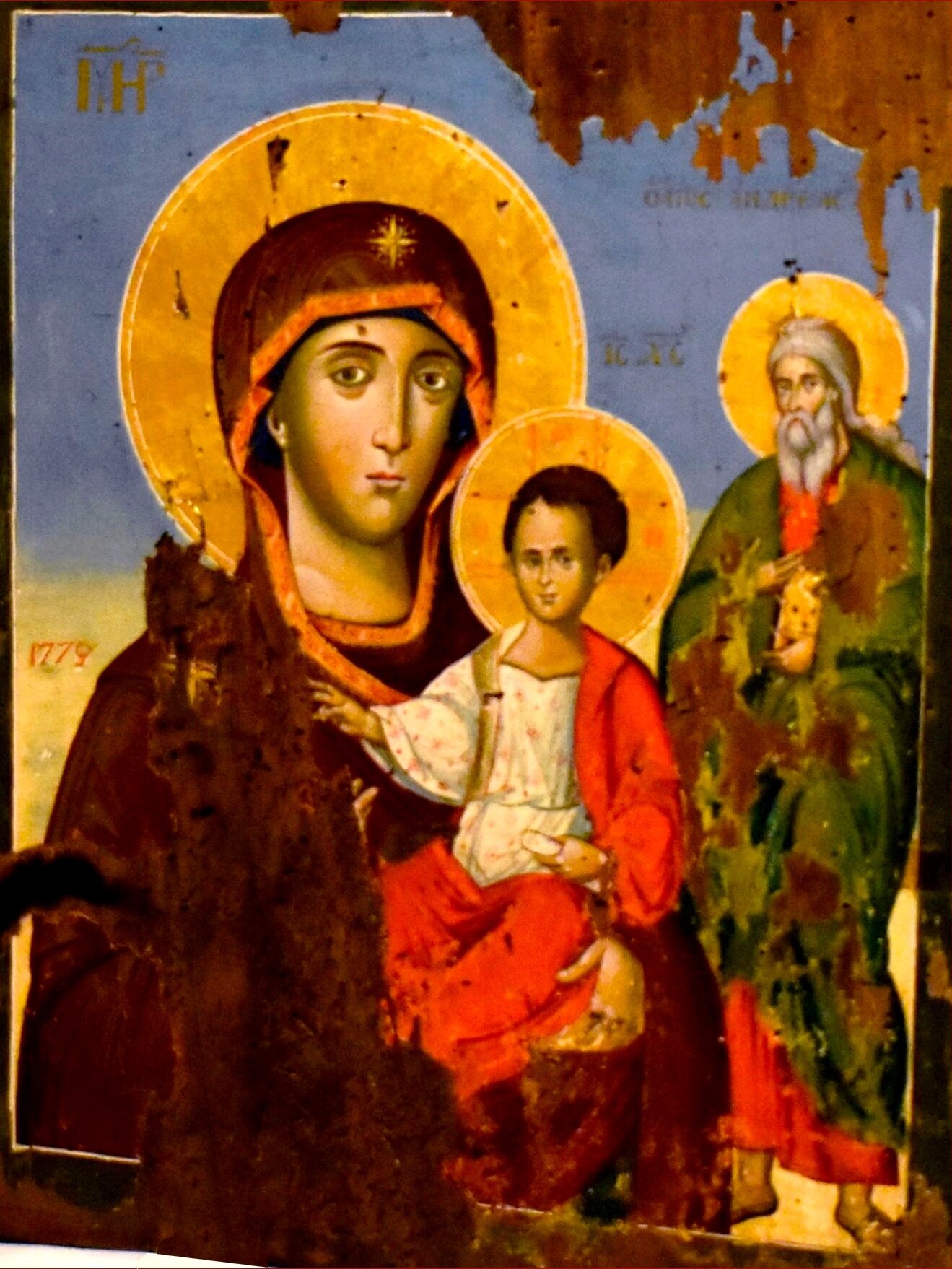
The Apostle Andrew
Icon with the Hodegetria Theotokos — Saint Andrew Church, Kastoria, 1779
Doctrinal reflection
Andrew stands frontal on the right side of the panel — white-haired, white-bearded, holding a cross-staff in his left hand and a closed scroll in his right. To his left, in a smaller medallion at the top of the icon, the Hodegetria Theotokos points to the Christ-child. The icon is from Saint Andrew Church in Kastoria in northern Greece, painted in 1779 by an unknown post-Byzantine Greek-Orthodox iconographer. The Kastoria region preserved a continuous fresco-and-icon-painting tradition from the 11th century into the 19th, making it one of the most iconographically continuous local schools in the Greek Orthodox world.
Andrew the Apostle is the corpus's first dedicated entry on the brother of Peter. The gospel record names him at the call: "And as he walked by the sea of Galilee, he saw two brethren, Simon called Peter, and Andrew his brother, casting a net into the sea: for they were fishers. And he saith unto them, Follow me, and I will make you fishers of men. And they straightway left their nets, and followed him" (Matthew 4:18–20; cf. Mark 1:16–18). John 1:35–42 fills in the prior scene: Andrew was first a disciple of John the Baptist, heard John identify Jesus as the Lamb of God, and went and brought his brother Simon to Jesus — "He first findeth his own brother Simon, and saith unto him, We have found the Messias" (John 1:41). **Andrew is the protokletos — the first-called.**
Andrew, not Peter. This is doctrinally consequential. The post-Reformation argument over apostolic primacy assumes Peter was the first-called and the foundational apostle. The gospels themselves (John 1) locate Andrew at the first call, and Andrew bringing Peter to Jesus. The corpus's anti-papal-supremacy material (#56 Sinai Peter, #78 Dumbarton Oaks Peter) reads the New Testament's own accounts of the apostolic order against the chain-of-touch reading; Andrew at John 1:41 is part of that reading. He first findeth his own brother — Andrew finds Peter, brings Peter, and Peter receives the calling because Andrew testified to him. The first apostolic act recorded in John is one apostle bringing his brother to Christ. That is the apostolic baseline.
The Theotokos medallion. The composition pairs Andrew with the Hodegetria — the most-copied Marian iconographic type in the Eastern tradition (#theotokos-hodegetria), in which Mary points away from herself toward the Christ-child. The post-Byzantine Kastoria iconographer placed the Hodegetria medallion above Andrew not to elevate Mary above the apostle but to render the iconographic argument: Andrew's apostolic gesture (bringing his brother to Jesus) and Mary's Hodegetria gesture (pointing the worshipper to her son) are the same gesture. He first findeth his own brother and brought him to Jesus (John 1:42); whatsoever he saith unto you, do it (Mary at Cana, John 2:5). The icon's composition is one continuous arrow-toward-Christ.
The historical Andrew. Tradition holds that Andrew preached in Asia Minor, Scythia, and the territory around the Black Sea, and was crucified at Patras in Achaea on an X-shaped cross (the crux decussata / Saint Andrew's cross). Eastern tradition names him as the founder of the see of Constantinople; this claim was deployed during the medieval Byzantine-Roman tensions to argue Constantinople's apostolic-foundational equality with Rome. The corpus does not adjudicate that historical claim — first-century-prefect-of-Achaia martyrdom is well-attested in early-Christian literature; the Constantinople-foundation claim is later tradition with reduced historical certainty. We honor what scripture and reliable early-Christian witness preserve.
Kastoria as a fresh Greek site. Kastoria is in Western Macedonia, far from the imperial centers but iconographically prolific. Its post-Byzantine iconographic continuity (11th–19th c.) sits in tension with the Ottoman political context: the church under occupation continued to paint the apostles in the same iconographic vocabulary as the church under Christian emperors. That continuity is itself a witness — the iconography survived political collapse because what it depicts is not bound to political-imperial conditions.
Andrew was first-called. He brought his brother. The corpus reads his iconography as the first apostolic act recorded: one disciple bringing another to Christ.