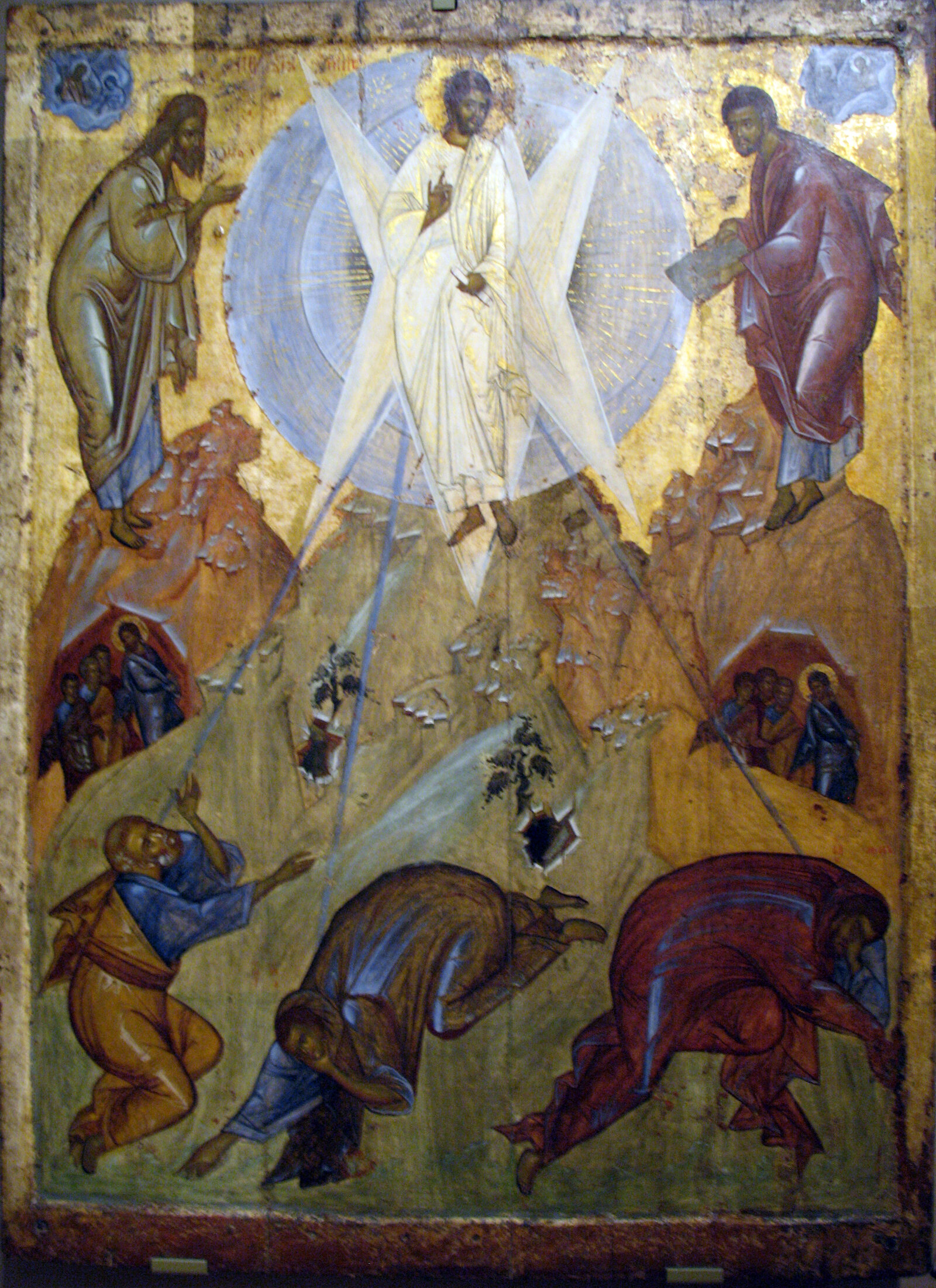
The Transfiguration of Christ
Icon by Theophanes the Greek — c. 1403, Tretyakov Gallery, Moscow
Doctrinal reflection
Christ stands at the apex of a high mountain peak, robed in white, surrounded by a triple-blue mandorla pierced with rays of golden light. Moses on his left holds the tablets; Elijah on his right gestures toward him. Below the peak, three disciples have collapsed: Peter on the viewer's left, half-rising and shielding his face; James in the center, prone and stunned; John on the right, fallen backward, hand raised against the brightness. Two smaller scenes flank the lower edges — angels delivering Moses and Elijah to and from the mountain.
This icon by Theophanes the Greek (c. 1335–1410) was painted c. 1403 for the Cathedral of the Transfiguration in Pereslavl-Zalessky and is now at the Tretyakov Gallery. Theophanes carried late-Palaeologan hesychast iconography north into Russia, where his work shaped Rublev and the Moscow school. The Transfiguration is the corpus's first dedicated entry on this Christological event (Matt 17:1–13, Mark 9:2–13, Luke 9:28–36, 2 Peter 1:16–18) and the moment that seals the inner-three-of-the-Twelve (Peter, James, John) as witnesses to Christ's revealed glory.
The voice from the cloud. Jesus taketh Peter, James, and John... and was transfigured before them: and his face did shine as the sun... behold a voice out of the cloud, which said, This is my beloved Son, in whom I am well pleased; hear ye him (Matt 17:1–5). The Father declares Christ's identity. Moses (the Law) and Elijah (the Prophets) bear witness. The disciples fall on their faces; Christ touches them: Arise, and be not afraid. When they look up, only Jesus remains.
Compositional theology. Christ is at the apex; the eye is drawn upward into the mandorla. The disciples below are unable to look directly — Peter shields his face, James is prone, John has fallen backward. The asymmetric-attention sub-pattern lands at maximum intensity: the disciples cannot bear what Christ initiates. They were sore afraid (Mark 9:6). Grace is initiated by the Lord; the disciples receive what they cannot stand to see.
Same-ladder, even at the inner-three. Peter, James, and John alone are taken up the mountain. Catholic tradition has read this as foundational for Petrine supremacy; some Eastern traditions read it for monastic-mystical authority. The corpus reads it differently: the inner three are witnesses — chosen to attest, not elevated to a categorically distinct rank. 2 Peter 1:16–18 closes the loop: we have not followed cunningly devised fables... but were eyewitnesses of his majesty. The witness is shared back to the gathering.
Moses and Elijah — witness, not co-mediators. Luke specifies the topic: who appeared in glory, and spake of his decease which he should accomplish at Jerusalem (Luke 9:31). The Law and the Prophets testify to Christ's coming death-and-resurrection — the Old Testament resolved in his face. They are not continuing mediators; they are the shadow giving way to the substance. And when they had lifted up their eyes, they saw no man, save Jesus only (Matt 17:8). Christ remains. When the Law and the Prophets have spoken their witness, what is left is Christ alone.
Hesychast light — qualified. Theophanes worked in the late-Byzantine hesychast tradition, which read the Transfiguration as a vision of the uncreated divine light (the Palamite essence-energies distinction codified in 1351). The corpus does not require Palamite metaphysics to read the Transfiguration faithfully. What the gospel supplies is enough: his face did shine as the sun. Christ's divinity, latent throughout his earthly ministry, is briefly visible. The light is the light of who Christ is.
Hear ye him. The Father's voice closes with an imperative: autou akouete — Greek present-imperative active, be hearing him. Continuing action. Not just the apostles on the mountain; not one revelation that ended in 33 AD. The imperative is addressed to every reader of the gospel. The composition's eye-line, ending at Christ alone after Moses and Elijah disappear, embodies it. Listen to him. That is the entire instruction.
We come to the foot of the mountain blind to glory. The Lord transfigures. Moses and Elijah testify, then leave. The Father speaks. We rise from our faces and look up. Only Jesus is there.