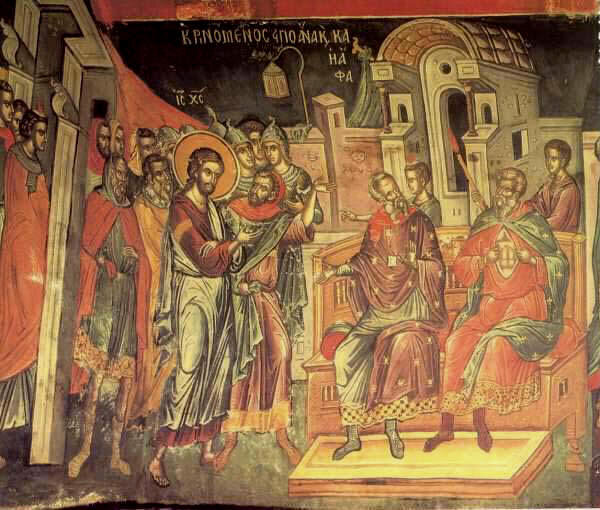
Christ before Pilate
Fresco by Theophanes of Crete — Stavronikita Monastery, Mount Athos, 1546
Doctrinal reflection
Christ stands bound at the center of the frame, head slightly inclined, hands tied at the waist. Pilate sits to the right on a raised seat under an architectural canopy, gesturing with his open right hand — the moment of question or pronouncement. Soldiers and onlookers crowd the spaces between, some pointing accusingly at Christ. The fresco is at the Stavronikita katholikon, painted in 1546 by Theophanes the Cretan as part of the same Passion cycle whose foot-washing scene the corpus has already engaged at #76.
The scene compresses the four-gospel Trial-before-Pilate narrative (Matthew 27:11–26; Mark 15:1–15; Luke 23:1–25; John 18:28–19:16) into a single iconographic moment. The four canonical accounts give different details — Matthew adds Pilate washing his hands; Luke inserts the brief stop at Herod's court; John gives the longest dialogue, including "What is truth?" (John 18:38) and "Behold the man" (John 19:5) — but all four converge on the same political-judicial figure: the Roman governor who knew Christ was innocent and condemned him anyway. Theophanes renders the moment of confrontation, before the verdict, where the doctrine is densest.
The political-judicial Christology. Pilate is a real Roman governor, named in Tacitus and Josephus and the canonical creeds — suffered under Pontius Pilate anchors the Apostles' Creed and the Nicene-Constantinopolitan Creed in actual Roman provincial history. The crucifixion is not myth; it happened in Judea under a known prefect during the reign of Tiberius. The fresco preserves the historical specificity. The Word was made flesh (John 1:14) means the Word was tried in a real provincial court by a real Roman official whose name the church has been reciting in its creed every Sunday for sixteen hundred years.
"Thou couldest have no power at all against me, except it were given thee from above." John 19:11 records Christ's reply to Pilate's threat. The doctrine is exact: Pilate has authority — he wields the power of the sword (Romans 13:1–4) — but his authority is derivative. The Father gives, the Son receives, and the Roman governor's complicity with the Sanhedrin's verdict is real moral guilt held inside God's sovereign delivery of the Son for the world. The fresco's compositional argument is the same: Pilate sits high, gestures with authority, but the bound figure at the center carries the actual doctrinal weight.
Pilate's question and the corpus's third fence. "What is truth?" (John 18:38). Pilate asks the question and walks out before the answer. The iconographer does not render the question — what Theophanes paints is the silent moment: bound Christ, gesturing Pilate, the truth standing in the room and the man who will not see it. The corpus has named this iconographic-restraint pattern at #74 Rossano (every figure whose eyes can see is looking at Christ), at #86 Karanlık (the painter renders the kiss, not the heart), at #91 Mileševa (an absence with an angel pointing at it). At Stavronikita, the iconographer renders the silence between question and answer. Truth standing bound in front of Pilate; Pilate asking what truth is. The composition is the gospel's own indictment of evasion in the face of the obvious.
The hand-washing the iconographer does not show. Matthew 27:24 records Pilate's washing of his hands: "I am innocent of the blood of this just person." Theophanes does not render it. The Stavronikita Trial focuses on the standing-confrontation, not the hand-washing exit. The omission is honest: Pilate's washing did not actually wash anything. The blood was on Pilate too. The iconographer's restraint refuses to let the hand-washing scene perform the absolution Pilate himself failed to achieve.
Christ stood bound. Pilate sat raised. The truth stood between them. Pilate asked the wrong question.