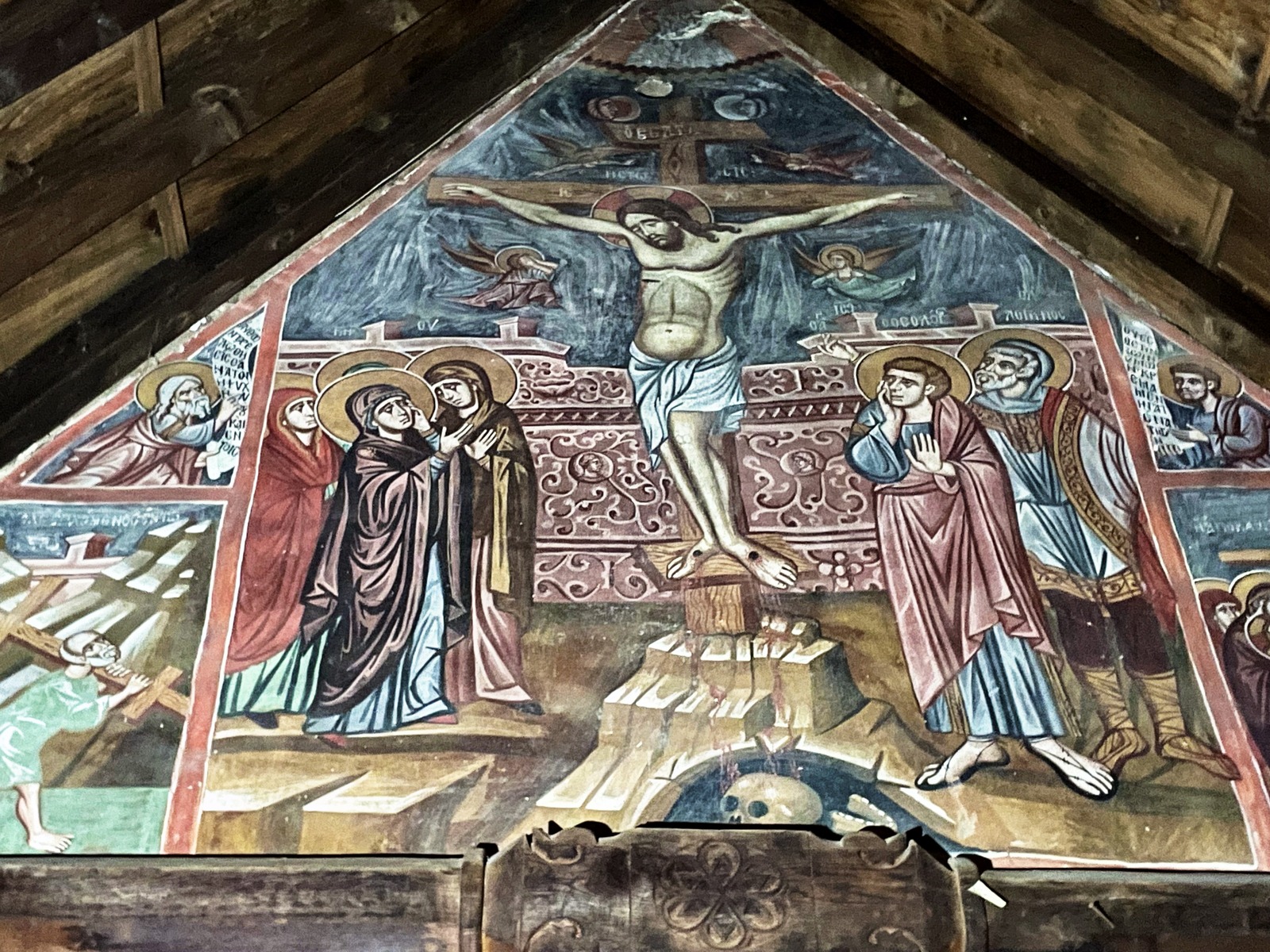
The Crucifixion
West Wall Gable Fresco, Church of Timios Stavros tou Agiasmati, Platanistasa, Cyprus — 1494
Doctrinal reflection
Christ hangs on a tall cross at the center of the gable, head bowed to the right, blood streaming from his side. Mary stands at the foot of the cross on the left, John on the right; both turn their bodies toward Christ but their faces register grief restraint. Four angels circle the cross at the corners — a Latin-influenced detail that distinguishes this Cypriot Crucifixion from the standard Byzantine compositional vocabulary. The fresco occupies the west wall gable of the Church of Timios Stavros tou Agiasmati near Platanistasa, Cyprus, completed in 1494 by the painter Philippos Goul, a Syrian Orthodox master. The corpus's third Cypriot site after Asinou (#apostles-communion-asinou) and Panagia tou Arakos (#pantocrator-panagia-arakos). Cyprus broadens to 3 sites.
The Cypriot late-15th-century iconographic moment. Cyprus in 1494 was under Venetian rule (acquired from the last Lusignan queen, Caterina Cornaro, in 1489); the Byzantine Empire had fallen 41 years earlier (1453); Latin and Greek iconographic traditions were in active negotiation across the island's village churches. Goul's program at Stavros tou Agiasmati is described by historians (Stylianou) as combining local naive art, Palaiologan Byzantine iconographic vocabulary, and Italian-Renaissance aesthetics. The four angels circling the cross are a Latin import; the rest of the composition holds the Byzantine Crucifixion tradition. The corpus reads this as the iconographic-survival principle (#70) operating at a tradition-boundary: what stayed (Christ on the cross, Mary and John flanking, the typological architecture of the gospel) versus what changed (the Latin angel-circling, the slight Renaissance modeling).
The corpus's locked Crucifixion register pattern-matched. The corpus has the Crucifixion at Daphni (#crucifixion-daphni, c. 1100, Constantinopolitan workshop) — the Collection 5 anchor for crucifixion iconography. Daphni handled the doctrinal core: the cross as the place of substitutionary atonement (1 Peter 2:24, who his own self bare our sins in his own body on the tree). The Stavros tou Agiasmati Crucifixion does not re-articulate; it pattern-matches into the locked Daphni reading and adds the village-church and the boundary-tradition contexts. The cross is the same cross 400 years and several thousand miles apart; the gospel rendered at the high Constantinopolitan workshop and at the village of Platanistasa is the same gospel.
John at the foot of the cross — the corpus's care. John 19:26–27 — "When Jesus therefore saw his mother, and the disciple standing by, whom he loved, he saith unto his mother, Woman, behold thy son! Then saith he to the disciple, Behold thy mother! And from that hour that disciple took her unto his own home." The corpus reads this scene as the iconographic anchor for the John-and-Mary pairing under the cross. The 17th flagship (Theotokos-not-Mediatrix, locked at #88) reads it: Christ entrusts Mary to John's family care — take her unto thy own home — not Mary to the church's liturgical mediation. The Stavros tou Agiasmati composition renders the entrustment as filial care; the Goul painter does not push the scene toward the Coronation-of-the-Virgin or the Mater-Dolorosa-as-co-redemptrix register that some Western Crucifixions add. The Cypriot painter, working at the boundary of Latin and Greek traditions in 1494, holds the apostolic line.
The four circling angels — Collection 8 cousin frame applied. The Latin compositional choice of four angels circling the cross is iconographically distinctive but doctrinally unproblematic when read with the Collection 8 ministering-spirits frame (Heb 1:14, locked at #109). The angels do not co-act in the atonement; they are witnesses to what Christ is accomplishing. The corpus reads the four-angels detail as the late-medieval Latin tradition's compositional way of saying the cosmic ministers of God witness this event — which is exactly what Hebrews and Revelation suggest (cf. 1 Cor 4:9, we are made a spectacle unto the world, and to angels, and to men). The angels watch; they do not mediate.
The painter Philippos Goul and the boundary register. Goul was a Syrian Orthodox painter working in Cyprus when Cyprus was under Venetian-Catholic rule. His religious identity was a third tradition (Syriac Christianity) painting in a fourth iconographic context (Cypriot-Greek-Orthodox village church) under a fifth political regime (Venetian-Latin). The corpus's cross-tradition convergence sub-observation (locked at #77 Georgian Pentecost enamel) operates: scripturally-disciplined iconography in any tradition converges on the same doctrine because it is reading the same text. Goul read the gospel; Goul painted what the gospel says happened; the painting holds the apostolic line across four tradition-boundaries.
Christ hangs on the cross. Mary and John stand at the foot. The angels circle and witness. The cross is the same cross at the village church as at Daphni; the gospel is the same gospel; the painter held the line.