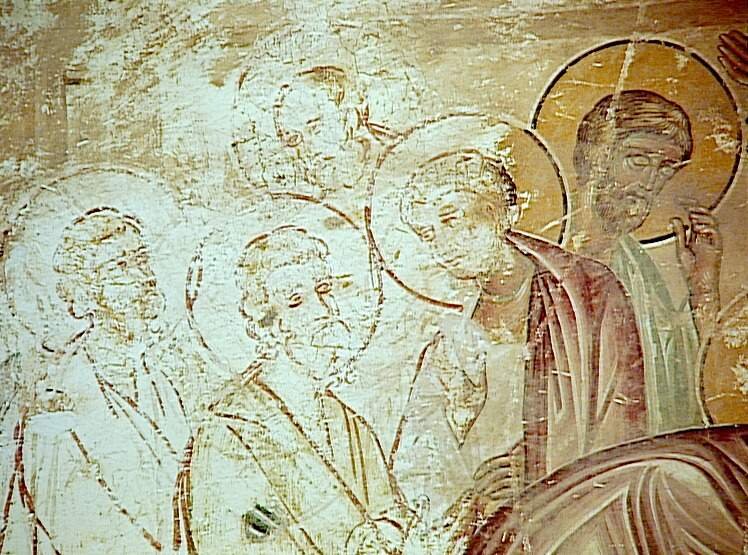
The Incredulity of Thomas
North Transept Fresco, Church of the Holy Savior, Tsalenjikha, Georgia — c. 1350
Doctrinal reflection
Christ stands frontal at the center, robe drawn aside to expose the wound in his side. Thomas leans forward from the apostles' group on the left, right hand extended, finger reaching toward the wound. The other ten — Peter at the front, others crowded behind — watch. The Tsalenjikha fresco, c. 1350 in the north transept of the Church of the Holy Savior in western Georgia, is one of the late-medieval Georgian-Byzantine extensions of an iconography the Eastern church had been rendering for nearly a thousand years.
The scene is John 20:24–29. Eight days after the resurrection, Christ stood among the disciples and said "Peace be unto you" and then to Thomas: "Reach hither thy finger, and behold my hands; and reach hither thy hand, and thrust it into my side: and be not faithless, but believing." Thomas's response is the highest single Christological confession in the four gospels: "My Lord and my God" (John 20:28). The Greek is exact: Ho Kyrios mou kai ho Theos mou. Two articulated nouns. Two predicates. One subject — the man standing in front of him with the wounds.
Thomas's confession is the gospel's own resolution of the unity-of-attributes question the corpus has been working at #84 Bawit and #89 Cappella Palatina apse. Lord and God — applied to the same risen body — in a single breath. Thomas is not picking one of the predicates and dismissing the other. He is not naming Christ's humanity (Lord, master, teacher) and the Father's divinity (God) separately. He is naming both predicates of the same subject. The corpus's unity-of-attributes architecture has its New Testament confession-form in eight Greek words.
The iconographer's compositional choice carries the doctrine. Christ does not retreat from the touch. He stands open, robe drawn aside, the wound visible. The risen body is the same body that hung on the cross — cosmic Lord and incarnate-servant, no bifurcation (#84). The fresco refuses the gnostic move that would have made the resurrection-Christ a phantom, untouchable; refuses the docetic move that would have made the cross-Christ apparent, not real. The wound is in the body, the body is risen, and Thomas's finger meets what God did not flinch from doing in the flesh.
Thomas's confession is the apostolic baseline. Thomas saw, touched, confessed. Subsequent claims to apostolic authority — Petrine succession, Marian mediation, episcopal-chain transmission (cf. #75/#77/#78/#81) — should be measured against this baseline of direct encounter. Where the apostolic confession was Lord and God of the risen body in front of me, the chain-of-touch claim that emerges in later centuries cannot exceed what Thomas confessed of what he himself saw.
"Be not faithless, but believing." Christ's word is gentle correction, not rebuke. The corpus has met this register before — Christ called Judas friend at the betrayal (#86 Karanlık). The risen Lord meets the doubting disciple where he is, invites the touch he asked for, refuses to humiliate him for asking. Faith and evidence are not enemies in this scene. Faith comes through evidence rightly received.
"Blessed are they that have not seen, and yet have believed" (John 20:29). Christ's closing word names the trajectory the church will take after the apostolic generation. The apostles saw, the apostles touched, the apostles confessed — and from their direct encounter the church receives the gospel without needing to repeat the touching. The Tsalenjikha fresco was painted thirteen hundred years after the resurrection by a Georgian iconographer who had not seen, but believed. The corpus you are reading was made by another generation of believers who had not seen, but believe. The chain is not apostolic-by-touch; it is apostolic-by-confession.
Thomas reached. Christ stood open. Thomas confessed. My Lord and my God.