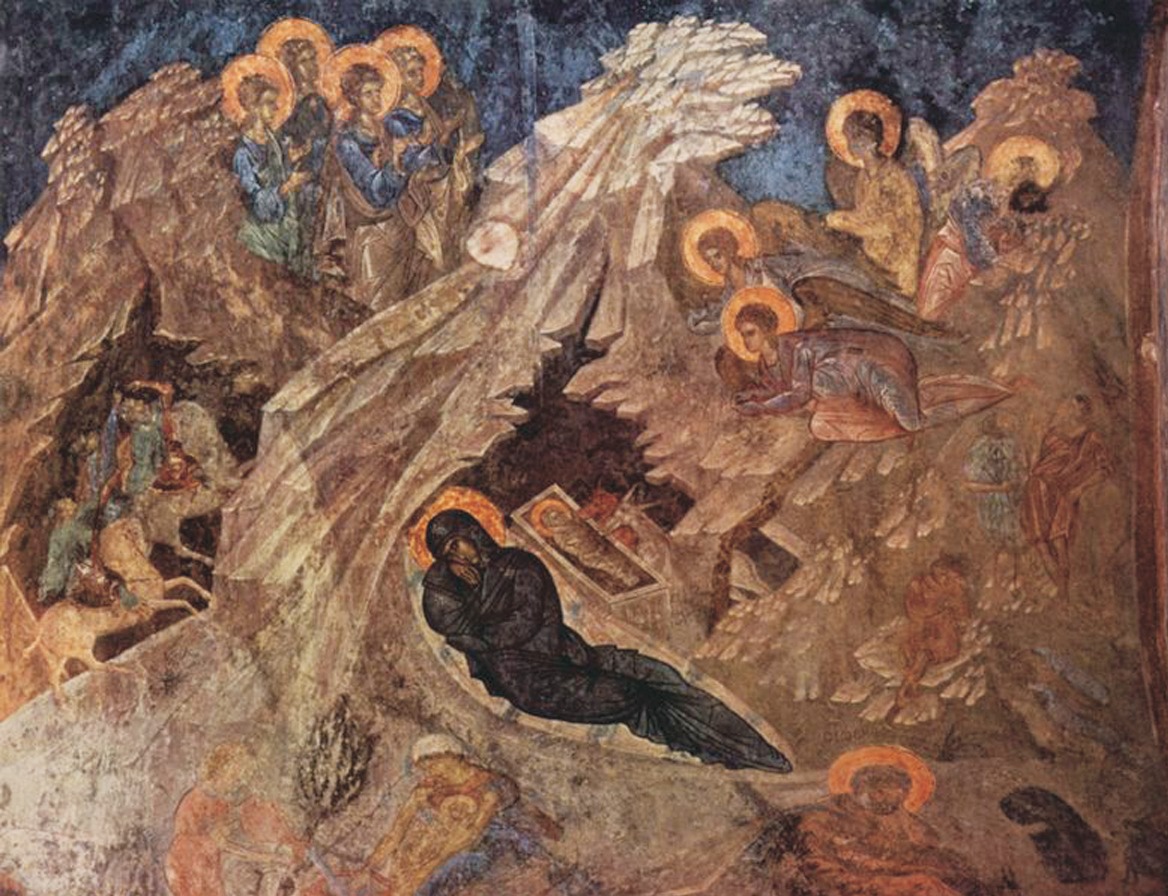
The Nativity
Fresco, Peribleptos Monastery, Mistra (Mystras), Peloponnese — c. 14th century (mid- to late-Palaiologan)
Doctrinal reflection
The Theotokos reclines on a red mattress at the iconographic center, Christ swaddled in the manger above her. The cave opens behind them in the rocky mountain typical of Byzantine Nativity iconography. Around the central scene, the canonical iconographic elements: the ox and ass behind the manger; angels above announcing to shepherds at upper right; magi approaching at upper left; the bath of the Christ-child in lower-right register (midwives Salome and Zelomi); Joseph contemplative in lower-left register, conversing with the shepherd-tempter figure. The fresco belongs to the c. 14th-century Peribleptos program at Mistra. The corpus's second Mistra entry alongside pantocrator-mistra-pantanassa (#26). Mistra at 2 sites / 2 entries.
The compressed-narrative compositional strategy. Byzantine Nativity iconography traditionally compresses the entire infancy narrative into one frame: Luke 2's announcement to shepherds + Matthew 2's magi + Protoevangelium tradition's midwives + apocryphal-tradition shepherd-tempter all rendered in one composition. The corpus reads this compressed-narrative through the iconographic-restraint principle (locked at #58 Christopher Cynocephalus pattern): the canonical core (Luke 2 + Matthew 2) is canonically grounded; the apocryphal accretions (the midwives' specific names; the shepherd-tempter as proto-Satan) are tradition-additions the corpus declines to amplify. The Peribleptos painter renders the compressed iconographic vocabulary; the corpus reads what's canonical and acknowledges what's accretion.
Joseph and the shepherd-tempter — a careful corpus reading. The lower-left register shows Joseph in contemplation, with a small figure (often interpreted as a shepherd or as the devil-as-shepherd) speaking to him. Patristic tradition (developed in apocryphal sources, not canonical) reads this as Satan tempting Joseph to doubt the virgin conception. The corpus declines the apocryphal embellishment in primary doctrinal payload while acknowledging the iconographic tradition. What scripture says: Matthew 1:18–25 — Joseph considers putting Mary away privately; the angel of the Lord appears to him in a dream and confirms the conception by the Holy Spirit; "then Joseph being raised from sleep did as the angel of the Lord had bidden him." The canonical narrative is enough. The Peribleptos painter's lower-left register may render the apocryphal expansion, but the corpus reads Joseph's contemplation as Matthew 1's taking-thought about Mary, with the angelic resolution arriving by dream rather than by visible figure.
The Helvidian standing-rule pattern-match (locked across corpus). The Nativity iconography places Mary on the mattress and Christ in the manger — Mary delivered, Christ born. The corpus's Helvidian standing-rule (Mary and Joseph had children after Jesus, locked from the start of the corpus) does not foreground here in primary form; the iconography is Christmas-Eve-narrative, not later-life Mary. Pattern-match held silently.
The Palaiologan painterly register. The Peribleptos frescoes (c. 1340s–1370s) belong to the late Palaiologan period — the era of Byzantine iconographic sophistication's final flowering before 1453. The painters (anonymous, sometimes designated Master of the Peribleptos) used the innovative-landscape-and-light register that Mistra Pantanassa would also develop a generation later. Compositional features: figures inhabit deep architectural-landscape spaces; the rocky mountains of the Nativity cave are rendered with internal-light gradients; the figures' draperies fall with calligraphic Palaiologan grace. The corpus reads Mistra as the late-Byzantine iconographic capital outside Constantinople, holding the iconographic tradition through the empire's final decades.
Mistra continues. Mistra's iconographic patrimony spans three Palaiologan-era churches in the same archaeological complex: Hodegetria/Brontochion, Peribleptos, Pantanassa, plus the Cathedral of Saint Demetrios. The corpus has two entries now (Pantanassa Pantocrator + Peribleptos Nativity) and may grow further. Lock A's three-entry-gap activates after this 2-from-non-consecutive cluster.
The Theotokos delivered the child. The shepherds came; the magi came; the angels announced. The compressed-narrative iconography holds the whole infancy in one frame. The Peribleptos painter rendered what scripture reports; the corpus reads what it reads and acknowledges what is acknowledged.