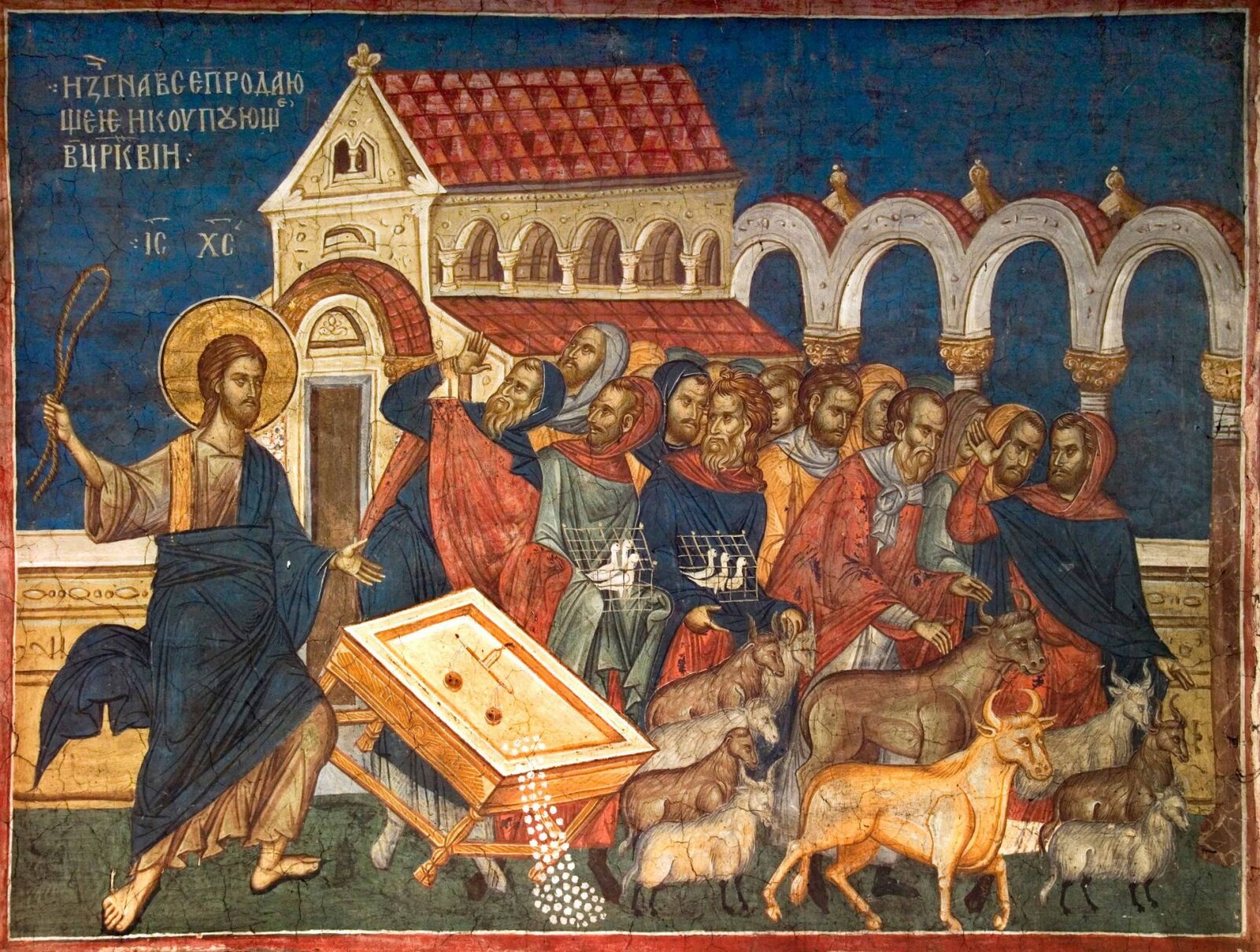
The Cleansing of the Temple
Fresco, Visoki Dečani Monastery, Kosovo (Serbia) — 14th century
Doctrinal reflection
Christ stands at the center, arm raised, a small whip of cords visible in his hand. Around him: the merchants of the temple court, scattering. Tables overturn at his feet, coins spilling out. Doves released from their cages take flight against the gold ground. Sheep and oxen bolt for the doorway. A few of the merchants look back over their shoulders, faces caught between anger and shock; one, on the right edge, raises an arm in protest. The fresco is on the wall of Visoki Dečani Monastery in Kosovo, painted c. 1335–1350 as part of the most extensive surviving medieval Serbian fresco cycle — over a thousand individual scenes covering the Christ-life, Old Testament, hagiographic, and liturgical-calendar registers.
The scene is in all four gospels: Matthew 21:12–17, Mark 11:15–19, Luke 19:45–48, and John 2:13–22. The synoptic accounts place the cleansing during Holy Week, immediately after the triumphal entry; John places a similar scene at the beginning of Christ's public ministry. Whether John records a separate first-Passover cleansing or simply rearranges the synoptic event for theological reasons, the iconographic vocabulary is the same: Christ with whip, tables overturning, animals fleeing, merchants scattering. The Dečani master renders the moment of action.
The wrath-of-Christ register. The fresco supplies one of the iconography's most direct refutations of the loving-Jesus-vs-wrathful-Father bifurcation the corpus declined at the 16th flagship (#84 Bawit, unity-of-attributes). Christ is angry here. He is using a weapon — a scourge of small cords (John 2:15). He is overturning property. He is driving men out by force. "My house shall be called the house of prayer; but ye have made it a den of thieves" (Matt 21:13, citing Isa 56:7 + Jer 7:11). The same Lord who said "Suffer the little children to come unto me" (Mark 10:14) drove the cattle-merchants out of the temple court with a whip the same week he wept over Jerusalem. One Christ, all attributes coherent. The Dečani fresco refuses the modern Marcionite-leaning move that retains a sentimental-Jesus and offshores his wrath onto the Father.
The temple was not a marketplace. The merchants Christ drove out were operating a foreign-currency exchange (the temple tax could only be paid in Tyrian shekels, requiring conversion from Roman currency) and selling sacrificial animals at marked-up prices to pilgrims who could not bring livestock from a distance. The system itself was not illegal. What Christ judged was the location — the merchants had moved the marketplace into the Court of the Gentiles, the only court non-Jewish God-fearers could enter. "Is it not written, My house shall be called of all nations the house of prayer?" (Mark 11:17). The Gentile court was the place where the nations could come to God. The merchants' tables made the prayer of the nations impossible by occupying the space designated for it. Christ's wrath was not against commerce but against commerce blocking the Gentiles from prayer.
Anti-clericalism implications, carefully. The corpus has consistently refused the framework that turns the church into a marketplace — the four-piece anti-mediation architecture (Collection 7 named-decline + 15th flagship + Helvidian lock + 17th flagship) declines petitionary mediation, sacerdotal sales of grace, the Mediatrix-of-graces apparatus. The Cleansing of the Temple is the Christological precedent for that discipline. Christ drove them out. When the church's gathered prayer is obscured by sales-of-access, the cleansing is precedent. The whip is not the church's first instrument; the church's first instrument is the gospel preached and the prayer offered. But the whip exists in the canonical record. Christ used it.
Serbia opens to 2. The corpus's first Serbian entry was Mileševa White Angel (#91). Visoki Dečani is the second, and the largest surviving medieval Serbian fresco cycle. Founded by King Stefan Uroš III Dečanski in 1327, decorated through the 1340s, it sits in iconographic continuity with the Palaiologan fresco renaissance flowing south from Thessaloniki and Constantinople into the Serbian church.
Christ made a whip. He drove them out. The court was meant for the prayer of the nations.